

It’s Tuesday and the time is 11:47 PM, with you now looking at your AI stack.
In one tab you have Claude Pro open, in another ChatGPT Plus is open, together with a Make.com automation that you began creating three weeks ago but which still isn’t connected to anything.
You also have a custom GPT that you trained using your brand voice but have never directed it towards a real workflow.
There are two YouTube tabs that are paused in the middle of a demonstration: one relating to a voice agent designed to manage inbound calls and the other concerning an AI-powered CRM that claims to “reimagine your pipeline”. In your Notion sidebar there is a folder named “AI Strategy” and it contains just one empty page.
You are building your stack. And your stack is building a wall between you and shipping anything.
Every tool you adopted came with the same promise. Four words: this will save you time. And it will. But the time it saves is time you have not spent yet.
The math is uncomfortable: you are borrowing against a future efficiency that never arrives because you are too busy onboarding the next tool to use the last one.
You do not have a tool problem. You have a sequencing problem. And there is a framework that has been sitting in your blind spot, one you may already know from a different context, that solves this exactly.
I call it the Staircase Strategy. It is time to apply it to your AI adoption. Here is how.
The All-You-Can-Eat Trap
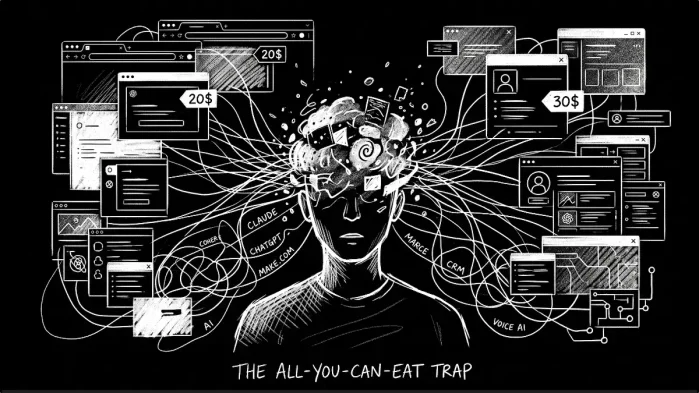
Right now, AI adoption looks like an all-you-can-eat buffet. And the pricing model is designed to make you grab everything.
Claude Pro, twenty dollars. ChatGPT Plus, twenty dollars. That new agent builder everyone is tweeting about, thirty dollars. A Make.com subscription, a voice AI, a vector database, a RAG pipeline you do not need but watched a tutorial on.
Each line item is small enough to justify alone. Together they form a monthly burn that would have made you sweat three years ago if it was spent on anything else.
But the real cost is not the subscription fees. The real cost is the switching cost.
Since every new tool requires onboarding, and since each onboarding process demands your attention, each shift in your attention splits up your focus, and fragmented focus results in nothing.
It doesn’t constitute progress to automate a workflow that you shouldn’t be carrying out; it’s just efficiency theater.
I have watched this play out across dozens of founders in the last twelve months. The pattern is identical. They start with one tool. Then two. Then they join a community where someone posts a screenshot of their “AI stack” and suddenly one tool becomes a deficiency.
They now need the entire set of tools: Claude for reasoning, ChatGPT for drafting, Perplexity for research, a voice agent for making calls, a custom GPT for the brand, a second custom GPT for strategy, and a third one for the strategy that the second custom GPT had recommended. They end up creating a museum of AI capabilities. Yet nothing gets launched.
This is not a new problem. It is the same problem I had when I was chasing three visions at once, trying to be a tech entrepreneur, a thought leader, and an investor simultaneously.
I called it visionary multitasking. It felt like driving three cars at once. You do not move forward. You just strip the gears. And the return on investment? A lot of burnout.
AI adoption right now is the same trap with a different skin. The buffet is the distraction. The staircase is the exit.
What the Staircase Strategy Actually Teaches Us
Start where you are. Use what you have. Do what you can.
Arthur Ashe
The Staircase Strategy is not complicated. It is simply difficult to execute because it asks you to do the one thing entrepreneurs hate doing: say no to opportunity.
Here is the principle. You have multiple visions, multiple goals, multiple things you want to build.
They also have executable realities: the real sequence of steps needed to achieve the goal, the resources that each step requires, and the way in which the steps depend on one another.
The Staircase Strategy states that you should not prioritize based on fantasy benefits, whereas you should prioritize according to an executable sequence, each step of which must be achievable and must cover the cost of the following one.
The Staircase Strategy says: prioritize not by fantasy benefits. Prioritize by executable sequence. Each step must be achievable, and each step must pay for the next one.
When I first wrote about this, I was talking about vision management. I had spent years trying to jump to the top of the staircase. I wanted to be three different people at the same time. It cost me money, time, and nearly my identity.
The lesson was so hard for me, but at the same time it was such a simple thing that I’ve learned: you cannot skip steps.
Simply, here the staircase is not a metaphor for waiting and being patient. Reality imposes that constraint because energy is finite, and attention is also finite. So, it is clear: you can only convert so much potential energy into kinetic output before the system overheats.
Applied to AI, the Staircase Strategy becomes a sequencing framework for your entire tool stack. The question is not “which AI tools should I adopt?” The question is “which AI tool should I adopt first, and what must it accomplish before I adopt the second one?”
That is an entirely different question. And it is the question almost nobody is asking.
Step One: Map Your Workflows Before You Map Your Tools
Luke Pierce, in his guide to building an AI-native operating system, starts with the same step.
Before using a single AI tool, you should draw up a map of every workflow in your business—of every task that repeats, every handover, every decision point, and of all the things you carry out more than once a week.
Most founders completely omit this stage. They go straight to choosing tools since choosing tools seems like a step forward. You are comparing the features, you are reading the reviews and you are watching the demonstrations. Your brain sees this as work.
It isn’t work; it’s organized laziness—the ritual involving upgrading, migrating, comparing, and configuring tools—which so effectively uses the language of progress that it succeeds in passing all the internal checks one might have.
An improved dashboard can’t cure a flawed thesis, and if you can’t give a name to a workflow then you can’t automate it.
Well then, here is the exercise.
Spent one week—not a single day, not even an afternoon—just one full week. Each time you finish a recurring task, make a note of it. Not the major strategic activities. The operational ones. The things that occur every Tuesday regardless of whether you notice them or not.
For example: sending client onboarding emails, generating invoices, scheduling content, qualifying leads, sorting the inbox, carrying out meeting follow-ups, writing proposals, carrying out data entry, and producing reports.
For each one, capture three numbers: how often it happens, how long it takes, and what happens if it does not get done.
Do not skip this because you think you already know your workflows. You do not. I did not. Every founder I have ever put through this exercise discovered at least three recurring tasks they were doing manually that they had never identified as tasks. They were just “things that happened.”
Things that happened were eating twelve hours a week. Twelve hours a week is a part-time job you did not know you had.
The output of this step is not a strategy. It is a list. A single page. Every recurring workflow in your business, named, with frequency, duration, and cost of delay.
The page forms the basis of your staircase, and if it isn’t there you’ll be building in the air.
Step Two: Find the Uranium, Not the Coal
Now you have your list. Maybe it has fifteen items. Maybe thirty. The instinct is to scan it and think: “I can automate half of these with a few tools and some Zapier workflows.”
That instinct is the trap. It is breadth-first thinking. Horizontal motion disguised as vertical progress.
The Staircase Strategy demands something different.
You do not pick five workflows to automate. You pick one. The one with the highest energy density.
I am using physics as a metaphor since it is precise; not every element in your business has the same potential energy. Some of them are coal and they burn, producing heat and keeping the lights on.
The man who moves a mountain begins by carrying away small stones.
Confucius
However, there is uranium, and this is the bottleneck. It is the workflow such that if you were to get rid of it or shorten it, you would free up capacity which then has a cascading effect on all the other areas. It is the workflow in which the cost of a delay is not measured in minutes but in money, momentum, or customer experience.
How do you find it? Three filters.
First filter: frequency.
How often does this workflow recur? A task you do three times a week is a better candidate than a task you do once a quarter.
Frequency compounds. Saving ten minutes on a daily task gives you back sixty hours a year. Saving an hour on a quarterly task gives you back four.
Second filter: cost of delay.
What will happen if this workflow is left unattended for 24 hours or for 48 hours?
When the answer is “nothing”, it’s coal; but if the answer is “a client gets angry”, “a payment is delayed”, or “a lead goes cold”, then you have something more dense.
Third filter: cognitive load.
Certain tasks are quick but require a lot of effort, for example preparing proposals, onboarding clients, and any activity that involves keeping eight separate bits of information in your head at the same time.
These tasks take up more than just your time; they diminish the quality of the following hour and leave a residue behind.
A workflow that is cognitively expensive is a workflow worth automating even if it is not the most frequent, because the real cost is the invisible tax it levies on everything that comes after it.
Concrete examples
A freelance brand strategist carried out this exercise. She simply identified 14 workflows that occurred regularly, among which inbox triage was the most common. She spent ninety minutes each day handling email. It was important, true enough. But automating it would only save time, not transform her business.
The uranium was part of the client intake process. Each new client had to go through a seven-step manual procedure, consisting of a discovery call, a follow-up email, the drafting of a proposal, negotiations regarding the scope, the generation of the contract, the creation of the invoice, and the onboarding sequence.
It took her between four and six hours per client. It was cognitively draining. And when it was delayed, clients went elsewhere.
So, she built one agent against that workflow. Nothing else. We will get to what that looked like. But the point is: she found the uranium. She ignored the coal.
That is the discipline.
Here is another. A SaaS founder with a small team listed his workflows. The uranium was bug triage. Every support ticket required him to manually route it to the right developer, check the status, and follow up.
Not the most frequent task. Not the most visible. But it was the bottleneck that kept his developers context-switching and his customers waiting. He built one agent.
Revenue did not jump the next month. But developer throughput doubled. And that compounds.
The hardest part of this step is not the analysis. It is the restraint. You have fifteen workflows. You are picking one. The other fourteen continue exactly as they are. Manual. Slow. Unoptimized.
Your brain will scream at you to “at least set up a quick automation” for the email triage. Do not.
The staircase functions since each step covers the cost of the next. If you divide your attention among five workflows, then none of them will have the depth needed to actually cover any costs. You end up with five incomplete automations and nothing that has been shipped. That is the situation we’re back in again.
Step Three: Build Exactly One Agent
It isn’t a fleet, not a system that coordinates multiple agents, not a “swarm”. It’s single, working on a single thread and with a narrow scope. Indeed, the way it is specifically limited becomes so dull that you feel embarrassed having to mention it. It’s only when you see that you know it will work.
The one-agent rule goes against all your instincts since AI tools are meant to seem extensive. The demonstrations show all the things they are capable of. The landing pages give a list of all the integrations. The sales message is that this product can replace your whole team.
The Staircase Strategy says: ignore all of that. Pick the one workflow. Build the one agent. Ship it. Measure it. Let it pay for the second one.
What does “pay for the next” mean in practice?
It means the agent must produce a measurable return that justifies the cost of building the next one.
The return can be time.
The brand strategist’s client intake agent saved her four hours per client. At four clients a month, that is sixteen hours. Sixteen hours is enough time to build the second agent.
It can be money.
The SaaS founder’s bug triage agent did not directly generate revenue. But it freed up developer hours that were worth more than the cost of building it.
It can be quality.
A consultant who automated his proposal generation saw his close rate increase because proposals went out the same day instead of three days later.
The metric does not have to be revenue. It has to be real.
Let me show you what this looks like side by side, because the contrast is the lesson.
Founder A has eight AI agents. One for email. One for social media. Then one for lead qualification. One for content repurposing. One for meeting summaries. Also, one for research. One for proposal generation. One for customer support.
They spend every Monday morning reviewing agent outputs and tweaking prompts. Their revenue is flat. Their stress is high. Also, their tool stack is a second full-time job they did not apply for.
Founder B has one agent. It handles client intake. Discovery call notes go in. A proposal, a contract, an invoice, and an onboarding email come out.
It took three weeks to build and test. It replaced a five-hour manual process.
Founder B now has five hours a week she did not have before. She uses those five hours to build the second agent.
Her staircase has a second step. Founder A’s staircase is a diagram. It exists in a Notion page. It has never been walked on.
The situation has nothing to do with intelligence or with ambition; it’s about sequencing. Founder A focused on coverage, while Founder B focused on sequence. Founder A created a stack and Founder B constructed a staircase.
So, what is the real agent like?
It was nothing complicated for the brand strategist; she simply used one AI tool and gave it a structured prompt containing her brand voice, her pricing tiers, her contract template, and her onboarding sequence.
The input was the discovery call transcript. The output was a complete client package.
She still reviewed it before sending. That is the human in the loop. But review takes twenty minutes. The old process took five hours. That is a 15x compression on the highest-density workflow in her business. That is the uranium converting.
The agent used by the SaaS founder was even simpler in design; it read the support tickets that came in, sorted them by severity and product area, allocated them to the appropriate developer according to a rotation schedule, and then posted a status update to Slack.
That is it. No reasoning. No generation. Just classification and routing. It took two days to build. It saved the team eight hours of manual triage per week.
That is the first step. The second step is building an agent that handles the most common bug category entirely. But that is the second step. You earn it.
The Scaffold, Not the Stack
Focus is a matter of deciding what things you’re not going to do.
John Carmack
I would like to end by offering a different way of looking at things, since the language we use influences the decisions we make.
A stack is flat; it consists of a number of tools which are placed beside one another. You add things to it horizontally—another tool, another subscription, another capability. A stack has no sequence, only a count.
The question a stack asks is “what else can I add?” And the answer is always “more.”
A staircase is sequenced. It is vertical.
Each step does not just sit next to the previous one. It is supported by it. You add to a staircase by building upward, not outward.
The question a staircase asks is “what must come first?” And the answer is always “the step that pays for the next one.”
The AI moment is not a technology moment. It is a sequencing moment. AI has collapsed the cost of building to near zero. Execution is no longer the premium skill.
What to build, and in what order, is the only scarce skill. I call this Sequencing Intelligence. It is the ability to look at a business system, identify which element has the highest energy density, and sequence it first.
AI can mine anything. It cannot tell you where the uranium sits. That is your job. It has always been your job.
So here is what you do. Close the tabs. Cancel the subscriptions you have not used in thirty days. Take one week and map your workflows. Find the one that has the highest energy density. The uranium, not the coal.
Create one agent to counter it, release it, monitor it, and let it earn the right to build the second one.
The first step doesn’t need just one new tool; it only needs a notebook and an honest hour.
This is what we call the Staircase Strategy. It was effective for vision management and it is effective for AI adoption as well, since it doesn’t require you to be smarter, faster, or better funded; instead, it only asks that you sequence, and sequencing is the one thing that no AI can do for you.