

The traditional view of a property management system (PMS) is about as exciting as a dusty paper ledger.
Historically, it was viewed as a necessary evil. It was a clunky, on-premise software with a user interface straight out of 1998, designed simply to manage bookings and keep the front desk from collapsing into total chaos during the 3:00 PM check-in rush.
But that’s all changed.
In today’s incredibly competitive, fast-paced hospitality landscape, hotels are turning to modern technology not just to survive, but to aggressively improve efficiency, enhance guest experiences, and unlock entirely new revenue streams.
Among the most impactful innovations we’ve seen over the last decade is the complete reinvention of the Property Management System. It has evolved from a basic operational tool into a strategic growth driver. Today’s systems sit at the absolute core of a hotel’s digital ecosystem, connecting isolated departments and enabling the kind of data-driven growth that used to be reserved for massive global chains.
If you aren’t treating your PMS as your hotel’s digital brain, you’re essentially treating it as a typewriter in the age of the smartphone. And your competitors are already using smartphones.
So, what is a modern property management system, really?
At its basic level, it is a platform that covers every aspect of managing a property. It centralizes and automates your key hotel operations, including reservations, check-ins and check-outs, billing, housekeeping dispatch, and guest communications.
Traditionally, independent hotels and even mid-sized groups relied on disjointed spreadsheets or highly manual processes to manage these functions. Traditionally, night auditors manually reconcile the POS with the PMS, and front desk agents enter guest preferences into notes fields that are rarely reviewed.
On the other hand, modern PMS platforms consolidate everything into a single, intuitive interface. They reduce operational complexity and drastically improve accuracy.
The real catalyst for this evolution?
The cloud.
Cloud-native systems have expanded capabilities in ways we couldn’t imagine twenty years ago. They allow your staff to access real-time data securely from any device—whether the General Manager is looking at occupancy rates from an iPad at an industry conference, or a housekeeper is updating room statuses from a smartphone in the hallway.
Let’s talk about the elephant in the industry: the labor shortage.
Finding and keeping great hospitality talent is harder than ever. This is why operational efficiency is no longer just a “nice-to-have”—it is one of the most immediate, critical benefits of adopting a modern PMS.
By automating routine, mind-numbing tasks—such as manually updating room availability across OTAs, processing repetitive payments, and sending standard guest communications—you can significantly reduce manual workloads. Platforms like Mews unify bookings, payments, and housekeeping into a single workspace, helping your staff save dozens of hours each week and virtually eliminating the risk of human error.
Actionable Takeaway: Automate the Mundane to Elevate the Human
Think strategically about what you are automating. If your front desk agent is spending three minutes per guest manually typing passport details and swiping a physical credit card, they aren’t looking the guest in the eye. They aren’t asking about their trip.
This streamlined approach improves coordination across your entire property. When front desk teams, housekeeping staff, and management all work from the exact same real-time data, you minimize miscommunication. You stop sending guests to dirty rooms. The result is a leaner operation where your staff can focus their energy on hospitality rather than administration.
People will forget what you said, people will forget what you did, but people will never forget how you made them feel.
Maya Angelou
Guest expectations haven’t just shifted; they’ve skyrocketed. Travelers are increasingly seeking personalized and seamless experiences, driven by the seamless digital interactions they have with brands like Amazon, Uber, and Netflix.
Your PMS plays a crucial role in meeting these massive expectations and is the foundational tool for delivering a remarkable customer experience. By maintaining incredibly detailed guest profiles—including granular preferences, stay history, dietary restrictions, and spending patterns—you can deliver tailored services that genuinely surprise and delight.
What “Seamless” Actually Looks Like
Modern systems enable true digital guest journeys.
Consider the mobile check-in and check-out process. A guest receives an email three days before arrival, completes their registration via their phone, securely tokenizes their payment, and arrives at your property to simply pick up a key (or use a digital key on their phone) and head straight to their room.
These enhancements are not just about convenience for the guest; they are a direct line to your bottom line. Satisfied, frictionless guests are infinitely more likely to return, leave glowing online reviews, and spend more money at your F&B outlets during their stay.
Historically, PMS software was a pure cost center—a monthly IT expense. A key advantage of modern platforms is their ability to actively support revenue generation, rather than simply tracking the money after it’s been spent.
Systems like Mews incorporate powerful features such as dynamic pricing algorithms, automated upselling tools, and highly optimized, integrated booking engines.
Strategy Check: Attribute-Based Selling (ABS)

One of the most exciting strategic concepts enabled by modern PMS data is Attribute-Based Selling. Instead of just selling a “Standard Queen Room,” you are unbundling your inventory. You allow the guest to pay a base rate, and then add on specific attributes for a fee: a high floor ($15), a guaranteed balcony ($25), or late check-out ($30).
These integrated tools allow you to seamlessly promote these additional services during the digital check-in flow—when the guest is most likely to buy—creating highly profitable, incremental revenue.
Monetizing the Micro-Moments and Dead Spaces
Additionally, your PMS should help you look beyond the bedroom. Modern platforms enable you to monetize historically underutilized spaces. Have a meeting room that sits empty on weekends? A co-working area in the lobby? Extra parking spaces? A flexible PMS lets you sell these spaces by the hour or the day, creating entirely new income streams without requiring any significant capital investment.
By combining real-time booking data with automated pricing strategies, you ensure you are maximizing both occupancy and revenue per available room (RevPAR), the industry’s ultimate metric for health and success.
If you want to grow, you have to stop managing by your “gut” and start managing by the numbers. Access to accurate, real-time data is the non-negotiable foundation for strategic growth, and your PMS is the fountain from which all this data flows.
Without data, you’re just another person with an opinion.
W. Edwards Deming
Modern systems generate incredibly detailed reports on everything that matters: real-time occupancy rates, granular revenue performance, guest behavioral shifts, and booking channel profitability (so you can see exactly how much those OTAs are really costing you).
Real-World Scenario: The Predictive Pivot
Let’s say your PMS data shows a strange uptick in booking velocity for a random Tuesday three months from now. With real-time reporting, your revenue manager spots the anomaly immediately. After a quick search, they discover a massive convention was just announced in your city for that week.
Because you spotted it in real-time, your dynamic pricing tools can automatically adjust room rates upward based on this forecasted occupancy spike, maximizing profitability. If you were relying on legacy end-of-month spreadsheet reports, you would have sold out your entire hotel at your lowest base rate before you even realized what happened.
Over time, this continuous, data-driven feedback loop allows you to deeply refine your operations and continuously improve your property’s performance.
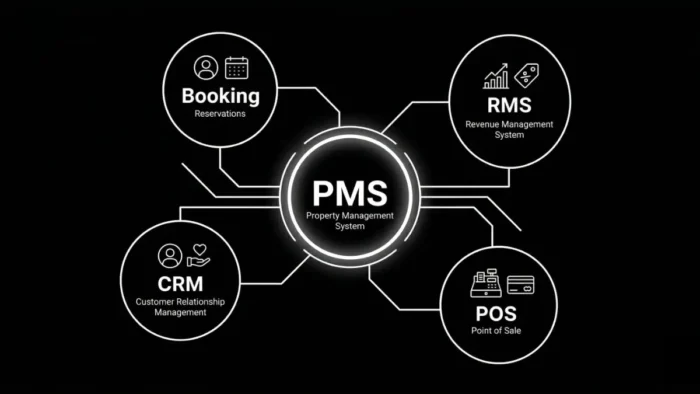
One of the defining features of a modern PMS platform is its ability to play nicely with others. We live in the API economy.
From payment gateways and channel managers to customer relationship management (CRM) tools, point-of-sale (POS), and specialized revenue management systems, seamless software integrations allow you to build a fully connected, bespoke technology stack.
Why the “All-in-One” System is Often a Trap
In the past, legacy vendors sold “all-in-one” systems, claiming their PMS also did POS, CRM, and Revenue Management. The problem? They were usually mediocre at all of them.
Today, the strategy is about building an ecosystem. You want a core PMS with an open API that allows you to plug in the absolute best-in-class software for every other function.
This flexibility is particularly critical for growing hotel groups. As your operations expand—perhaps you acquire a new property or launch a complex F&B outlet—a scalable, cloud-native PMS ensures new technologies can be bolted on without ripping out the foundation or disrupting existing workflows.
Furthermore, according to a recent Skift report on hotel technology, the industry is moving “from cost center to growth engine, with AI, data integration, and guest-facing tools driving efficiency and revenue”, making this kind of seamless, open-API connectivity a top priority for forward-thinking hoteliers worldwide.
The Elephant in the Room: Navigating the Pain of PMS Migration
We can’t talk about the benefits of a modern PMS without addressing the anxiety holding most hoteliers back: the migration process.
Every hotelier knows that changing your PMS feels like performing open-heart surgery on your business while running a marathon. It’s daunting.
You worry about system downtime, losing historical guest data, and the massive headache of retraining staff who are comfortable with the old “F-key” shortcuts of your legacy system.
Actionable Takeaway: De-Risking the Move
If you are planning a migration, approach it strategically.
Demand that your new vendor provides a “sandbox” environment—a safe, offline version of your new system where staff can practice checking in fake guests for weeks before going live. Ensure you have a clear data-mapping strategy so your historical guest profiles migrate cleanly.
Yes, the transition period will be uncomfortable, but holding onto a legacy system out of fear is the fastest way to guarantee your hotel’s stagnation.
What’s Next: AI and the Future of Property Management
As we look toward the next three to five years, the role of the PMS is only going to expand, largely driven by Artificial Intelligence and the Internet of Things (IoT).
We are already seeing the beginnings of this. AI-driven chatbots integrated directly into the PMS can handle 70% of routine guest queries (e.g., “What time is breakfast?”, “Can I have extra towels?”) automatically, further freeing up your front desk.
IoT integrations will allow your PMS to communicate directly with smart thermostats in the rooms, automatically adjusting the temperature to save energy when the PMS knows the guest has checked out.
The PMS is evolving from a system that records what happened, into an intelligent partner that anticipates what needs to happen next.
The shift toward digital transformation in hospitality is no longer optional; it is a fundamental necessity for survival.
Property management systems are the beating heart of this transformation. They are the engine enabling modern hotels to operate with ruthless efficiency, deliver the highly personalized experiences guests demand, and ultimately generate significantly higher revenues.
By aggressively automating your routine processes, unlocking creative new revenue opportunities, and leaning on actionable data insights, modern PMS platforms help you move out of the weeds of day-to-day operations. They allow you to step back and focus on high-level, strategic growth.
As technology accelerates, the capability gap between hotels using modern systems and those clinging to legacy software will only widen. The hotels that invest in modern, flexible, cloud-native PMS solutions today are the ones strategically positioned to adapt to wild market swings, meet ever-evolving guest expectations, and sustain real, profitable success in this fiercely competitive industry.
The tools to grow your business are out there. It’s time to put down the ledger and start building your digital brain.