

Traditional goal-setting relies heavily on positive visualization, but I found a massive, hidden trap buried deep within this approach, especially regarding the execution part of the strategy. So, I’ve developed the A.D.A.P.T. Execution Matrix to help you break free from this trap and achieve your goals.
When you sit down and daydream about your ideal future, it feels incredible.
Simply, your brain lights up, your dopamine spikes, and you feel an immediate rush of accomplishment. The excitement is extremely high, and there is little progress.
So, you start with excitement about the project idea. Also, when you start visioning your future and setting up goals, your excitement continues to rise, even though achievements are still far away. Then, when you start preparing your action plan and quarterly, monthly, weekly, and daily tasks, your excitement starts to decrease.
Yes, you make a lot of progress, but you are still far away from achieving your goals. So, excitement continues to decrease until around 30% of the journey to full achievement. I’ve seen that to this point, 90% of people, including me, give up.
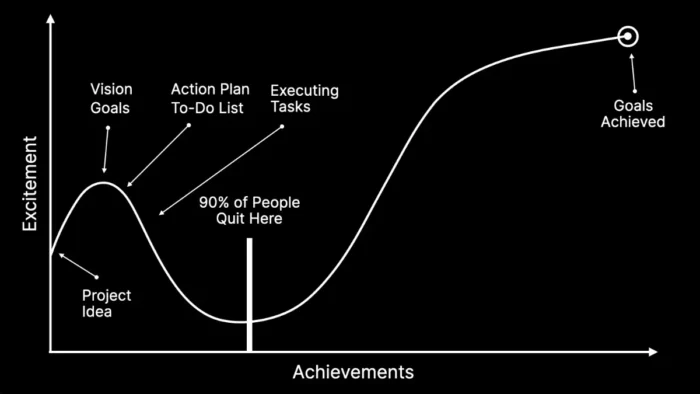
And, this is really disappointing. Your excitement, motivation, and energy are gone, and you simply decide to give up, even though you have two-thirds of the journey to full achievement.
But modern psychological research reveals a disturbing truth: positive visualization alone actually tricks your brain into feeling as if the goal has already been achieved. Because of that, you are excited at the beginning.
By basking in the warm glow of a future fantasy, you inadvertently tell your nervous system that the battle is already won, which completely kills your visceral motivation to take action in the real world.
When you see that the goal is still far away, and you put so much effort into planning, preparing, and executing your action plan, your excitement, motivation, and energy are gone.
Think about it this way: if you only hold onto one end of a rubber band—the beautiful positive vision—it remains completely loose, slack, and totally lacking in mechanical energy. It cannot move anything.
To generate true motivational energy that snaps you out of bed, you have to stretch that band tightly. You must create really strong psychological tension.
That is precisely why defining an “Anti-Vision” popularized by creator and entrepreneur Dan Koe is so shockingly powerful.
Instead of just asking yourself what you want, you must do something that feels like psychological déjà vu—you look directly into the dark, familiar patterns of your past failures and current bad habits, and you clearly document everything you absolutely despise and do not want your future to look like.
When you map out this worst-case scenario in detail, you pin down the other end of that rubber band. You generate a powerful, visceral negative energy born from disgust and discomfort, and you learn how to translate that raw energy into highly productive daily fuel.
The impediment to action advances action. What stands in the way becomes the way.
Marcus Aurelius
This intentional, aggressive action is your primary weapon against “entropy“—the supreme law of the universe.
In physics and systems theory, the law of entropy simply states that if a complex system is not actively maintained with fresh energy and strict order, it will naturally and inevitably decline into absolute chaos, randomness, and disorder.
Your life, your entrepreneurial or managerial career, and your daily habits are not immune to this law. The moment you stop applying deliberate energy, personal entropy takes over.
Mindless actions, daily distractions, or taking no action at all do not keep you in a safe baseline; they actively pull you downward into a state of personal decline.
Imagine your life or business as a car. Entropy is the natural, silent, steady buildup of dust, rust, and decay that occurs if you stop cleaning, polishing, and maintaining it.
You do not have to try to break down your car; if you do nothing, time and the elements will do it for you. Your daily focus operates under the exact same universal tax.
Your Anti-Vision is not some unclear worry; it is a clear, high-definition picture of that car completely infested with rats, its structural parts rotting away, and its engine collapsing.
The sheer disgust, anger, and visceral discomfort of looking at that mental image forces you to snap out of your daily trance. It forces you to pick up a tool (or go to a mechanic)) right now to maintain your car within your vision quadrant in the A.D.A.P.T. Execution Matrix, which I will discuss in this post.
Over the last decade, while using the business strategy canvas approach to help my clients break free from this trap, I developed the A.D.A.P.T. Execution Matrix. This framework converts raw, unstructured psychological friction I’ve talked about above into a tight, daily operational reality that keeps you moving forward when willpower completely fails.
To transform these deep philosophical concepts into a rigid daily workflow, you cannot rely on a basic, static checklist or a simple list of goals.
No, today’s reality does not work that way.
A simple list lacks context, geometry, and energetic dynamics. Instead, we must evolve a standard two-column table (yes, I’ve started this many years ago as a table of two columns – vision and anti-vision) into a comprehensive, highly integrated four-quadrant execution matrix.
The A.D.A.P.T. Execution Matrix seamlessly bridges the gap between abstract, high-level planning and immediate physical execution.
The adapt mnemonic stands for:
- Anti-Vision: Use what you hate as fuel.
- Deep Work: Commit one to two focused hours daily on the most priority tasks.
- Author your character: Identify your current and future identity.
- Priority Ladder: Protect your mornings for creation, afternoons for maintenance.
- Transcend Entropy: Actively create order to prevent chaos.
To map this out both scientifically and strategically, we plot these four components onto a classic Cartesian X and Y axis coordinate system. This grid allows us to measure exactly where your mental energy is originating and where your physical actions are being directed every single day.
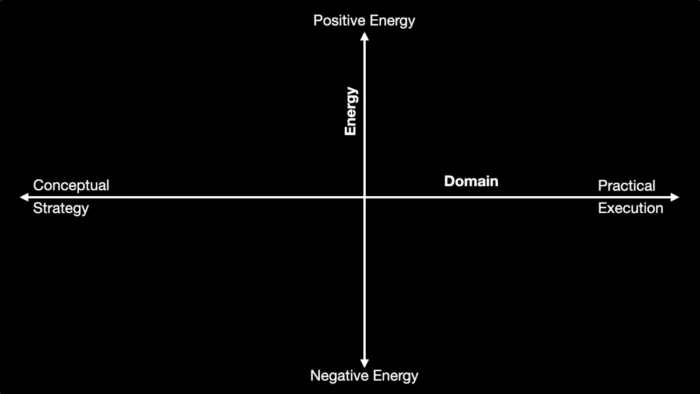
The Y-Axis (Energy / Motivation)
This vertical axis measures the exact type of emotional fuel you are burning to drive your behavior.
The top half of the matrix represents Positive Energy (Desire/Pull). This space is driven entirely by inspiration, long-term building, and what you deeply want to create.
The bottom half represents negative energy (Discomfort/Push). This space is powered by your constructive aversion to failure, the visceral discomfort of laziness, and everything you aggressively want to avoid.
The X-Axis (Domain / State of the Work)
This horizontal axis separates your internal mind from your external body.
The left side represents Conceptual Strategy (Abstract/Future). This domain focuses purely on mental planning, architectural design, and mapping out your internal identity.
The right side represents Practical Execution (Concrete/Present). This domain focuses entirely on immediate physical actions, environmental design, and rigid daily behavioral rules.
Because the quadrants separate abstract strategy on the left from concrete execution on the right, it would make no sense to place separate identities on the quadrants themselves.
You do not have one identity for thinking and an entirely separate identity for doing. You are one single identity operating simultaneously across both the conceptual and practical realms.
By mapping your life onto this grid, you gain an instantaneous diagnostic view of your daily performance. You can see exactly where you are stalling out, where you are hiding in over-planning, and where you are burning through empty willpower.
While the matrix layout provides a clear mechanical framework, the “Identity Shift” is required to act as the deep psychological gears that turn the entire machine.
Throughout my career working as a consultant, coach, and mentor to hundreds of scaling entrepreneurs and high-performing executives, I have seen every execution system fail if the underlying identity is ignored.
It becomes infinitely easier to change what you want to change when, right from the very beginning, you establish absolute, radical clarity about your current and future identities.
To understand why this is non-negotiable, we have to look at evolutionary psychology.
Your brain treats a threat to your self-identity exactly like a physical predator attacking you in the woods.
If you do not actively, intentionally design and invest mental energy into a future identity, you create a vacuum. When that happens, society will happily step in and assign you a cheap, default identity—such as a specific corporate job title, a passive college student, or a mindless, scrolling consumer automaton.
To completely hack this biological survival mechanism, the A.D.A.P.T. matrix places large, explicit custom row headers right across the top and bottom of your grid to map your identity transition:
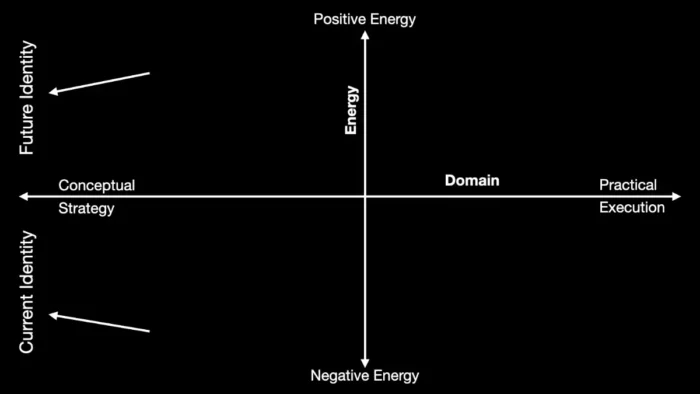
Your Future Identity (The Top Row Header)
This banner spans completely across your positive quadrants the Y-axis.
By explicitly titling this top row with your target Future Identity (e.g., “The Successful Entrepreneur” or “The Disciplined Creator” or “Productivity Genius” or whatever you want to achieve in life or in business), you are handed a clear, higher concept that your brain immediately begins trying to survive every single day.
Your Current Identity (The Bottom Row Header)
This banner anchors the entire lower half of the matrix (negative side of the Y-axis).
By titling this row with your unvarnished Current Identity (e.g., “The 9-5 Job Holder Who Despises Their Trajectory), you place a stark label on the state of personal entropy and chaos you are aggressively fighting to escape.
When you structure your matrix with the Future Identity at the very top and your Current Identity at the bottom, you create a perfect visual and psychological map of a person climbing, fighting, and transcending.
From current to future identity.
Every action you take is a vote for the type of person you wish to become.
James Clear
As James Clear famously popularized in his book Atomic Habits, true, lasting behavior change is never actually driven by standard, outcome-oriented goals; it is entirely driven by an identity shift.
Achieving an isolated goal is only a temporary, fleeting result. But an identity is a permanent, foundational shift in your entire worldview.
The identity headers on the matrix simply force you to step into the identity first, making your daily productive habits a natural, automatic byproduct of who you now believe you are.
Furthermore, this structural arrangement triggers Cognitive Dissonance, a classic psychological theory originally developed by Leon Festinger.
Cognitive Dissonance is the intense, deeply uncomfortable mental friction and psychological pain you experience when your real-world daily actions do not match up with your stated internal beliefs or identity.
If you crown the top of your matrix with the identity of “The Successful Entrepreneur,” but your daily physical actions reflect the lazy, unfocused habits of a passive worker who hates their current reality, your brain experiences massive psychological distress.
To resolve this painful friction, your mind will naturally push you to execute your practical, high-leverage tasks to prove to yourself that your new identity is actually real.
Think of an elite actor stepping onto a chaotic movie set.
The internal quadrants of the matrix are the written script and the physical stage directions. But the “Identity Shift” row header is the physical costume.
Before the actor even opens their mouth to read a line of the script, simply putting on the heavy costume instantly alters how they walk, how they talk, how they stand, and how they behave.
The costume, in our case, identity shift dictates the actions.
The five-letter mnemonic A.D.A.P.T. is far more than a memorable list of self-improvement buzzwords for adapting; it serves as the exact physical engine that drives the four-quadrant Execution Matrix we have just engineered.
If the matrix grid is the structural blueprint of your new life, A.D.A.P.T. gives you the operational instructions required to build it.
Let us break down exactly how these four distinct quadrants function together to create an automated, closed-loop behavioral system.
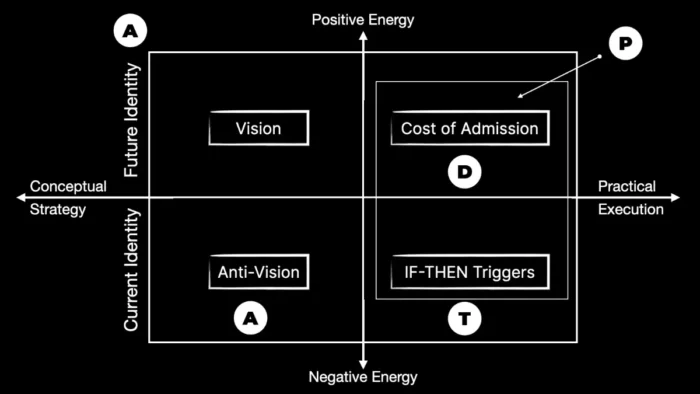
Quadrant 1: The Anti-Vision (Bottom-Left)
The first quadrant, or anti-vision quadrant, measures the Negative Energy + Conceptual Strategy.
This quadrant represents the foundational “A” (Anti-Vision) of the core framework. It is deliberately positioned directly beneath your Current Identity row header because it maps out the dark, chaotic, and default future that awaits your current self if you fail to take action and let entropy win.
To construct this quadrant, you must sit down completely uninterrupted for at least 30 minutes to document every single thing you absolutely hate and refuse to allow your future to become.
You write out the exact financial strains, the physical lethargy, the broken relationships, and the deep professional stagnation that you despise.
Loss Aversion
This exercise works because it activates Loss Aversion. It is a primary concept in behavioral economics, developed by Nobel laureates Daniel Kahneman and Amos Tversky in their Prospect Theory.
Their peer-reviewed research conclusively proved that human beings are wired to find the psychological pain of losing something roughly twice as intensely motivating as the joy of gaining something of equal value.
Traditional goal-setting talks about the joy of winning a prize, but the Anti-Vision (Loss Aversion) forces you to focus on the terrifying reality of what you stand to lose—your time, your money, your health, your autonomy, and your human potential—if you remain stagnant.
Think about finding a random $100 bill crumpled up on the side of the street. Finding it gives you a quick, pleasant flash of happiness. But imagine opening your leather wallet and realizing that someone is actively stealing $100 from it every single day you procrastinate.
The agony, panic, and sheer rage of losing trigger a far deeper emotional response that forces you to stand up and protect your possible assets immediately.
Inversion
Furthermore, Quadrant 1 utilizes Inversion, a brilliant strategic mental model rooted in mathematics by Carl Jacobi and brought into the business world by billionaire investor Charlie Munger.
The foundational premise of Inversion is that the most complex, overwhelming problems in life cannot be solved by simply thinking forward; they must be evaluated backward.
“Invert, always invert.”
Carl Jacobi
Instead of stressing over the vague, complicated question, “How do I achieve [what my vision requires]?” you invert the entire problem.
You ask yourself, “How do I guarantee not achieving [what my vision requires]?”
You list the actions: sleep in late, check your phone first thing in the morning, hang around toxic people, eat junk food, procrastinate, and avoid deep work.
Once you have mapped out this failure blueprint, your strategic path to massive success becomes so much simplified: you simply avoid doing those specific things.
Imagine you are trying to pilot a massive ship safely through a treacherous, foggy harbor.
If you are looking only for the perfect, fastest route (the pure Vision), you will likely crash because the dense fog completely blocks your view of the horizon.
Inversion is like being handed a high-resolution map that strictly highlights where every single hidden rock, sandbar, and explosive mine is located (the Anti-Vision).
You do not need to see the perfect path; you can cross the entire harbor with absolute safety simply by choosing to avoid the mines.
All I want to know is where I’m going to die, so I’ll never go there.
Charlie Munger
The Anti-Vision quadrant functions as a conceptual predator for your mind.
When your nervous system looks directly at the behaviors that lead to a broken, miserable life, it experiences a healthy threat response. It triggers a constructive “fight or flight” response that pushes you directly away from the edge of the cliff and accelerates you toward your positive goals.
Quadrant 2: The Vision (Top-Left)
The second quadrant is the Vision quadrant that measures Positive Energy + Conceptual Strategy.
When you try to sit down and invent an ideal future completely out of thin air, your mind often goes blank or copies and pastes generic goals from society.
But because it is so much easier for our brains to identify what we hate than what we want, your true, authentic Vision naturally reveals itself in this quadrant.
Your positive vision is simply the exact, polar opposite inversion of your anti-vision quadrant.
If your anti-vision details a life of feeling trapped in a rigid, soul-crushing corporate schedule, your vision naturally becomes absolute temporal and financial autonomy.
This precise, dual alignment operates on psychologist Gabriele Oettingen’s scientifically validated framework known as Mental Contrasting, popularized through the WOOP framework.
Oettingen’s research showed that positive visualization lowers your blood pressure and drains your energy. It is because it tricks your brain into thinking the work is complete. However, true motivation requires contrasting that beautiful future vision directly against your current negative reality and internal obstacles.
Let’s go back to the rubber band analogy.
If you only hold one side, it sits slack. When you firmly anchor one end to your raw anti-vision in Quadrant 1, and pull the other end toward the ideal future in Quadrant 2, you create intense psychological tension.
That structural tension is the exact motivational fuel that propels your behavior forward the moment you choose to execute.
Simply, quadrant 2 acts as your architectural rendering, providing a clear North Star so your brain knows exactly how to direct its daily physical energy.
Quadrant 3: If-Then Triggers (Bottom-Right)
The third quadrant is related to If-Then Triggers that will measure your Negative Energy + Practical Execution.
This quadrant combines “P” (Priority Ladder) and “T” (Transcend Entropy) from the core framework. It acknowledges that personal entropy will constantly try to disrupt your routines. You actively transcend that chaos by deploying pre-planned, automated behavioral defense mechanisms.
If-Then Triggers quadrant relies heavily on B.F. Skinner’s classic psychological theory of operant conditioning, specifically focusing on Negative Reinforcement.
In behavioral psychology, negative reinforcement occurs when a specific behavior is strengthened and repeated because it successfully stops, avoids, or removes an unpleasant, negative outcome.
By keeping your uncomfortable anti-vision fresh in your mind, your brain feels an intense desire to escape that reality. The productive, daily habits listed in your positive vision become the ultimate “escape route,” strongly reinforcing your urge to do the actual work.
Think about the annoying, high-pitched, repetitive dinging sound your car makes when you sit down and forget to buckle up.
The vehicle isn’t playing a beautiful classical symphony to reward you or praise you for being safe. It deliberately uses an irritating, piercing noise that you want to escape.
Your anti-vision is that annoying car ding, and standing up to execute your morning routine is clicking the seatbelt into place to make the noise stop.
To make this completely hands-free, the A.D.A.P.T execution matrix utilizes psychologist Peter Gollwitzer’s breakthrough research on Implementation Intentions.
Decades of behavioral studies show that people are significantly more likely to achieve a complex goal if they completely bypass willpower. Instead, they must pre-plan their clear tactical responses to all specific obstacles using a strict IF-THEN format.
This functions exactly like a high-end property security system. You do not sit up all night waiting to manually fight off intruders.
Instead, you pre-program the system: IF an intruder (a distraction like mindless social media scrolling) tries to cross the perimeter, THEN the alarm automatically sounds, and the doors lock down (putting your phone in another room).
This automation requires absolutely zero raw willpower from you at the moment of temptation.
It protects you from the common neuroscientific trap of falling into “unconscious open focus”. When you lack a rigid direction, your brain defaults to internal tracking, which triggers stress, overwhelm, and anxiety.
By creating these strict, automated rules, you instantly narrow your attention. Distractions and irrelevant problems fail to register in your awareness, keeping you locked onto your targets.
It works exactly like hitting the bumpy rumble strips on the shoulder of a dark highway. Hitting those strips feels jarring, negative, and uncomfortable. But they do not exist to punish you; they exist to instantly snap your attention back to the road and correct your steering before you crash into the ditch.
Quadrant 4: The Cost of Admission (Top-Right)
The cost of admission quadrant is where you measure Positive Energy + Practical Execution.
This is where you implement “D” (Deep Work) and “P” (Priority Ladder). To truly “author your character” means you completely stop playing a passive role in life.
You gamify your personal growth like an open-world role-playing game, establish a strict hierarchy of quests, and willingly collect experience by repeating the boring but important tasks day in and day out.
This quadrant represents the literal physical currency you must pay upfront to earn the right to enter your ideal vision.
It means performing the real-world actions of your ideal self right now, even if you can only manage 30 to 60 minutes a day to start building momentum.
To execute this properly, we lean on Cal Newport’s research regarding Deep Work and the optimization of the brain’s “task-positive network”.
Getting ahead does not require exhausting 12-hour workdays; it begins with committing to just one single hour of highly focused, uninterrupted deep work every morning on a project that actually matters for achieving your strategic vision.
This quadrant requires you to implement a strict “Priority Ladder” task management system.
Priority One is kept strictly for high-leverage, vision-building creative work, and it must be executed first thing in the morning when your mental energy is at the highest possible level.
The lowest priority is reserved exclusively for low-leverage maintenance tasks, administrative work, and conversational distractions—like sorting emails, replying to messages, or checking Social Media. These maintenance tasks must be pushed entirely to the end of the afternoon to prevent focus-splitting and protect your creative cognitive resources.
Imagine you are building a massive skyscraper in the middle of a city. Priority One (Deep Work) is pouring the massive concrete foundation and welding the heavy steel frame together.
The lowest priority is choosing the wallpaper for the lobby.
If you wake up first thing in the morning and waste your peak brainpower stressing over the lobby wallpaper (checking your email inbox), you will never actually build the building.
To master this quadrant, you must learn to love the boring fundamentals. Entering a deep “flow state” requires a delicate, constant balance between your current skill level and the challenge you are facing.
If the challenge is too high, you experience severe anxiety; if your skill is too high, you experience deep boredom.
By expanding your goals into this comprehensive A.D.A.P.T. Execution Matrix—mapping your Anti-Vision, your Vision, your Cost of Admission, and your If-Then Triggers—you completely stop relying on the fickle, emotional fuel of positive thinking or raw, exhausting willpower.
When your daily friction, laziness, or your own chaos inevitably arises, your brain no longer has to hesitate, debate, or suffer from executive decision fatigue. It simply executes the designated, pre-programmed “THEN” action automatically.
This matrix functions as a complete, closed-loop psychological system. It harnesses everything you hate and fear (your Anti-Vision) to generate the raw energetic fuel required to pay the exact daily currency for everything you want (your Deep Work), while systematically deploying automated rules to block the universe’s natural pull toward chaos (your If-Then Triggers).
Using the A.D.A.P.T. framework, you are no longer a passive observer hoping for good luck. You are the strategic mad scientist of your own behavior.
Put on your identity costume, author your character, anchor your focus, and step onto the stage of execution today.