

If I want to be honest, I will say making decisions is easy, but making the right strategic decisions is the ultimate test of leadership. Anyone can call a meeting, look at a spreadsheet, and point in a direction. But true strategic decision making represents the systematic, often grueling process of making high-impact business choices that shape your long-term organizational success.
If you think you can just go with your gut or rely on “instinct” because it got you this far, you need to look at the numbers. Strategic decisions determine a staggering 80% of long-term business success.
While McKinsey research shows that inefficient decision-making costs a typical Fortune 500 firm $250 million in wasted time alone, the true cost—including the “strategy-execution gap”—is estimated to be as high as 10% of total annual revenue, often exceeding $3 billion per year for large-scale enterprises.
I’ve seen it firsthand in the trenches.
I have watched brilliant founders tank their companies because they couldn’t separate a daily fire drill from long-term strategic decisions and required pivoting. In 20 years, I’ve learned that this critical skill separates successful, visionary, and strategic business leaders from those who only react to specific circumstances rather than shape them.
In today’s rapidly evolving, hyper-competitive business world, the ability to make effective strategic decisions isn’t just a “nice-to-have” leadership trait; it directly impacts your financial performance, your stakeholder confidence, and ultimately, the survival of your career.
Before we dive into the “how,” we need to get crystal clear on the “what.” The word “strategy” gets thrown around boardrooms like confetti.
Let me be clear: this guide isn’t about routine operational decision-making techniques, managing a difficult employee, or crisis management tactics. This is about the big picture—the stuff that will make or break your company’s future.
Strategic vs. Operational Reality: Know the Difference
If you are spending 80% of your week putting out fires, you aren’t leading; you are just a highly paid firefighter.
Operational decisions address immediate needs and day-to-day business operations within existing, established frameworks. Think about hiring individual contributors, adjusting quarterly marketing budgets, tweaking a supply chain route, or optimizing your current software processes. These are important, yes, but they keep the ship running—they don’t chart a new course.
Strategic decisions are entirely different beasts. They involve broad-range choices affecting multiple stakeholders, demand significant resources, and carry long-term implications for your competitive advantage.
We are talking about massive, needle-moving choices like entering new customer segments, acquiring a competitor, forming multi-year strategic partnerships, or completely restructuring the organization to align with new, audacious company goals.
Unlike operational choices, strategic decisions determine your company’s market position and dictate your success trajectory over the next 12 to 36 months and beyond. If you get an operational decision wrong, you might lose a few weeks of productivity or a few thousand dollars. If you get a strategic decision wrong, you might lose your company.
The Strategic Impact Spectrum
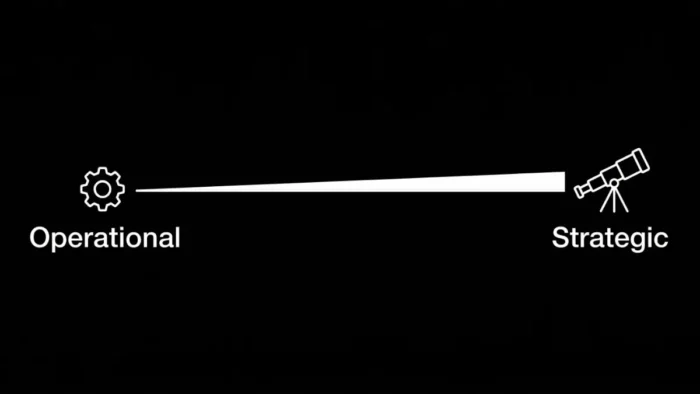
Every decision you make exists on an impact spectrum. You need to know exactly where a choice falls before you allocate your mental energy to it.
On one end of the spectrum, you have localized, departmental changes. On the far end, you have transformational choices that completely reshape your entire market position, your product architecture, and your company culture.
High-impact decisions require substantial resource allocation and typically demand 3-6 months of deep, un-rushed analysis and planning. Understanding this spectrum is vital.
Why?
Because it prevents you from over-analyzing routine, low-impact choices (which causes bottlenecks), while ensuring your major, high-stakes decisions actually receive the adequate attention, business agility, and capital resources they require.
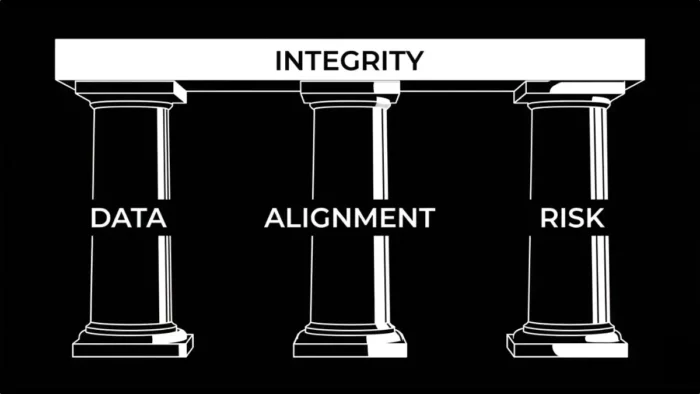
Successful strategic business decisions don’t happen by accident, and they don’t happen in isolation. They require critical, interlocking components that distinguish high-performing organizations from those that constantly struggle with strategic missteps.
According to research published in the Harvard Business Review, companies that move from haphazard planning to formal, structured decision-making processes see a measurable boost in their ability to achieve strategic goals—with some frameworks yielding more than 20% higher success rate in project outcomes compared to those that “wing it”.
To develop a strategy that remains effective in practice, focus on these three essential pillars:
Pillar 1: Data-Driven Analysis (Separating Signal from Noise)
We live in an era of information overload. The problem isn’t getting data; the problem is figuring out which data actually matters.
You must gather comprehensive, unfiltered data about market trends, competitive dynamics, and customer behavior before making major strategic choices.
You need to look at industry reports, robust financial forecasting models, and deep market research that reveals actual consumer behavior patterns—not just what consumers say they will do, but what their wallets prove they are doing.
Let’s look at a brutal real-world example: Quibi’s epic $1.75 billion streaming platform collapse in 2020. The executives assumed that because people watched short videos on YouTube, they would pay premium subscription fees for high-end, short-form mobile content. They had mountains of data, but it was the wrong data.
They ignored the fundamental consumer behavior patterns of how and why people consume premium entertainment. Inadequate, biased market research derailed a massively funded initiative.
Actionable Tip: Always seek “disconfirming data.” Don’t just look for data that proves your brilliant idea is right; actively hunt for the data that proves it is wrong.
Pillar 2: Stakeholder Alignment (The Execution Engine)
You can have the most brilliant, data-backed strategy in the world, but if the people who have to execute it don’t believe in it, it’s dead on arrival.
Successful strategic decisions typically involve 5-8 key stakeholder groups providing input. You must effectively and transparently engage your board members, department heads, major customers, and most importantly, the middle managers and frontline team members who will actually implement the chosen strategy.
This collaborative decision-making process does two things.
First, it ensures internal organizational readiness. Second, it builds genuine, psychological commitment.
When people feel they had a voice in the blueprint, they will fight to build the house. If you just hand them a finished blueprint from the ivory tower, they will find every reason why it can’t be built. Invest heavily in team collaboration early in the process.
Pillar 3: Risk Assessment and Mitigation (The Pre-Mortem)
Hope is not a strategy.
Effective strategy requires a cold, calculated, and systematic evaluation of financial, operational, reputational, and competitive threats.
Strategic leaders lean heavily on risk matrices and scenario planning to quantify probability and impact. A fantastic tool here is the “Pre-Mortem” (popularized by behavioral economists).
Instead of waiting for a project to fail to figure out why, you sit your team down before you launch and say: “Fast forward one year. This strategy has completely failed. It’s a disaster. Why did it fail?“
This forces your team to identify the hidden risks they were too polite or scared to bring up during the brainstorming phase.
Consider Netflix.
They demonstrated masterful, calculated risk-taking by shifting from their cash-cow DVD delivery business to online streaming.
They deliberately cannibalized their own existing revenue streams. It looked incredibly risky in the short term, but their long-term risk assessment showed that physical media was dying.
By taking the short-term hit, they ultimately achieved an unassailable, dominant market position.
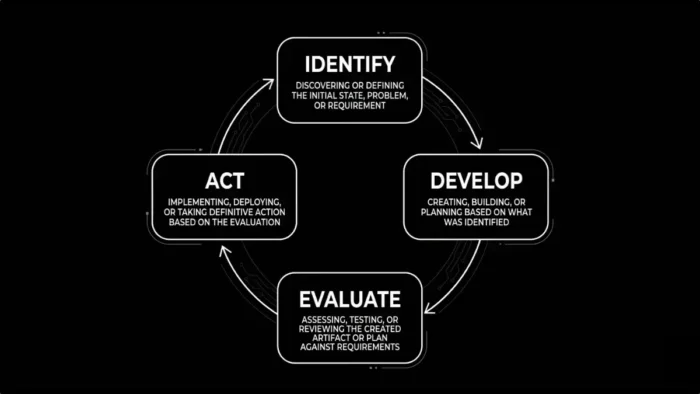
Building on these three pillars, successful organizations like Amazon, Microsoft, and Toyota don’t just guess; they use proven, repeatable methodologies to navigate complex choices.
Enter the IDEA framework. Bookmark this. Print it out. Use this structured approach for any decisions involving significant investment, affecting multiple departments, or impacting your competitive advantage and long-term objectives.
1. Identify the Strategic Challenge (Get to the Root Cause)
Before you start looking for solutions, make sure you are solving the right problem. Often, what looks like a strategic issue is just a symptom of a deeper, underlying core business problem.
Define the exact opportunity or threat requiring a strategic response. Gather preliminary data to validate the urgency.
Simply ask, “Is this a ‘hair-on-fire’ problem or a slow-burn market shift?”
As an outcome from this step is established hard decision criteria and success metrics that align perfectly with your company’s long-term mission.
If the proposed decision won’t move these specific metrics, kill the idea immediately.
2. Develop Alternative Solutions (Expand the Options)
Never let your team present you with a “yes or no” decision on a single strategy. That’s a trap. You need options.
You must generate 3-5 distinct, viable strategic options. Use brainstorming sessions with cross-functional teams. Do not just let the marketing team solve a marketing problem—bring in sales, finance, and product design.
Diverse perspectives ensure comprehensive solution development and expose operational blind spots.
When you develop alternative solutions, ensure that they are rigorously documented, including risks, and hard resource allocation requirements for each alternative approach.
3. Evaluate Options Systematically (Remove the Emotion)
Now it’s time to put those alternatives through the meat grinder. You must remove personal bias and office politics from this stage.
To evaluate your options run them through rigorous SWOT analysis templates to evaluate external and internal factors objectively. Apply your predetermined decision criteria consistently across all options using scoring matrices.
Also, you must conduct deep financial modeling for the top two choices.
Wherever feasible, test your assumptions through small pilot programs, beta tests, or localized market research before committing the full budget.
4. Act and Monitor Progress (The Reality Check)
A decision isn’t actually made until resources are allocated and action is taken. Implementation is everything.
You must execute your chosen strategy with ruthless precision. Assign single-point accountability for every task. Establish clear, non-negotiable milestones and weekly review checkpoints.
A good plan violently executed now is better than a perfect plan executed next week.
General George S. Patton
Also, you must ensure that there are right Key Performance Indicators (KPIs) to track progress toward your objectives. Create a “tripwire” metric—a specific number that, if hit, triggers an automatic pause and course correction.
Finally, document lessons learned to improve your future strategic agility.
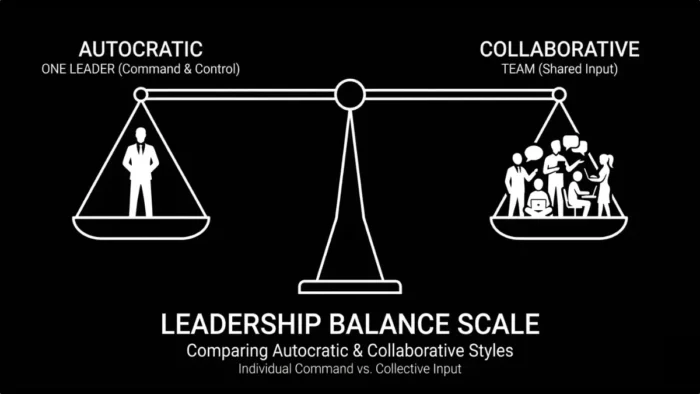
Let’s address the elephant in the room: modern leadership advice heavily pushes the narrative that every decision must be collaborative, consensus-driven, and highly democratic.
That is terrible advice.
Not every decision requires a drum circle, and not every decision should be made in a vacuum. The best leaders are chameleons; they adapt their decision-making style to the specific requirements of the situation. Sometimes you need to be the collaborator; sometimes, you need to be the dictator.
Here is a breakdown of when to deploy which style:
| Feature | Autocratic Approach (The Dictator) | Collaborative Approach (The Facilitator) |
| Speed | Highly rapid, fast implementation. Ideal for crises. | Longer, methodical evaluation process. |
| Quality | Limited to the leader’s existing knowledge and perspective. | Diverse input significantly improves analytical depth. |
| Buy-in | High potential for team resistance if overused. | Deep, psychological stakeholder commitment. |
| Risk | Higher chance of critical oversight and blind spots. | Superior, 360-degree risk identification. |
The Consensus Trap
Collaborative approaches typically produce far superior strategic outcomes when dealing with complex business decisions affecting multiple stakeholders, parsing out resources, or changing the company culture.
However, autocratic methods work much better for urgent, time-sensitive decisions with clear parameters, provided you are an experienced decision-maker who genuinely understands the relevant factors.
Furthermore, beware of the “Consensus Trap.”
If you wait for 100% agreement from your team on a bold strategic move, you will end up with a watered-down, compromised strategy that achieves nothing.
Look to Amazon’s famous leadership principle: “Disagree and Commit.” As a leader, your job is to gather the input, listen to the dissent, make the hard call, and then demand that everyone commits to the execution—even if they initially disagreed with the choice.

Frameworks like IDEA are the vehicle, but your own mental acuity is the engine. To make the framework function, you have to cultivate daily habits of critical and strategic thinking. This isn’t something you just turn on during an off-site retreat; it is a muscle you must build.
Master Second-Order Thinking
Most failing leaders are only capable of first-order thinking.
First-order thinking is fast and easy: “Sales are down. Let’s offer a 20% discount.”
The immediate result? Sales go up.
Strategic leaders use second and third-order thinking.
“If we offer a 20% discount (First Order), sales will rise. But what happens next? (Second Order) We train our customers to wait for sales, eroding our premium brand perception. (Third Order) Our profit margins shrink, forcing us to cut R&D, which means our next product cycle will be inferior to our competitors, ultimately destroying our market share in three years.”
As you can see to be strategic and critically evaluate your options you must always ask: “And then what?”
Respect “Chesterton’s Fence”
Before you make a massive strategic decision to tear down a process, fire a department, or pivot a product, apply the principle of Chesterton’s Fence.
The principle states that if you come across a fence in the middle of a field, do not tear it down until you understand why it was built in the first place.
Tearing down existing organizational structures without understanding the historical context of why they exist is a recipe for operational disaster. Seek to understand before you seek to disrupt.
Even with perfect frameworks, crystal-clear data, and a brilliant team, human nature constantly gets in the way. Your own brain will try to sabotage you.
You must recognize these traps to avoid them.
Beating Analysis Paralysis
We’ve all been there.
You have 15 spreadsheets, 4 market reports, and you still feel like you need “just one more study” before you pull the trigger.
If you have a 70% probability of being right, you should probably make the decision.
Jeff Bezos
Waiting for perfect data delays market entry and wastes vital competitive windows, allowing competitors to capture new customer segments while you are stuck in committee meetings.
The brutal truth is that perfect data does not exist in business. By the time the data is perfect, the opportunity is gone.
To solve this problem, you can apply the 80/20 rule. Make informed, aggressive decisions when you have 80% of the relevant information. Furthermore, set hard, non-negotiable 90-day decision deadlines for major strategic choices.
If the decision isn’t made in 90 days, the default answer becomes “no,” and you move on.
Surviving Short-Term Pressure
It is incredibly, painfully difficult to balance quarterly financial performance expectations (especially from anxious investors or an impatient board) with your 3-5 year visionary strategic objectives.
The fact is that if you only manage for the next quarter, you will have no company in five years.
You must create rigorous dual-horizon planning with compartmentalized resource allocation. You must literally ring-fence capital and talent for the future that cannot be touched by the demands of the present.
As mentioned earlier, Amazon demonstrated this balance perfectly by sacrificing short-term profitability for over a decade to build long-term market dominance in cloud computing and logistics.
Defeating Cognitive Bias
In high-stakes environments, your ego is your enemy. Cognitive biases like the sunk cost fallacy (“we’ve already spent $1M on this failing project, we can’t quit now!”), confirmation bias (only listening to data that supports your gut feeling), and survivorship bias (trying to copy Apple’s strategy while ignoring the 10,000 companies that tried the same thing and died) can single-handedly destroy a brilliant strategy.
The Brutal Truth: You are biased. I am biased. We all are.
You cannot will yourself out of bias.
The solution is to Implement structural speed bumps. Assign dedicated “Red Teams” or “devil’s advocate” roles in your meetings whose sole job is to professionally attack the proposed strategy, challenge the underlying assumptions, and identify your blind spots.
Make it safe for your team to poke holes in your ideas.
Strategic decision making represents a learnable, highly critical skill that dictates the ultimate trajectory of your organizational success. It requires the systematic application of proven frameworks, the maturity to balance collaborative and autocratic leadership, and the psychological fortitude to outsmart your own cognitive biases.
Mastering this leadership development process is what enables elite business leaders to confidently navigate complex strategic challenges, build an unassailable competitive advantage, and drive sustainable growth—regardless of what the economy or the competition is doing.
But reading this guide changes nothing. Knowledge without execution is just trivia. You need to put this into practice today.
In any moment of decision, the best thing you can do is the right thing, the next best thing is the wrong thing, and the worst thing you can do is nothing.
Theodore Roosevelt
Your Action Plan:
- The 30-Day Challenge: I want you to identify one pending strategic decision that has been sitting on your desk or stuck in committee. Apply the 4-step IDEA framework to it this week. Set a firm 30-day deadline to make the final call. No extensions.
- Review the Past (The Post-Mortem): Establish a formal strategic decision review process. Block out two hours next week to conduct an honest, ego-free assessment of the three biggest choices you made in the previous 12 months. Simply, you must ask yourself: What did you get right? Where did your biases blind you?
- Upskill Your Team: Forward this guide to your leadership team and schedule a specific training session on cognitive bias recognition and structured decision-making techniques. You cannot scale your strategy if your executive team doesn’t share a common language for how choices are made.