

Agentic search startup Seltz Inc. said today it has bagged $12.5 million in seed funding to build a more optimal infrastructure so that artificial intelligence agents can find their way around the web.
The round was led by Speedinvest and B Capital. Also participating were Italian Founders Fund, Future Back Ventures, futurepresent, Arc Investors, Vento Ventures, Mango Capital, 2100 Ventures and United Ventures, plus angel investors from Google LLC, Hugging Face Inc. and Ramp Network Inc.
The startup was founded by Chief Executive Officer Antonio Mallia, who told Fortune that he’s not just trying to build another AI answer engine like Perplexity. Rather, he’s looking lower down the stack, building search infrastructure that’s optimized for AI algorithms that generate long and detailed queries and run them in parallel to surface structured evidence, rather than a list of links.
“The old search methods don’t work because they were architected for humans,” Mallia told Fortune. He explained that the most useful information needed by AI agents often sits beyond where traditional search engines such as Google can reach. For instance, it might be inside the main body of text, or it might be embedded in tables, images, snippets or other page-level material that human-focused search engines cannot easily dig up.
Mallia is an expert when it comes to search. His studies at the University of Pisa were focused on information retrieval, and he later earned a Ph.D. in computer science at New York University before working as an applied scientist on Amazon.com Inc.’s artificial general intelligence team. He also worked as a research scientist at Pinecone Systems Inc., the creator of a specialized vector database that helps large language models to search through unstructured data.
In a blog post in April, Mallia wrote that he realized the need for a specialized agentic search platform while working at Amazon as part of the team that developed Alexa’s question answering engine. It was then that it struck him that the consumer of search was no longer a human, but a machine using what it surfaces to inform its own answers.
Unlike other search engines that often route their queries through Google Search, Bing or another major search provider, Seltz has built its entire search stack, including the crawlers, index, retrieval models and ranking systems. It’s a big part of the company’s plan, though he conceded in a blog post announcing today’s round that web-scale search is “one of the most capital-intensive problems in software.” He added that Seltz sought funding to scale its platform to “tens of billions of documents.”
Mallia said he started with a news index and was able to ship its platform within eight months of starting to build it. The company has also created its own Dynamic News Search benchmark, which reveals that it delivers 89% accuracy and returns its results in less than 250 milliseconds.
It should be noted that those numbers are not an independent assessment, but Fortune said Seltz can crawl “hundreds of millions of pages a day,” and generally returns its results in under 200 milliseconds. Mallia explained that Seltz’s platform works by searching, scoring passages and extracting the exact text, table or image that an agent needs.
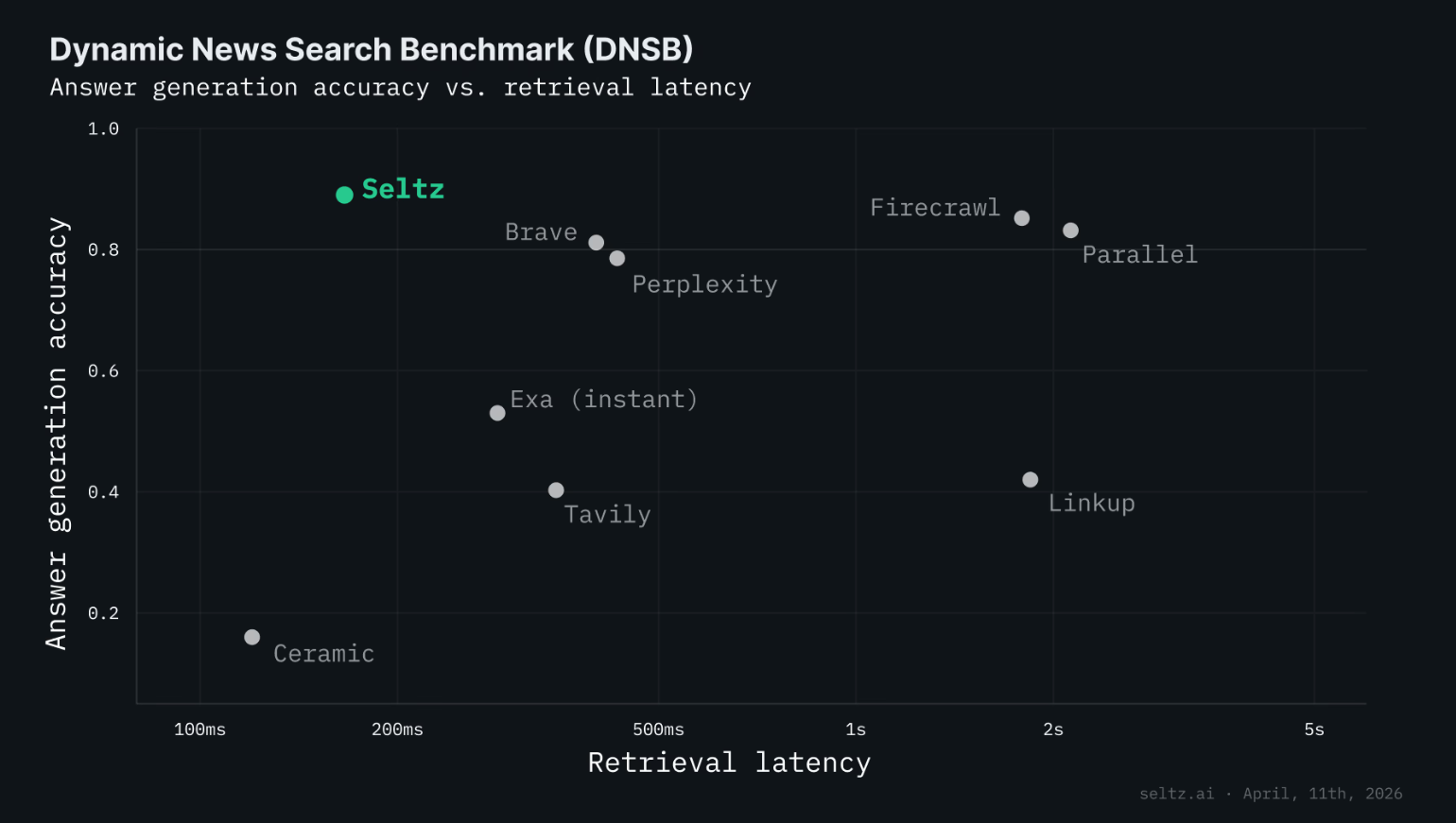
Seltz is attacking a genuine problem, but it’s not the only startup trying to do this and it has a distinct disadvantage in terms of the funding it has been able to attract. In April, Parallel Web Systems Inc., led by former Twitter CEO Parag Agrawal, raised $100 million in a Series B round that valued it at $2 billion, while Exa Labs Inc. nabbed $250 million just last month. The data center infrastructure giant Nebius Group N.V. is also making an agentic search play, having bought the Israeli startup Tavily Inc., which has developed a specialized search layer for autonomous AI agents, in February.
Mallia’s company is also much smaller than those rivals, with just 15 staff on its books at present, only half of those working for it full-time. However, many of its employees hold Ph.D.s in information retrieval, and others previously worked with Mallia on Amazon’s AI research teams.
Seltz already has a foundational lab under contract and is running multiple pilots with companies building agentic workflows. The funding will be spent on engineering, hiring more staff and launching enterprise sales, Mallia said.
Images: Seltz
Support our mission to keep content open and free by engaging with theCUBE community. Join theCUBE’s Alumni Trust Network, where technology leaders connect, share intelligence and create opportunities.
- 15M+ viewers of theCUBE videos, powering conversations across AI, cloud, cybersecurity and more
- 11.4k+ theCUBE alumni — Connect with more than 11,400 tech and business leaders shaping the future through a unique trusted-based network.
About SiliconANGLE Media
SiliconANGLE Media is a recognized leader in digital media innovation, uniting breakthrough technology, strategic insights and real-time audience engagement. As the parent company of SiliconANGLE, theCUBE Network, theCUBE Research, CUBE365, theCUBE AI and theCUBE SuperStudios — with flagship locations in Silicon Valley and the New York Stock Exchange — SiliconANGLE Media operates at the intersection of media, technology and AI.
Founded by tech visionaries John Furrier and Dave Vellante, SiliconANGLE Media has built a dynamic ecosystem of industry-leading digital media brands that reach 15+ million elite tech professionals. Our new proprietary theCUBE AI Video Cloud is breaking ground in audience interaction, leveraging theCUBEai.com neural network to help technology companies make data-driven decisions and stay at the forefront of industry conversations.