

So long I have taught and measured hours instead of output density.
For two years, I tracked every hour as if it were the unit that mattered. Simply, my calendar was a mosaic of color-coded blocks.
First was the morning routine. So, I was spending 90 minutes, scheduled each morning precisely.
Then, deep work sprints: 2 hours each, 3 per day.
At the end, admin tasks, email, planning, reviewing metrics, and adjusting workflows.
By 7 PM, I had logged 10 or 11 hours. I closed the laptop with the quiet satisfaction of a man who had already done his duty for today.
There was just one problem.
Revenue did not move. The business felt heavier, not lighter. Every month looked like the month before, except I was more tired. I was doing more of everything and getting less of anything.
I told myself the story every entrepreneur tells: I am building. I am laying foundations. I am in the grind. The results will come.
They did not come.
What came instead was a conversation with a founder I respected. She ran a different kind of operation. Smaller team. Narrower focus. But her numbers were climbing while mine were flat. I asked how her quarter was going.
She said that her revenue had doubled.
I asked what she changed for such a result.
She said, “I cut my workday to four hours.”
I laughed. She did not.
Then she explained her system, and I realized I had been measuring the wrong thing for my entire career.
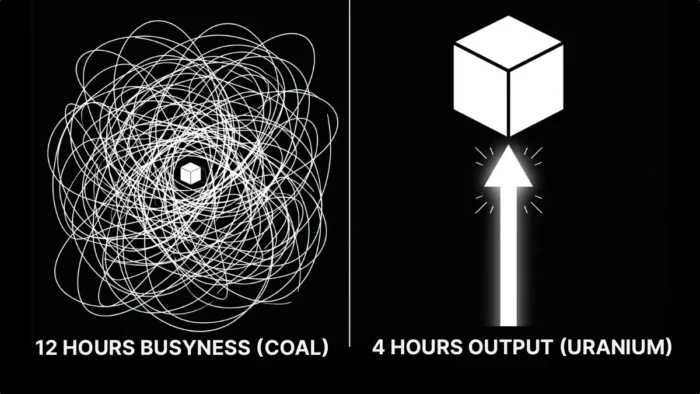
I was counting hours (inputs). She was counting output density.
The difference sounds subtle. But it is not.
It is the difference between a business that moves and a business that just burns fuel.
Here is what she did differently.
As I said, she did not track hours. She did not try to fill a calendar. She did not have a morning routine that required a flowchart.
Every morning, she asked exactly one question:
“What is the single action that, if I ship it today, makes everything else irrelevant?”
She called it the load-bearing move. The one piece of output that holds weight. The shipment that carries the business forward, whether or not anything else happens.
On Monday, it might be a partnership email sent to one specific person. Without a batch of outreach. Without a “networking strategy.”
One email. To the right person. With a clear ask.
On Tuesday, a product change that removes the biggest friction point for customers. Not a roadmap meeting. Not a list of potential improvements. One change. Shipped.
On Wednesday, a single piece of content designed to convert, not perform. Not a content calendar. Not a posting schedule. One piece. Published.
Four hours of work. One shipment. Done.
Then she closed her laptop.
While she was doubling revenue in four-hour days, I was optimizing my morning routine for the eleventh time.
I was reading another book on productivity. I was reorganizing my Notion workspace. I was busy. Genuinely busy. Sweating. But I was converting almost nothing.
Being busy is a form of laziness—lazy thinking and indiscriminate action.
Tim Ferriss
This is the Busyness Paradox in its clearest form.
Busyness is input. It is the cost you pay, the energy you burn, the hours you log.
Output is what leaves your hands and lands in someone else’s world.
You cannot measure output by measuring input. That is like measuring a car’s speed by how much fuel it burns. The fuel matters only if the car is moving. And most entrepreneurs I know have their foot on the gas in neutral.
They are not lazy. They are exhausted. But they are measuring the wrong unit.
Peter Drucker put it plainly sixty years ago: “There is nothing so useless as doing efficiently that which should not be done at all.”
Efficiency is a trap when the thing you are doing efficiently does not move the business.
You can optimize your morning routine until it is a symphony, but if the first shipment does not leave your hands until 2 PM, you have spent your best hours on preparation, not output.
What my peer understood, and what I had forgotten, is that not all work has the same energy density.
Every business is a system with stored potential energy. But not every element inside that system has the same density.
Some actions are uranium.
One small unit, properly converted, produces huge output. For example, a single email to the right person. A single product change that removes a bottleneck. A single piece of writing that earns attention for years.
On the other side, most actions are coal.
They burn. They take effort. They keep you warm. But you need mountains of them to produce the same result as one uranium move. And here is the uncomfortable part: coal burns just as hot as uranium while you are shoveling it.
You feel the effort. You see the flame. You mistake the heat for progress.
The entrepreneur’s job is not to burn more coal. It is to find the uranium and convert it.
My peer had built her entire working life around that distinction. I had built mine around the assumption that more hours meant more output.
Simply, she was converting uranium in four hours. I was shoveling coal for twelve.
The effort felt identical. The results were not even in the same league.
Once I understood the principle, I rebuilt my working day around five rules. They are not complicated. They are difficult. There is a difference.
Most of what we say and do is not essential. If you can eliminate it, you’ll have more time, and more tranquillity. Ask yourself at every moment, “Is this necessary?”
Marcus Aurelius
1. Identify your load-bearing move before you do anything else.
Most founders start the day by opening their inbox or their task manager and start reacting to whatever is loudest.
But that is not strategy. That is triage. And triage keeps you alive. It does not make you grow.
Because of that, I have developed the A.D.A.P.T. Execution Matrix.

The load-bearing move is the one action that, if completed, makes the rest of the day optional.
It is the shipment that moves the business forward. It is never a meeting. It is never “research.” It is never “planning.”
It is an output that someone outside your head can receive, use, or pay for.
Here is the test: if you only ship one thing today, what must it be?
If you cannot answer that question in ten seconds, you do not know what your load-bearing move is.
And if you do not know, you will default to coal.
Write it down before you touch anything. A single sentence. “Today I will ship X.” That is your day. Everything else is noise until it is done.
2. Kill the ritual inflation.
There is a whole industry selling you the idea that you need a two-hour morning routine to be productive. Cold plunge. Journaling. Meditation. Gratitude practice. Reading. Visualization. Breathwork.
By the time you finish “preparing to work,” you have burned the hours when your brain was freshest.
I am not saying those practices are worthless.
I am saying they are not work. They are preparation. Preparation is infinite. Output is finite.
You can prepare forever. The market only pays for what ships.
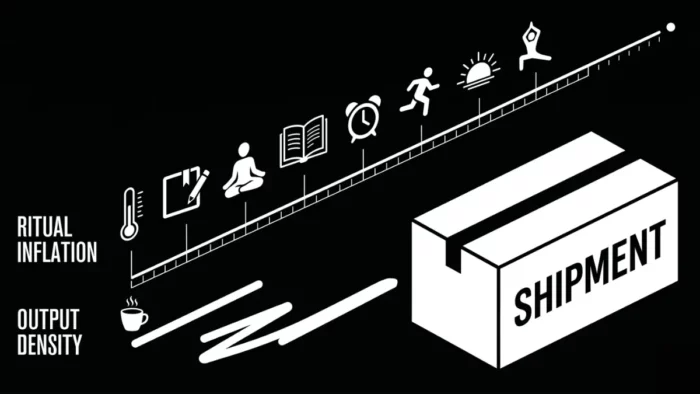
My peer did not have a morning routine. She woke up, made coffee, and opened the document that mattered. Within 30 minutes of waking, she was building the load-bearing move.
By 10 AM, it was shipped. Two hours from waking to done.
Keep your morning routine simple. If it takes you more than 30 minutes to go from waking up to working on your main task, you are probably just putting things off (procrastinating).
In reality, you might be calling it discipline, but it is just procrastination in disguise.
3. Ship before noon.
Eat a live frog first thing in the morning and nothing worse will happen to you the rest of the day.
Mark Twain
There is a reason this works, and it is biological, not motivational.
Your cognitive capacity peaks in the first four to six hours after waking. Decision-making is better. Creative synthesis flows. You can hold complex systems in your head without effort.
After noon, cortisol drops, adenosine builds, and your brain starts conserving energy.
You “work” but you are really rearranging things. Answering emails that did not need answering. Tweaking designs that were already done. Mistaking motion for output.
The goal is to convert your best biological hours into your most important output. One shipment. Complete. Live. In the hands of a customer, a partner, or an audience.
If it ships before noon, two things happen.
First, you win the day. Whatever else occurs, you moved the business.
Second, the afternoon becomes optional. You can rest, think, plan, or do the secondary work without the pressure of unfinished business pressing on your chest.
Most people do this backward.
They spend the morning on email and admin, then try to do creative work at 3 PM when their brain is a puddle.
Flip it. Ship first. Answer emails when you are too tired to think.
4. Measure output density, not duration.
At the end of the day, do not ask “how many hours did I work?”
You must ask, “What held weight?”
One load-bearing move you have done in four hours is worth more than twelve hours of scattered motion. This is not because the math is cute. It is because the business does not move when you optimize your calendar. It moves when value leaves your hands.
I started keeping a simple log. Not a time log. An output log. Every day, one line: “Today I shipped X.”
If I could not write a line, the day did not count. Did not matter how many hours I worked. Did not matter how tired I felt. No shipment, no progress.
The first week I did this, I worked fewer hours than I had in years. I also produced more output than I had in the previous month.
The ratio was almost embarrassing. I had been confusing exhaustion with achievement for two years.
5. Apply the “So What?” test to every item on your list.
Most to-do lists are not lists of work. They are lists of anxiety dressed as tasks.
- “Research competitors.” So what?
- “Brainstorm content ideas.” So what?
- “Organize files.” So what?
- “Update the website.” So what?
- “Check analytics.” So what?
When you look at each item, ask: “If I do this, so what? What ships? Who receives it? Does revenue move?”
If the answer is “I will feel more organized” or “I will be prepared for later,” delete it.
Those are not outputs. They are procrastination disguised as planning. They feel productive because they involve effort, but effort without shipment is just exercise.
If the answer is “a customer will receive something they can use” or “revenue will move” or “a bottleneck will be removed,” that is a shipment. Do that.
The “So What?” test is ruthless. It will cut 80 percent of your list. That is the point.
You are not cutting work. You are cutting theater. And theater, no matter how well-performed, does not pay the bills.
Here is what I wish someone had told me many years ago.
A productive day is not a day when you worked many hours. It is not a day when your calendar was full. It is not a day when you “made progress” in a way you cannot name. Exhaustion is evidence of friction, not output.
A productive day is a day when you shipped one load-bearing thing.
One piece of output that held weight. One conversion of potential energy into something real that landed in someone else’s hands.
The hours you worked are invisible to the market. Nobody pays you for your morning routine. Nobody pays you for your planning sessions. Nobody pays you for “thinking about strategy.”
They pay you for what leaves your hands and lands in theirs. You are not paid for the effort you invest. You are paid for the shipment.
Stop measuring hours. Start measuring density.
One load-bearing move per day. Ship it before noon. Cut everything that does not convert.
That is not a productivity hack. It is the difference between a business that moves and a business that just burns fuel.
You already know which one you are running.
The question is whether you are ready to stop shoveling coal and start mining uranium.