

Every leader says they want innovation. They put it on the wall. They print it in the annual report. They hire consultants to “embed a culture of creativity” into the organization, as if creativity is a software patch you install on a Tuesday afternoon.
And then they go back to their desks and do the exact things that kill it.
This is not a character flaw. It is a design flaw.
Most organizations are built to execute, not to explore.
They reward closure, not questions. They optimize for predictability and then act surprised when predictability produces nothing worth predicting.
Curiosity is the prerequisite to every breakthrough your company will ever have.
It is the raw material. It is the difference between a team that spots a market shift six months early and a team that reads about it in a competitor’s press release.
And here is what nobody tells you: Curiosity is not a personality trait you either have or you don’t. It is a discipline. A system. Something you can build, measure, and protect.
I call this system the S.P.A.R.K. Curiosity Framework. And it starts with understanding why your current environment snuffs curiosity out before it has a chance to produce anything useful.
Curiosity does not die because people stop caring.
It dies because the environment makes it irrational to stay curious.
Three forces are responsible. I will name each one because naming a thing is the first step toward dismantling it.
The Thinking Shortcut.
Leaders are outsourcing their judgment to AI, and they are doing it quietly. Not in the obvious way — nobody is asking ChatGPT to write the quarterly strategy and hitting “send.”
The erosion is subtler.
A manager needs to decide something. They prompt an AI. The AI returns a confident, articulate answer. The manager accepts it.
The collaborative dialogue that used to happen between colleagues — the back-and-forth that sharpened thinking, surfaced blind spots, and built shared conviction — never takes place.
AI should be used to make sense of conversations you have already had, not replace the ones you need to have.
When you skip the dialogue, you skip the staircase.
Your own capability atrophies. Your team’s capability never forms.
The Thinking Shortcut is procrastination disguised as efficiency.
The First-Answer Trap
And, this is really interesting.
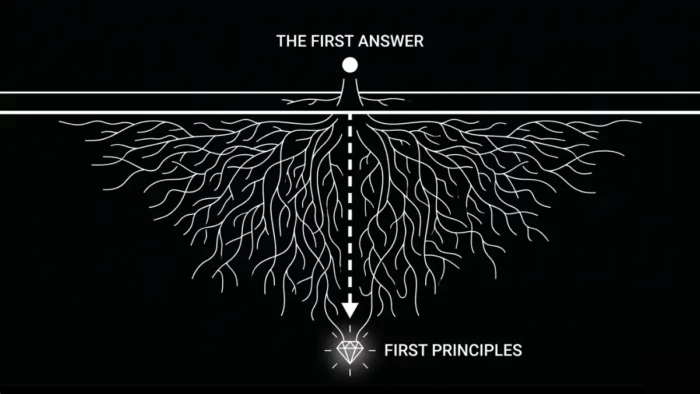
We have trained ourselves, through years of digital feeds and instant search results, to accept the first available answer as the right answer. You type a question. Something appears. You nod and move on.
The diversity of your ideas flattens because you never dug past the surface.
This is not research. It is a reflex. And when an entire organization operates on first answers, it starts solving symptoms instead of causes.
It is because the first answer almost never points to the root. It points to the most obvious layer.
The First-Answer Trap is the enemy of First Principles.
I would rather have questions that can’t be answered than answers that can’t be questioned.
Richard Feynman
The Optimization Paradox.
Here is the cruel irony: the harder you optimize for efficiency, the less capable your organization becomes of the one thing that creates long-term value.
Curiosity requires unstructured time. It requires space to wander, to follow a thread that might lead nowhere, to sit with a problem long enough that the non-obvious answer has time to surface.
But the modern workplace interrupts people an average of 275 times a day. Every minute is accounted for. Slack time is treated as waste.
And so the organization becomes a machine that runs perfectly and produces nothing original. You don’t move forward. You just strip the gears.
These three forces — The Thinking Shortcut, The First-Answer Trap, and The Optimization Paradox — are not cultural accidents. They are structural. And if the problem is structural, the solution must be structural too.
Before you can build a system for curiosity, you need to understand what you are building toward.
Most people talk about curiosity as if it is one thing — you are either curious or you are not. That is like saying a Swiss Army Knife is just a knife. It misses the entire point.
Curiosity has five distinct dimensions, each governed by different cognitive and motivational mechanisms.
The five-dimensional model of curiosity, developed by psychologist Todd B. Kashdan and his colleagues, was designed to capture the full, sophisticated breadth of human curiosity.
Joyous Exploration.
This is the purest form: the intrinsic desire to seek out new knowledge for the sheer pleasure of learning.
It is wandering a foreign city without a map. It has no agenda beyond discovery itself.
Organizations that kill Joyous Exploration are the ones that treat any activity without a measurable output as a waste of time.
They are wrong. Joyous Exploration is the topsoil. Nothing grows without it.
Deprivation Sensitivity.
This is the tension you feel when there is a gap in your understanding — like having a song lyric stuck on the tip of your tongue.
It is uncomfortable. It gnaws at you. And it is one of the most powerful drivers of problem-solving in existence.
High-performing teams are addicted to closing information gaps.
Low-performing teams learn to live with them.
Stress Tolerance.
Curiosity is not comfortable.
Exploring the unknown means sitting with doubt, confusion, and anxiety.
Stress Tolerance is the shock absorbers on an off-road vehicle.
Without it, people retreat to the known at the first sign of difficulty. With it, they stay in the discomfort long enough for insight to arrive.
Social Curiosity.
This is the drive to understand other people — what they think, why they think it, how they arrived at their conclusions.
There are two versions.
Overt social curiosity builds empathy and trust; it is the investigative journalist asking genuine questions.
Covert social curiosity is gossiping. It is the tabloid snooper.
One version builds organizations. The other corrodes them from the inside.
Thrill Seeking.
This is the willingness to take risks — physical, social, financial — to acquire intense, varied experiences. It is the extreme sports of the mind.
In business, it shows up as the founder who enters a market nobody believes in, or the product leader who kills a profitable line because they sense it has no future.
Here is what matters: most organizations reward only one or two of these dimensions and actively punish the others.
They want Deprivation Sensitivity (solve the problem!) but suppress Stress Tolerance (don’t show weakness!).
They want Joyous Exploration (be creative!) but eliminate the unstructured time it requires.
You cannot cherry-pick dimensions. The system either supports all five or it supports none.
This is the engine.
Five pillars, each grounded in cognitive science, each tied to a concrete application. This is not a motivational framework. It is a mechanistic one.
S — Safety
Chronic stress floods the body with cortisol. Cortisol triggers a fight-or-flight response that shuts down the prefrontal cortex — the part of the brain responsible for reasoning, creativity, and long-term thinking.
In other words, when your people are afraid, they become biologically incapable of the very thing you hired them to do.
Think of cortisol as an aggressive bouncer locking the doors to the brain’s VIP lounge. The party is happening inside. Every good idea you need is in that room. But the bouncer will not let anyone through.
Psychological safety means people can relax and focus. It is not just about being nice. It is about making sure everyone feels safe enough to think clearly and stay engaged.
Leaders create this environment when they admit what they do not know, treat failure as a chance to learn, and show humility in their thinking.
In high-capacity cultures, 94% of workers feel safe asking questions. In low-capacity cultures, people hide their confusion and hope nobody notices.
One of these cultures produces breakthroughs. The other produces PowerPoint decks that everyone privately knows are wrong.
P — Principles
The human brain conserves energy by reasoning by analogy: “This problem looks like that problem, so the solution must be similar.“
It is fast. It is efficient. And it is wrong more often than anyone wants to admit.
Reasoning by analogy is remodeling a prefabricated house. You can change the paint and rearrange the furniture, but the foundation was set by someone else, for a different purpose, in a different era.
First Principles Thinking breaks the house down into individual Lego bricks and asks: what can we build from scratch?
James Clear explained the First Principles through the example of Elon Musk and SpaceX.
Elon Musk did not reduce rocket costs at SpaceX by asking how to make rockets cheaper. He asked what a rocket is made of — aluminum, titanium, copper, carbon fiber — and what those materials cost on the open market.
The answer was roughly 2% of the price of a finished rocket. Everything else was assembly.
That is First Principles.
To build this muscle, teams must use the 5 Whys technique aggressively.
When a problem surfaces, ask why. Then ask why again. And again.
Most teams stop at the second why because the third why makes someone uncomfortable.
Push past that. Comfort is not the goal. Truth is.
A — Ask
The brain registers an information gap the same way it registers a physical itch. It wants to close it.
This is why questions are so powerful: they create an itch that demands scratching.
Judge a man by his questions rather than by his answers.
Voltaire
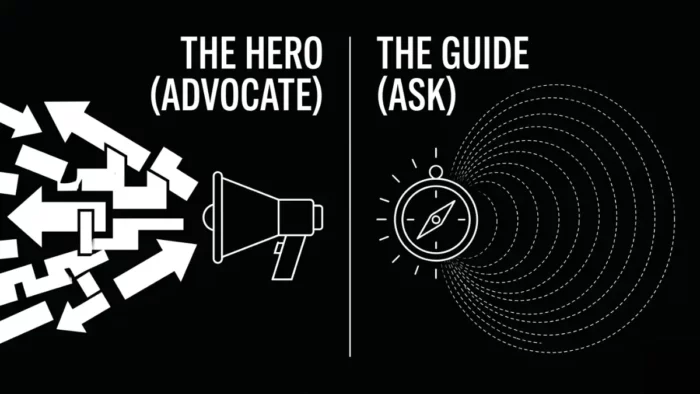
But most leaders operate in the wrong archetype. They adopt the Hero stance — the one who must have all the answers.
Heroes issue directives. They advocate. They close conversations instead of opening them.
The better archetype is the Guide.
The Guide asks powerful questions and lets the team pursue the answers. The Guide equips the ship with radar instead of steering it with a bullhorn.
The practical shift is simple: before you offer an opinion, ask one open-ended question.
Before you prescribe a solution, ask the team what they have already considered. Before you close a meeting, ask what questions remain unanswered.
This is not soft leadership. It is the hardest kind, because it requires you to resist the gravitational pull of being the smartest person in the room.
R — Reward
Self-Determination Theory tells us that humans need autonomy and competence to sustain motivation. But most organizations reward only output. Hit the target. Close the quarter. Ship the thing.
If you want to build a ship, don’t drum up the men to gather wood, divide the work, and give orders. Instead, teach them to yearn for the vast and endless sea.
Antoine de Saint-Exupéry
Performance goals cause people to hide mistakes.
If the only thing that matters is hitting the number, admitting you took a wrong turn becomes professionally dangerous.
Learning goals — acquiring new skills, testing new approaches, deepening understanding — produce the opposite effect. They create permission to experiment. They turn failure from a verdict into a data point.
Managing by performance goals is mining for gold: you extract until the vein is empty.
Managing by learning goals is farming: you fertilize the soil for recurring harvests.
One is a depletion strategy. The other is a growth strategy. Most organizations are mining.
Reward the process of experimentation. Base performance reviews partially on skills acquired, not just results delivered.
When a hypothesis fails and the team comes forward with the data, celebrate that moment. It is the only kind of failure that makes future success possible.
K — Knowledge
States of joyous epistemic curiosity modulate the hippocampus through the dopaminergic circuit.
In plain language: when you are genuinely curious about something, your brain releases dopamine, and dopamine acts as fertilizer for memory. The new knowledge takes deep root because the soil was prepared before the seed arrived.
This is why unstructured exploration time is not a perk. It is infrastructure.
When you give people space to follow their curiosity — to read outside their industry, to research a problem nobody assigned them, to connect ideas that have never been connected — you are not indulging them. You are building the biological conditions for insight.
Democratize learning. Create shared platforms where people post what they are discovering.
Engineer collisions between people who think differently — the precise chef and the improvisational chef, the engineer and the storyteller.
Most breakthrough ideas do not come from within a discipline. They come from the space between disciplines, where nobody was looking.
Before you start applying S.P.A.R.K., you need to know where your organization actually stands.
I use a 2×2 matrix for this, because frameworks that cannot diagnose are just decoration.
The S.P.A.R.K. Curiosity Matrix maps your culture on two axes.
The vertical axis is Environment: Safety and Reward together act as the coolant. Without coolant, the engine overheats and shuts down.
The horizontal axis is Behavior: Inquiry and Knowledge together act as the fuel. Without fuel, you are not going anywhere.
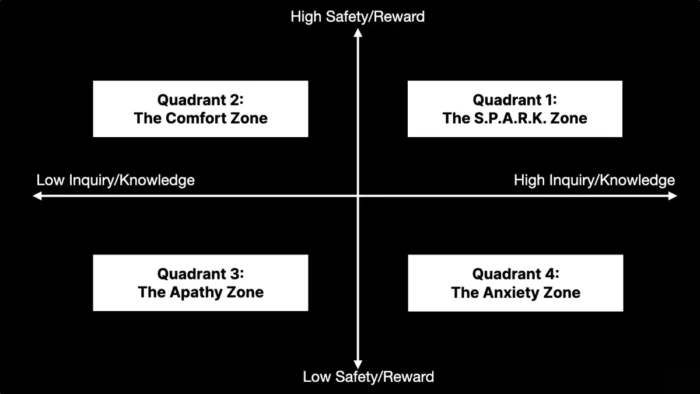
Quadrant 1: The S.P.A.R.K. Zone (High Safety/Reward, High Inquiry/Knowledge).
This is Scale Insurgency — the optimal state.
Teams use First Principles safely. Questions are currency. Failure is data.
For the people in this quadrant, innovation is not an initiative; it is a byproduct of how the system runs.
Quadrant 2: The Comfort Zone (High Safety/Reward, Low Inquiry/Knowledge).
Pleasant but stagnant.
People feel good at work. They just do not produce anything original.
This is where The Thinking Shortcut and The First-Answer Trap thrive.
The culture is warm, but it is relying on analogy instead of inquiry.
Quadrant 3: The Apathy Zone (Low on both axes).
Bureaucratic free fall.
Workers execute tasks to avoid punishment. Nobody asks questions because questions are dangerous.
Unstructured time does not exist. This is where organizations go to die slowly.
Quadrant 4: The Anxiety Zone (Low Safety/Reward, High Inquiry/Knowledge).
Toxic ambition.
People are driven by deprivation sensitivity and fear, but the environment punishes the very exploration it demands.
Gen Z workers often land here — using AI to mask what they do not know, burning out while looking productive.
The diagnostic rule is simple.
If your team is in the Anxiety Zone, do not push harder on inquiry. Fix Safety and Reward first. Coolant before fuel.
If your team is in the Comfort Zone, do not make them more comfortable. Inject cognitive strain through Principles and Ask.
The goal is Quadrant 1, and you get there by addressing the deficiency, not by amplifying the strength.
Knowing how the engine works is not the same as building it.
Here is what you actually do on Monday.
Audit the climate.
Use the S.P.A.R.K Curiosity Matrix to locate your team and you.
Be honest about what quadrant you are really in, not the one you wish you were in.
If the answer makes you uncomfortable, good. Discomfort is the starting line.
Hire for curiosity.
The shelf-life of hard skills is plummeting. The only sustainable competitive advantage is learning agility.
Ask interview candidates what they are curious about outside their domain. Ask what questions they are currently trying to answer.
The ones who have answers are the ones you want. The ones who stare blankly are telling you something important.
Model intellectual humility.
Enter meetings with questions, not directives.
When you do not know something, say so. When you were wrong about something, say so. Your team will mirror whatever behavior you normalize.
If you hide your ignorance, they will hide theirs. And hidden ignorance is the most expensive line item on any P&L.
Protect the apprenticeship.
Young workers are sabotaging their own development by using AI to bridge every knowledge gap instantly. They are skipping the cognitive struggle that builds real capability.
Intervene directly. Teach them how to sit with a problem before outsourcing it. Teach them how to ask the right questions in the right rooms.
This is not mentoring. This is preventing a generation of professionals who can prompt but cannot think.
Build unstructured time into the infrastructure.
This is not “20% time” as a cultural slogan. This is scheduling white space the same way you schedule revenue reviews.
If it is not on the calendar, it does not exist.
If it does not exist, neither does the curiosity that produces your next advantage.
Most organizations treat curiosity as a cultural garnish — nice to have, aspirational, the kind of thing you mention in an all-hands and never operationalize.
The organizations that win treat it as the operating system.
The S.P.A.R.K. Curiosity Framework is not about making people feel good at work. It is about building a system where the biological, cognitive, and social conditions for insight are protected by design.
Where Safety keeps you and your team members’ prefrontal cortex online.
Where Principles automatically force the brain off analogy and onto first truths.
Where Asking simply becomes the default mode instead of advocacy.
Where Reward aligns incentives with real learning, not just output.
Where Knowledge gets the unstructured time it needs to take root.
You can keep optimizing for predictability. The machine will run smoothly all the way to irrelevance.
Or you can build the engine. The blueprint is here.