

It is 2:00 AM on a Thursday.
You are staring at a glowing screen, eyes bloodshot, typing out a manic response to a demanding client or manually fixing a deliverable that your team or freelancer botched.
On paper, your business is growing. Your top-line revenue is higher than it was last quarter, your calendar is packed, and you are technically “in demand.”
But when you look closer at your shrinking profit margins, your non-existent free time, and your compounding cognitive fatigue, a brutal economic reality sets in: you are scaling your business, but you are scaling your losses faster than your profits.
This is the ultimate paradox of modern entrepreneurship.
Most solopreneurs, consultants, and small business owners believe that their primary bottleneck is a lack of revenue, a lack of leads, or a lack of raw market opportunity.
They believe that if they just work harder, log more hours, and push through the current crisis, they will eventually reach a magical plateau of stability.
However, they are wrong.
In my experience, in most cases, what they are experiencing is not a market problem; it is an internal operating system failure. They are paying a compounding, ruinous Invisible Tax—the operational and psychological penalty of continuous, reactive firefighting.
If your business requires your constant, manual, physical presence and a daily sacrifice of your mental clarity just to survive, you do not own a scalable business. You own an incredibly stressful, hyper-reactive job where you are both the tyrannical boss and the exploited employee.
To break free from this loop, you must stop treating strategy as the manipulation of external market forces and start treating it as something far more rigorous: the governance of oneself.
As business owners, we have been conditioned by modern hustle culture to view exhaustion as a badge of honor, not as a bad thing. We simply confuse activity with productivity, and we kinetic motion with strategic progress.
This cultural conditioning creates our primary operational villain: The “Do It Myself” 2 AM Trap.
The Illusion of Nobility
The trap always begins with an internal monologue that feels noble, protective, and elite: “If I want something done right, I simply have to do it myself.”
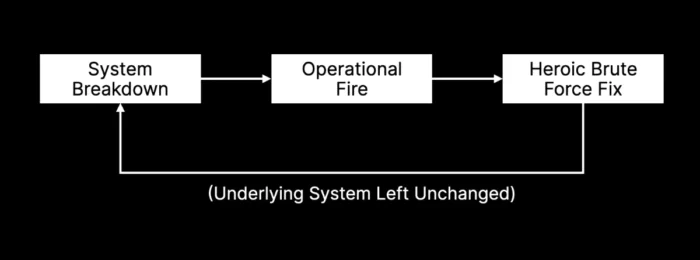
For example, when a freelancer misses a deadline, when a client voices dissatisfaction, or when an operational error occurs, your immediate survival reflex is to grab the task back. You step into the breach, stay up all night, manually fix the problem, and deliver the result.
The client is angry, the immediate fire is extinguished, and your ego receives a powerful shot of dopamine. You feel like the indispensable hero of your own enterprise.
But this heroism is an operational illusion. It is inefficiency disguised as dedication.
When you treat a systemic, recurring failure with raw, unscalable human effort, you guarantee the fire will flare up again next week. You have rewarded a broken structure with your own life force.
If you can’t describe what you are doing as a process, you don’t know what you are doing.
W. Edwards Deming
Because your personal energy, time, and cognitive bandwidth have fixed boundaries, relying on brute-force effort to scale means your business will eventually hit an absolute ceiling.
Once you reach that ceiling, every new client you sign does not represent wealth; it represents a direct assault on your well-being.
The Downstream Chaos: The Three Henchmen
When you choose the short-term comfort of the “Do It Myself” mindset over the long-term discipline of system building, you pull the trigger on a systemic domino effect.
The 2 AM trap does not stay limited to midnight fulfillment; it sends three distinct operational “henchmen” to take the rest of your business architecture:
1. The Time Management Illusion
You wake up every day feeling completely exhausted, drowning under a wave of customer service tickets, administrative tasks, and operational friction.
Because you feel disorganized, you simply start searching for external solutions. You download the latest hyper-optimized productivity apps, purchase complex calendar tools, or watch motivational videos to spark your energy.
But procrastination and operational paralysis are rarely motivation or time-management problems; they are structural system problems.
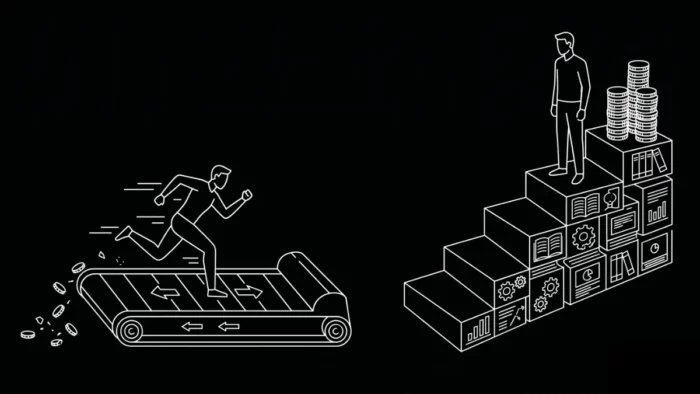
You do not need a new app to help you manage your 80-hour workweek more efficiently; you need a strategic framework that eliminates the low-leverage tasks eating your life.
You are trying to optimize a treadmill when you should be building a staircase.
2. The Flailing Marketing Loop
Because your daily calendar is entirely consumed by manual fulfillment and firefighting, you have zero remaining energy to dedicate to high-level, predictable client acquisition. In such a way, your marketing becomes an inconsistent, reactive event rather than a consistent system.
When your revenue dips into a terrifying valley, you panic. You spend a frantic weekend sending cold emails, posting randomly on social media, or burning money on unoptimized ads.
You land a few clients through sheer desperation, immediately become too overwhelmed by fulfillment to market yourself, and the cycle repeats. You are permanently locked into an unpredictable, exhausting boom-and-bust revenue cycle.
3. The Price-Shopping Trap
Because your marketing is erratic and your revenue is unpredictable, you operate from a permanent state of psychological scarcity.
When a prospect appears, you cannot afford to lose them. You abandon your operational boundaries and drop your prices during sales calls simply to win competitive bids. Also, you say “yes” to toxic, low-value clients who demand endless revisions.
You fail to realize that you haven’t built an upfront system to filter out bad fits before they ever book a call with you. You are playing a short-term game of raw survival, which forces you to fill your ecosystem with the exact clients who cause the fires that keep you awake until 2:00 AM.
This entire destructive loop is exactly what Michael Gerber diagnosed in his strongly influential work, The E-Myth Revisited.
You have fallen into the fatal trap of working entirely in your business as a tactical technician, completely abandoning your true responsibility to work on your business as a strategic architect.
You are falling to the level of your systems.
The psychological rule says that when an inner situation is not made conscious, it happens outside, as fate.
Carl Jung
To cure a disease, you must first stop blaming yourself for the symptoms. If you find yourself trapped in this hyper-reactive loop, you must realize an uncomfortable truth: you are not an undisciplined leader. You are simply a human being whose biological survival instincts have successfully seized your business operations.
You are attempting to win a highly sophisticated, modern economic game using paleolithic biological software.
Your brain did not evolve to build scalable digital enterprises or manage complex multi-variable business systems; it evolved to keep you alive in a hyper-dangerous, immediate-return environment.
1. The Ego as Outdated Tribal Safety Software
In modern business culture, we treat the “ego” as a moral failing—a synonym for arrogance, vanity, or pride. But in evolutionary psychology, the ego is something entirely different: an ancient survival mechanism designed to maintain your social standing within a small tribe.
For early humans, being perceived as incompetent, unreliable, or weak by your tribe meant social ostracization.
In a primitive world, being cast out of the tribe meant certain physical death. Therefore, your brain developed a hyper-sensitive, deeply hardwired emotional trigger designed to aggressively defend your reputation and prove your worth at the first sign of trouble.
When a client screams, or an error occurs, your ancient biological software registers that operational event as a life-or-death tribal threat.
The frantic urge to step in, fix it yourself, over-explain, and save the day is not a rational business strategy—it is your primitive brain desperately trying to prove its utility to the tribe to avoid being cast out into the wilderness.
Your ego demands immediate validation and fights desperately for appearances, while true strategy requires you to stay calm and fight exclusively for systemic outcomes.
2. The Caveman in a Skyscraper
Our ancestors evolved in what anthropologists call an Immediate-Return Environment.
If a caveman was hungry, he hunted and ate it that day. If he was thirsty, he drank from a river. There was no evolutionary stimulus to conceptualize a five-year asset plan or invest energy into structures that would not yield a caloric return for months.
Today, we operate in a highly abstract Delayed-Return Environment.
The strategic actions that actually scale a business—such as writing clean standard operating procedures (SOPs), automating onboarding sequences, or building deep infrastructure—require you to expend massive energy today for a return that you will not see for weeks, months, or years.
When you choose to chase a quick, low-paying project or manually fix a client crisis rather than sit down to design a long-term system, you are falling victim to Hyperbolic Discounting.
This is the hardwired behavioral bias where the human brain consistently selects smaller, immediate rewards over significantly larger, delayed rewards.
Your primitive brain simply registers a delayed system as a form of starvation. It screams at you to seize the immediate dopamine and cash flow of the quick fix today. However, you are completely blind to the fact that this choice guarantees structural starvation tomorrow.
So, your exhaustion is not a sign of hard work; it is proof that your primitive survival biology is successfully overriding your strategic judgment.
True strategy is not a battle against the market; it is an ongoing, daily act of self-governance over your own evolutionary programming.
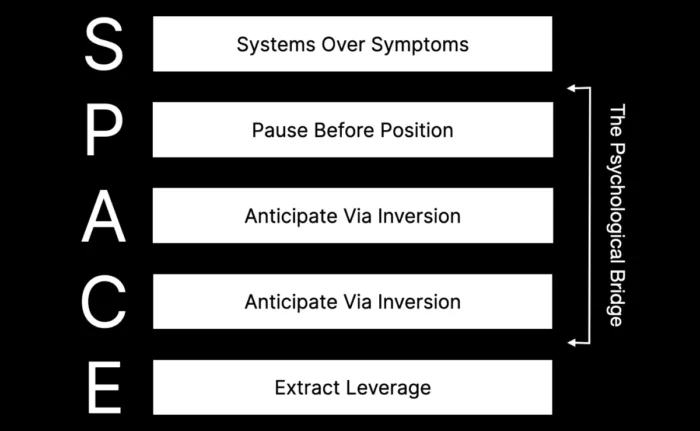
To stop paying this Invisible Tax and transition from a chaotic operator to a strategic architect, you must install a new cognitive framework. The S.P.A.C.E. framework is an integrated, five-part internal operating system designed to replace raw, unscalable human effort with systematic, compounding leverage.
No, it’s not a perfect framework, but I have used it for my clients and me to give us a starting point to build a better system.
S — Systems Over Symptoms
The foundation of the framework requires an absolute mindset shift: you must stop treating outcomes as random, isolated events, and start treating them as the mathematically predictable byproducts of your underlying systems.
Yes, we spend so much time on systems, but I think that many people still don’t understand what a system is.
A system is not just a piece of software; it is the deliberate combination of structures, explicit habits, internal incentives, feedback loops, and clear boundaries that consistently produces a specific, repeatable result without requiring your continuous manual input.
When an operational failure occurs—whether it is a revenue decrease, a bad client deliverable, or a team error—the symptom thinker asks: “Who did this, and how do I fix it right now?”
On the other side, the systems architect zooms out entirely and asks: “What current structure, missing incentive, or flawed feedback loop naturally allowed this failure to occur, and how do I redesign it so the problem permanently solves itself?”
Consider the common struggle of chronic procrastination or creative burnout. Most business owners attempt to solve these issues by watching motivational media or engaging in a brutal, exhausting internal battle of willpower.
But procrastination is almost never a motivation problem; it is a system problem rooted in poor project planning, vague goals, or high emotional friction within your workspace.
When you change the underlying system—removing friction points, clarifying variables, and changing your daily incentives—you eliminate the symptom of procrastination entirely without burning an ounce of precious willpower.
The Psychological Bridge (P → A → C)
If you want to successfully transition from identifying a system failure (S) to deploying real-world leverage (E), your mind must pass through three rigid psychological barriers.
Without this connective tissue, your systems will remain theoretical ideas that you will instantly abandon the moment your business experiences high stress.
P — Pause (The Tourniquet & Time-Delay Rule)
“To the mind that is still, the whole universe surrenders.”
Lao Tzu
When an operational crisis erupts, your emotional brain undergoes an immediate amygdala hijack.
The contrast between emotional reactivity and strategic observation mirrors Daniel Kahneman’s dual-process theory: suppressing the impulsive “System 1” to engage the analytical “System 2” brain.
Your System 1 thinking—fast, reactive, and automatic—takes complete control of your body, demanding that you run fast or fight hard.
If you act within this state of heightened emotional intensity, you will almost always make a short-term, panic-driven decision that creates far more problems than it solves.
To execute a pause mid-crisis without letting your business implode, you must deploy a practical containment strategy known as The Tourniquet Rule.
When a client sends a furious email or a project derails at 2:00 AM, do not attempt to solve the problem immediately, and do not ignore it. Instead, issue a pre-scripted, completely emotionless Holding Statement:
“Dear [Client Name], thank you for your message. I understand the [issue], and our team is looking into the cause to fix it for good. I will update you with our plan and next steps by 9:00 AM.”
When you use this or a similar statement, it will act as an operational tourniquet. It stops the reputational bleeding and satisfies your client’s psychological need to be heard, preventing further escalation.
This holding statement acts as an operational tourniquet. It stops the reputational bleeding and satisfies the client’s psychological need to be heard, preventing further escalation.
More importantly, it instantly buys your brain a multi-hour window of absolute silence.
By taking control of the speed of communication, you allow your emotional System 1 to cool down, giving your logical, analytical System 2 the necessary temporal space to step in, evaluate the vitals, and design a strategic response.
Consider an elite Emergency Room physician confronted by a bleeding, screaming patient. If the doctor reacts purely to the noise and chaos (the symptoms), they might panic and perform an unstable, messy surgery right there on the waiting room floor.
Instead, the physician applies a tourniquet to stop the bleeding, steps back to read the objective vitals, calms the room, and strategically moves the patient to a sterile operating environment.
Or, when your car hits a patch of black ice and begins to spin out of control, your reactive survival biology screams at you to slam your foot onto the brakes and violently jerk the steering wheel in the opposite direction.
If you follow this instinct, you guarantee a catastrophic crash.
The protocol for surviving a skid requires you to do something deeply counterintuitive: take your feet off the pedals entirely and keep the wheel steady for two seconds.
It feels terrifying, but this deliberate pause allows the tires to regain their natural traction with the asphalt so you can safely steer out of danger.
A — Anticipate Via Inversion
Once you have paused and stepped off the reactive treadmill, you cannot simply build a new system blindly. You must engineer it to survive the brutal realities of human error and market friction.
You do this through the mental model of Inversion—the practice of thinking backward to solve complex problems.
Instead of asking, “How do I build the perfect client management system?” you must invert the problem and ask: “If I wanted to completely destroy my client relationships, maximize scope creep, and guarantee that my team does not finish this project in six months, what would the exact causes be?”
The answers will illustrate your true vulnerabilities:
- “We would accept them without explicit written boundaries regarding revision limits.”
- “We would communicate across four different unorganized channels instead of a single source of truth.”
- “We would rely on verbal instructions instead of a standardized, mandatory checklist.”
By anticipating these exact failure points before they ever occur, you can proactively design strong safeguards, boundaries, and protocols into your new structural blueprint.
You aren’t just building a system; you are actively outsmarting future bottlenecks before they have the chance to disrupt your life.
C — Compound Long-Term
A perfectly anticipated, beautifully designed system will not produce massive operational leverage on day one. Like any valuable long-term asset, it requires time, consistency, tweaking and structural momentum to compound.
The guardrail of Compounding is the strict discipline of enduring short-term friction for long-term scalability.
Many solopreneurs build an automated system or train a freelancer, face a minor roadblock or employee mistake during the very first week, get impatient, and immediately slide back into the “Do It Myself” trap because it feels faster in the moment.
They interrupt the compounding process right before the returns begin to scale.
You must maintain the strategic maturity to let the system run, accept minor early friction, and resist the urge to micromanage, allowing your operational infrastructure to gain irreversible momentum.
E — Extract Leverage
This is the ultimate promised land of the S.P.A.C.E. framework. Extracting leverage is the systematic realization that your raw personal effort must be replaced by strategic force multipliers—mechanisms that allow you to dramatically increase your operational output while consistently reducing your physical and mental input.
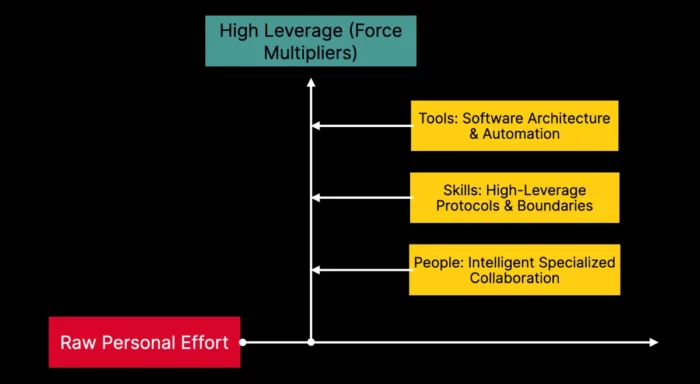
To start systematically eliminating the Invisible Tax, you must aggressively audit your business operations and filter all your recurring tasks through three primary leverage assets:
1. Tools – Automation Architecture
Turn your software stack from a group of disconnected apps into a system that runs routine tasks automatically in the background.
If you find yourself manually copying data from one spreadsheet to another, sending manual invoice reminders, or coordinating calendar availabilities back and forth via email, you are wasting valuable executive bandwidth.
When you set up automated pipelines with tools like Zapier, Make, or AI Agents and use fixed templates for tasks you do often, you remove a lot of manual work from your daily operations.
2. Skills – High-Leverage Protocols
Leverage is not just about technology; it includes your personal abilities. Developing the skill of ironclad, unambiguous communication is one of the highest-leverage assets a leader can possess.
By mastering the art of setting firm operational boundaries, designing crystal-clear project briefs, and structuring explicit contracts, you save hundreds of hours of downstream misinterpretation, endless client revisions, and fractured professional relationships.
3. People – Intelligent Collaboration
Let go of the idea that real leadership means taking on all the responsibility by yourself. Success comes from working with coordinated systems and teams, while trying to do everything alone only leads to short-term wins.
Extracting leverage through people means investing your front-loaded time and energy into building detailed Standard Operating Procedures (SOPs), comprehensive training protocols, and outcome-based checklists.
When you start delegating these tasks to other people (team members), virtual assistants, or trusted partners, you move from being overwhelmed by daily work to becoming someone who manages and designs your business more strategically.
To understand how the S.P.A.C.E. framework operates at scale, look at a real-world case study from the highly complex enterprise software development sector.
A specialized software consulting firm was brought in to engineer a comprehensive, multi-million dollar customs administration platform (known as CDPES – Customs Declaration Processing & Excise System) for a public sector client.
Early in the first phase of deliverables, the client’s representatives began throwing the project into chaotic gridlock. They were sending frantic daily emails, raising urgent alarms, and demanding immediate, sweeping modifications over completely surface-level visual details—such as the specific font style, background colors, and button placements on the preliminary interface previews.
A symptom-driven manager, terrified of losing the client’s favor, would have yielded to the 2 AM trap. They would have panicked, pulled their lead software engineers off core functional database coding, and ordered them to pull all-nighters, manually changing font styles and adjusting color hex codes to appease the immediate screaming.
The result?
The company might experience short-term relief, but the main development schedule would be thrown off for good. This would cause major deployment delays, serious system bugs, and could even lead to the project failing.
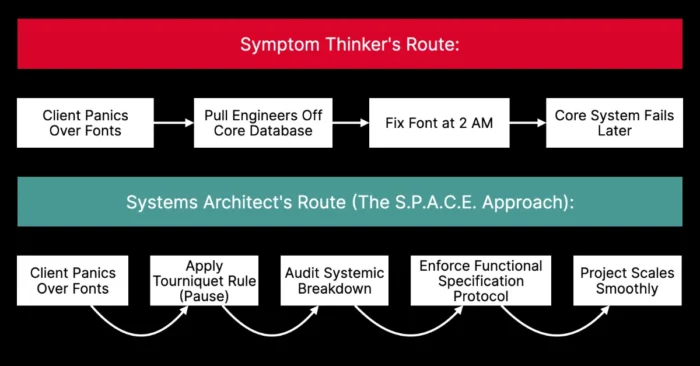
A systems architect uses the S.P.A.C.E. framework instead.
First, they use the Pause step with the Tourniquet Rule. This means they recognize the client’s visual feedback but do not change any code yet.
Next, they use root-cause analysis to identify the deep system failure (Systems Over Symptoms). The real problem is not the font style; the real problem is a profound breakdown in the onboarding and alignment system.
The client’s representatives had failed to read, comprehend, or sign off on the comprehensive functional specifications and architecture documentation before the engineering phase began.
Because they lacked clarity on how the complex functionality worked, their anxiety caused them to focus hyper-reactively on the only variable they could understand: the visual surface aesthetics.
Instead of firefighting the symptom by changing fonts, the systems architect enforces a mandatory Functional Specification Protocol. They stop with visual iterations, sit down with the client stakeholders to walk through the structural blueprint of the software, align on core functionalities, and establish an explicit, systematic feedback loop that separates architectural engineering from visual design.
When you fix the underlying system rather than treating the noisy symptom, you preserve your engineering resources, protect the project timeline, and establish unshakeable authority..
If you find yourself trapped in an 80-hour workweek, you cannot buy your way out of the trap, and you cannot hustle your way out. You must subtract your way out.
You must use the mental model of Opportunity Cost—realizing that every time you say “yes” to a low-leverage task, an administrative distraction, or a toxic client out of fear, you are saying an absolute “no” to the strategic systems that will free your life.
Here is your concrete, step-by-step playbook to brutally steal back your first two hours of operational margin over the next 48 hours:
| Step | Action Protocol | Tactical Mechanism | Operational Payoff |
| 1 | Plug the Time Leaks | Ruthlessly audit your calendar and eliminate non-value-producing activities born from sheer exhaustion: overthinking, endless email refreshing, and low-quality digital numbing. | Recovers immediate mental clarity and stops cognitive hemorrhaging. |
| 2 | Sacrifice the Bottom 20% | Identify your most demanding, lowest-margin obligations or minor clients. Intentionally delay, reschedule, or drop them. Accept the temporary discomfort of letting a non-critical standard slide. | Creates an immediate two-hour deposit of uninterrupted strategic time. |
| 3 | Enforce Sequencing | Stop swinging wildly at the jungle vines. Take your two stolen hours, sit down in isolation, and use them exclusively to build one automated system or draft one comprehensive SOP checklist. | Sharpens your operational machete, ensuring every future action requires half the effort. |
The smartest, most leveraged entrepreneurs are not afraid to say “no.” They do not decline opportunities because they lack ambition; they decline them because they have a profound respect for the true cost of their attention.
Stop running yourself ragged on the exhausting treadmill of raw human effort. Apply the tourniquet to your daily crises, face the biological flaws of your ancient evolutionary software, install the S.P.A.C.E. framework, and start building a quiet, scalable, and highly profitable enterprise of long-term leverage.