

Chinese artificial intelligence lab Moonshot AI today announced the imminent release of Kimi K3, its latest large language model, and already, it’s sending shockwaves across the AI industry.
That’s not only because it’s believed to be the world’s largest open-source model to date, but because benchmarks show it outperforms the best models from OpenAI Group PBC and Anthropic PBC in some applications. With a staggering 2.8 trillion parameters, Kimi K3 will become the largest open-weight model available once its weights are released to the public on July 27.
Moonshot, which is backed by Alibaba Group Holding Ltd., said in a blog post that Kimi K3’s performance still trails GPT-5.6 Sol and Claude Fable 5 in some areas. However, the company’s internal tests reveal that it’s extremely close behind those models in several key tasks. Moreover, Artificial Analysis has carried out a number of independent tests which show that it places just behind those top proprietary models on its Intelligence Index and in real-world work evaluations.
Meanwhile, Arena.ai’s front-end development leaderboard has Kimi K3 ranked above those models. That puts it 17 places above Moonshot’s previous model release, Kimi K2.6. Arena Chief Executive Anastasios Angelopoulos made an extremely bold claim in a post on X, saying that it may be “the single biggest release of the year,” and may represent the moment in which China has finally surpassed the U.S. in its AI model prowess.
For an open-source model that is an exceptional achievement, and it means that the general consensus that American AI firms remain several months ahead of their Chinese counterparts no longer holds much water. Anthropic only released Fable 5 last month, while OpenAI’s GPT-5.6 only debuted a week ago.
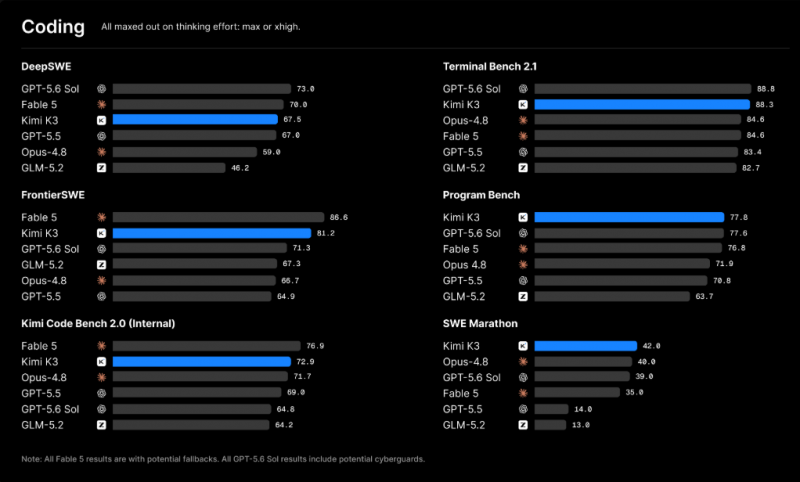
Software engineering focus
In a blog post, Moonshot explained that Kimi K3’s primary use case is focused on long-running autonomous software development tasks. The model is designed to analyze large codebases, coordinate programming tools and perform multistep tasks in order to achieve an end goal.
Kimi K3 also relies on visual feedback, the company explained. It can examine screen captures, modify code, then check the resulting visible output of its work. Moonshot said this is an example of a “vision-in-the-loop” system that makes it especially useful for tasks such as games development, user interface design and computer-aided design.
A demonstration posted by Moonshot shows off a 3D open-world game that Kimi K3 reportedly built entirely in a web browser using Three.js, WebGPU and GPU Compute. For the demo, the model procedurally generated the environment and used external tools to create a 3D rider and horse. It also demonstrated a simulation of the Long March 10 rocket’s launch and return, and a Game Boy Advanced emulator.
The Kimi K3 API documentation shows that the model is priced at 30 cents per 1 million input tokens with a cache hit and $3 without. One million output tokens, including reasoning, cost $15. Those prices apply regardless of context length. That makes it significantly cheaper than Western models. For instance, Fable 5 costs $1 per 1 million input tokens and $50 per 1 million inputs, while GPT-5.6 Sol costs 50 cents per 1 million input tokens and $30 per 1 million output tokens.
Another DeepSeek moment?
Former White House policy adviser on AI Sriram Krishnan summed up how many people felt about the release, saying on X that Kimi K3’s debut is a “big moment, with multiple implications for the entire industry.”
The last time that a Chinese AI lab released a cheaper model that matched the capabilities of its proprietary U.S. counterpart, it resulted in shockwaves that reverberated across the world. That was when DeepSeek Ltd. released its R1 model in January 2025, and the moment people became aware of just how good it was, it caused pandemonium on U.S. stock markets. Roughly $1 trillion was wiped from the value of leading technology firms, and its success sparked major security concerns in the White House, causing the Trump administration to double down on its hardline position regarding tech exports to China.
Do not be surprised if accusations of foul play are later thrown at Moonshot. Just a few months earlier, Anthropic accused the company, along with DeepSeek and another Chinese model maker called MiniMax of violating its rules by extracting the capabilities of its Claude model to train their own. That process is known as model distillation, and it’s actually quite common in the AI industry, though the Trump administration recently deemed it to be an “adversarial” approach and promised to crack down on it.
The launch of Kimi K3 comes at a time of heightened scrutiny and growing security concerns over the capabilities of frontier models. The release could well lead to yet more debate over issues like distillation, export controls and whether the restrictions placed on China are having any real effect.
Images: Moonshot
Support our mission to keep content open and free by engaging with theCUBE community. Join theCUBE’s Alumni Trust Network, where technology leaders connect, share intelligence and create opportunities.
- 15M+ viewers of theCUBE videos, powering conversations across AI, cloud, cybersecurity and more
- 11.4k+ theCUBE alumni — Connect with more than 11,400 tech and business leaders shaping the future through a unique trusted-based network.
https://siliconangle.com/aws-marketplace/
About SiliconANGLE Media
SiliconANGLE Media is a recognized leader in digital media innovation, uniting breakthrough technology, strategic insights and real-time audience engagement. As the parent company of SiliconANGLE, theCUBE Network, theCUBE Research, CUBE365, theCUBE AI and theCUBE SuperStudios — with flagship locations in Silicon Valley and the New York Stock Exchange — SiliconANGLE Media operates at the intersection of media, technology and AI.
Founded by tech visionaries John Furrier and Dave Vellante, SiliconANGLE Media has built a dynamic ecosystem of industry-leading digital media brands that reach 15+ million elite tech professionals. Our new proprietary theCUBE AI Video Cloud is breaking ground in audience interaction, leveraging theCUBEai.com neural network to help technology companies make data-driven decisions and stay at the forefront of industry conversations.