

A laser beam can cut through steel, we know that. On the other side, a floodlight only warms the surface. And both give off light and use energy. One simply lights up a wall, but the other changes what it touches.
The difference is concentration. I call it the Laser Principle.
In physics, intensity equals power divided by area. Spread the same watts (power) across a stadium and you create ambiance.
Focus them into a single coherent beam and you cut metal.
The energy has not increased. The distribution has changed. And that change is everything.
Business Potential Energy obeys the same rule.
Your message is stored energy. Your audience is the surface you are trying to affect.
Most founders believe that broadening the surface makes the energy do more work. It does the opposite. It dilutes concentration until nothing lands with enough heat to matter.
He who is everywhere is nowhere.
Seneca
I see this pattern everywhere once I started looking for it.
A founder with a consulting offer for three industries writes copy that could fit any of them. A SaaS founder with one main idea creates content about marketing, leadership, productivity, and hiring just because those topics seem related. A coach who could help one specific type of client sets up a funnel that tries to attract everyone.
The result in every case is the same.
Their stored potential energy is enormous. Their kinetic output is a whisper.
Founders add audiences because it feels like expanding inventory. More shelves, more products, more revenue. It is the logic of the department store.
But attention does not work like shelf space. It works like signal strength.
When your message says “I help entrepreneurs,” it competes with every other person who says “I help entrepreneurs.” That pool is infinite.
But, for example, if you say, “I help first-time SaaS founders who shipped an MVP and now need to hire their first three engineers without losing product velocity,” you stop competing with everyone else.
You become the only one in the room, and the space is small enough for your voice to be heard clearly.
That’s the Laser Principle.
The second you try to be for everyone, no one feels seen. This is not a marketing problem. It is a physics problem.
You have spread your energy across too large an area and now your intensity is zero.
To read again Peter Drucker: “Do first things first, and second things not at all.”
Most founders read that as a prioritization principle. I read it as an energy principle.
Every second thing you pursue is a release valve for your stored potential.
A small leak will sink a great ship.
Benjamin Franklin
In such a way, you bleed pressure. You cool the reaction. You turn a laser into a flashlight.
She talks to one person and makes seven figures a month because of the laser principle.
This is not a metaphor. This is not an exaggeration for a headline. This is what happens when you stop machine-gunning your message and start treating it like a controlled reaction.
The narrow-beam founders I have studied do three things differently.
First, they pick one person, not one audience.
An audience is an abstraction. A person is specific.
When you write for entrepreneurs, you write abstractions about abstractions.
If you write for the version of yourself who, three years into running a SaaS, couldn’t understand why the team was always busy but nothing ever shipped, your writing will sound more human.
The message works because the reader feels understood.
And the paradox is that thousands of other people feel seen too, because they share that same problem.
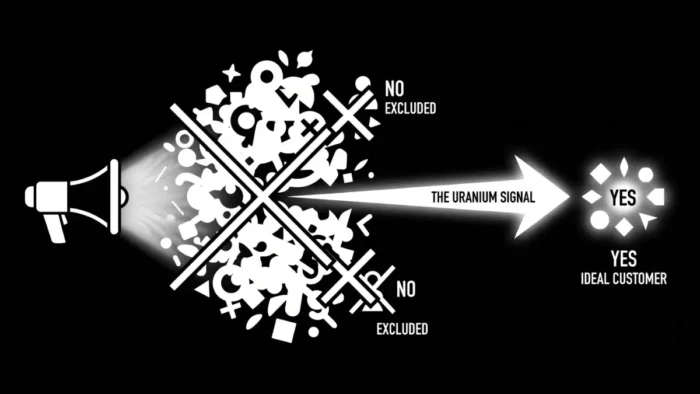
Second, they let exclusion do the selling.
People think focus means saying yes to the thing you’ve got to focus on. But that’s not what it means at all. It means saying no to the hundred other good ideas that there are.
Steve Jobs
Every time you clarify who you are NOT for, you strengthen the signal for who you ARE for.
When you focus your message (a narrow-beam message from the laser principle), it can feel scary to see half the room walk away, especially if you’ve always been told to pursue every possible lead.
But the people who stick around are the ones who will actually buy from you, refer others, and keep coming back. The ones who leave were never going to become customers anyway. You haven’t lost anything—you’ve just made your audience stronger.
Third, they ship one format of value at a time.
The narrow-beam founder does not publish a newsletter, a podcast, a YouTube channel, a course, a community, and a coaching program simultaneously.
They pick one output mechanism and they run it until the channel is hot. Then, and only then, they add the next one.
This is the Staircase Strategy in action.
Each step is achievable and each step pays for the next one. You do not jump to the top. You earn it.
Here is the part nobody says out loud.
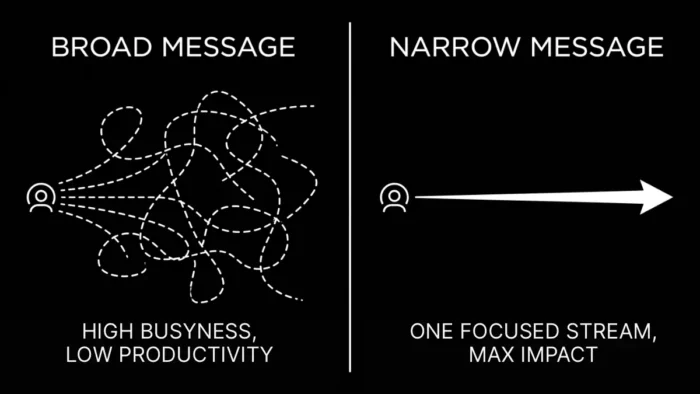
Broadening your message does not just dilute your audience’s experience. It dilutes your own output density.
The founder who speaks to five audiences has to create five content streams, five lead magnets, five nurture sequences, five conversion paths.
That feels like productive work. It fills calendars. It creates urgency.
But it is not output density. It is the Busyness Paradox in its most seductive form: high busyness, low productivity, maximum wasted energy.
The founder who speaks to one person (the laser principle) creates one content stream, one lead magnet, one conversion path.
She iterates on it until it works. Every word she writes compounds on the last one. Every insight deepens the last one.
Her output density is a hundred times higher because her surface area is a hundred times smaller.
I call this the Uranium Beam. You can read more about this analogy in my article: “The Modus Operandi of Growth: How to Calibrate Your Business Potential Energy”.
Most founders operate on coal. They burn low-energy material across a wide area and call it warmth.
The narrow-beam founder identifies the uranium: the one audience, the one problem, the one conversion mechanism with the highest energy density.
Then she concentrates everything on it. One controlled reaction. One massive output.
If you suspect your message has been diluted, run it through a simple test.
Read your last five pieces of content, your homepage, your offer description. After each one, ask: who specifically feels seen by this?
If the answer is “entrepreneurs,” you have a floodlight.
If the answer is “founders who launched a product, got initial traction, and now cannot figure out how to grow without burning out,” you have a laser.
If you cannot imagine a specific person reading your message and thinking “she is talking directly to me,” your signal is too weak to cut through.
You do not need more content. You do not need more channels. You do not need better algorithms.
You need a smaller surface area.
Here is the practical sequence.
One: Define your one person.
Not a persona document with five bullet points. A real person. Give them a name, a situation, a specific problem, a specific fear, a specific desire.
Write every piece of content as if only they will read it.
Two: Audit your energy distribution.
List every output channel you maintain. Every platform. Every content format. Every audience segment you are trying to serve.
Now ask: which one of these, if I tripled my focus on it, would create the most kinetic output?
That is your uranium. Everything else is coal.
Three: Let the coal go.
Close the secondary channels. Sunset the content that serves secondary audiences. Redirect your attention to the one beam.
You will feel resistance. That resistance is not intuition.
It is addiction to the feeling of being busy across many things. Resist it.
Four: Run the beam for six months.
Do not add a new channel. Do not broaden the audience. Do not launch a second offer.
Run the one beam. Measure the conversion, not the impression count.
A thousand people who feel seen will change your business.
A hundred thousand people who scrolled past you will not.
This is the hardest sentence I have written so far, and I am writing it to myself as much as to you.
The physics of focus does not reward effort. It rewards concentration.
You can work sixteen-hour days across five audiences and five channels and five offers. The energy you expend is enormous. The surface area is enormous. And so the intensity is zero.
The founder who works four focused hours a day on one audience, one problem, and one output mechanism will outperform you.
Not because she is smarter. Not because she works harder. Because she is obeying the physics.
Simply, from physics, we know that intensity equals power divided by area. You keep adding area and wondering why nothing cuts.
Stop adding area. Narrow the beam.
Your message is stored energy. Your audience is the surface. The rest is physics.
Turn the laser on.