

Meta Platforms Inc. is betting that people will be more willing to adopt artificial intelligence agents if they’re simpler to use and they can be trusted.
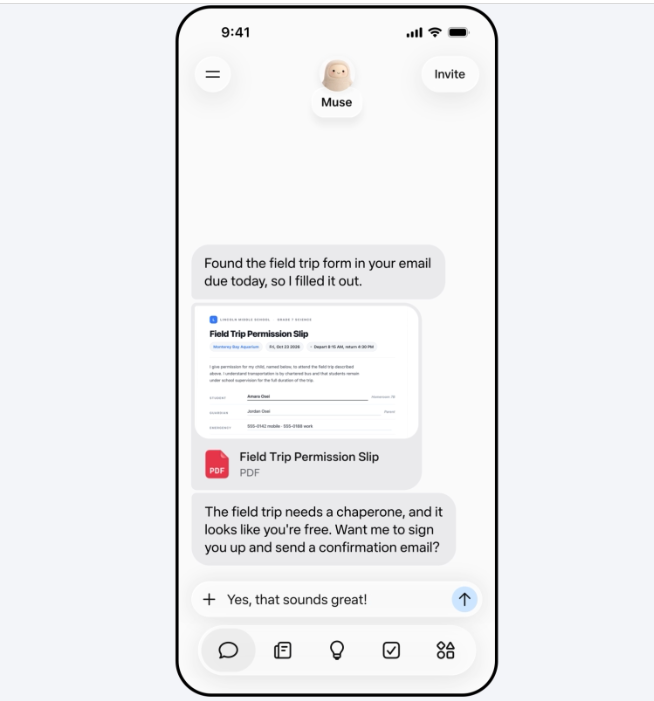
The social media giant today announced Muse, a personal AI agent that people can communicate with through a dedicated app and get it to automate digital tasks. It lives in a secure cloud environment, and the company assures users that privacy is “built in” to the agent’s core.
The Muse app is launching in the U.S. today on iOS and Android devices, and can also be accessed via the web through Muse.ai. As an alternative, users will also be able to message Muse through WhatsApp and interact with it from there.
And soon, those who own a pair of Meta’s AI glasses will also be able to access Muse from those devices. The agent is available for free for anyone to try, but those who want to use it to automate lots of different tasks will probably need to cough up for a subscription.
Muse has been in the works for quite a while. It’s an effort to compete against viral AI agents such as OpenClaw, Claw AI and NanoClaw. It works similarly, as users have to message the agent via an app to instruct it to perform different tasks.
The app was developed by Meta Superintelligence Labs, which is the company’s dedicated AI unit established about one year ago in an attempt by Meta to better compete with the likes of Google LLC, OpenAI Group PBC and Anthropic PBC. One of the reasons Meta founder and Chief Executive Mark Zuckerberg set up Superintelligence Labs is because he’s a big believer that AI agents will eventually become integral to people’s lives and change how they interact with the web.
Meta had been testing Muse internally as part of a project called “Hatch,” which saw various employees using the agent to operate third-party applications and browse the internet on their behalf. In a blog post, Meta explained that Muse has been designed with ease of use in mind and stressed that anyone should be able to start using it straight out of the box, with “no learning curve.” They’ll be able to prompt Muse to do things such as send emails, book flights and bus tickets, reserve a table at a restaurant, pay for things and even sell a car on their behalf.
Muse makes purchases via a new kind of payment infrastructure built by Stripe Inc. The tool is called Link, and for each purchase it will issue the agent with a single-use card number. The idea is that this means the agent won’t be able to access the user’s actual card details, so there’s no risk of this sensitive financial information being lost around the web. Link offers a number of purchase protections for agents, including guaranteed no-fee returns.
Secure by design, sort of
Though Meta isn’t the first to create a personal AI agent, it is trying to differentiate Muse, primarily through its privacy and security features. This might be a tough sell given Meta’s reputation and its recent legal issues, but the company wants to convince users that their data will be absolutely safe and secure with Muse.
That’s just as well, because Meta is asking users to give it access to far more information about themselves than apps such as Facebook and Instagram can see. To do its work on user’s behalf, Muse needs to connect to their email, calendar, financial, health and fitness, smart home apps and so on.
For that reason, Muse is built on a secure architecture that Meta calls Secure VM, which is designed to isolate the agent’s activity in a virtual machine. In a blog post, Meta’s vice president of Superintelligence Labs, Tarek Sheasha, said this helps ensure that any trusted data is kept away from the internet and the part of the agent that can actually take action on the user’s behalf.
Meta is also trying to convince people that it won’t go snooping into whatever data they upload to Muse or apps they connect it to. It has developed a tool called Sentinel that monitors everything that moves out of the user’s VM. It will either match that to an existing policy that has authorized that to happen, and if it can’t find a policy, it will then present the user with a notification, asking them to approve the action Muse wants to take. “The harness runs in its own isolated cell, it doesn’t see real credentials, and every interaction with the outside world runs through a Sentinel which the agent can’t override,” Sheasha explained.
However, users are still going to have to trust Meta itself to act appropriately. Though Meta’s policies don’t allow it to look inside user’s SecureVMs, it technically could do that if it wanted to, David Singleton, Superintelligence Labs’ vice president of engineering for consumer products, told Wired.
Still, Meta does plan to address this in a future update. Singleton said the company will later offer a version of Muse with a “Confidential VM,” where each VM runs in a trusted execution environment, for which users manage the security keys locally. That will prevent everyone, including Meta, from being able to access the VM.
Meta said users will be able to access Muse and use up to “100 million tokens per week” free of charge. With one token being equivalent to four characters, that should provide quite a bit of freedom to experiment with it before hitting a paywall.
Images: Meta
Support our mission to keep content open and free by engaging with theCUBE community. Join theCUBE’s Alumni Trust Network, where technology leaders connect, share intelligence and create opportunities.
- 15M+ viewers of theCUBE videos, powering conversations across AI, cloud, cybersecurity and more
- 11.4k+ theCUBE alumni — Connect with more than 11,400 tech and business leaders shaping the future through a unique trusted-based network
Are you an AWS customer? Support SiliconANGLE financially by buying your AWS services from our Marketplace portal page and links: https://siliconangle.com/aws-marketplace/
About SiliconANGLE Media
SiliconANGLE Media is a recognized leader in digital media innovation, uniting breakthrough technology, strategic insights and real-time audience engagement. As the parent company of SiliconANGLE, theCUBE Network, theCUBE Research, CUBE365, theCUBE AI and theCUBE SuperStudios — with flagship locations in Silicon Valley and the New York Stock Exchange — SiliconANGLE Media operates at the intersection of media, technology and AI.
Founded by tech visionaries John Furrier and Dave Vellante, SiliconANGLE Media has built a dynamic ecosystem of industry-leading digital media brands that reach 15+ million elite tech professionals. Our new proprietary theCUBE AI Video Cloud is breaking ground in audience interaction, leveraging theCUBEai.com neural network to help technology companies make data-driven decisions and stay at the forefront of industry conversations.