

In the past several years, when I coach clients, I’ve started integrating the “Creativity Quotient” into the strategic planning process. It’s not a new concept, but it’s one that’s often overlooked because, to shorten the time for strategic planning, we standardize the process, so many leaders are tempted to skip it.
They simply freeze and start using more data, more jargon, and normally it brings a much longer list of actions they must conduct that simply become unmanageable. Then it’s normal for them to point out that the strategy is the biggest culprit for strategic failure.
So, I decided to write this article to explain what the Creativity Quotient is and why it’s the missing element in strategic planning.
There is a specific kind of leader I have been seeing more of lately.
They are not incompetent. They are not lazy. Also, they show up to every meeting, they review every dashboard, and they can walk you through a 60-slide deck without breaking a sweat.
But here is the tell: watch what they add.
When pressure mounts and uncertainty rises, which is normal for the time we are living in, they do not make a decision. They simply add another data point. Another slide. Another row in the action log.
The language gets thicker — more jargon, more caveats, more “let’s circle back on this.” I call this “Wait & Watch” strategizing, and it is spreading fast. This is one of the reasons I have developed the strategy document language-clarity matrix.
It looks like diligence. It feels like thoroughness. But it is not.
It is simply what happens when a leader confuses gathering information with doing the work. Also, it is motion, not action. It is input without output.
And here is the uncomfortable truth beneath it: we cannot predict the future with 100% accuracy. No amount of data will give you that.
You can hire the best analysts, commission the deepest market research, and build the most sophisticated forecasting models. You will still be wrong about something. Probably several things.
The “Wait & Watch” leader sticks to what feels safe. They keep collecting information, hoping that the next report, trend line, or consultant’s framework will finally reveal the right answer.
In any moment of decision, the best thing you can do is the right thing, the next best thing is the wrong thing, and the worst thing you can do is nothing.
Theodore Roosevelt
However, it won’t. Because the code was never meant to be cracked. It was meant to be explored.
What is missing from most strategic planning processes is not more analysis. It is not more intelligence. It is a different kind of intelligence entirely — one that most organizations treat as decoration rather than the engine.
I call it the Creativity Quotient.
When I say “creativity,” I am not talking about artistic talent. I am not talking about brainstorming sticky notes on a wall. I am not talking about hiring a design agency to make your strategy deck look beautiful.
The Creativity Quotient is something more precise: it is the capacity to see new connections between existing elements, and to act on those connections before you have all the data.
Think about it this way.
Every business is a system with stored potential energy. You have assets, people, relationships, knowledge, brand equity — all sitting there, holding the capacity for doing work.
But potential energy is not output. It is not shipped value. It is just potential.
The Creativity Quotient is what helps you converts that potential into something kinetic. It is the mental spark that looks at two separate capabilities and says: “What if we combined these?” It is the willingness to run a small experiment instead of commissioning another market research report. It is the discipline to say: “We have enough to move. Let’s move.“
Most leaders today are fluent in two quotients.
IQ — analytical intelligence, the ability to process data, spot patterns, and optimize. EQ — emotional intelligence, the ability to read people, influence, and build trust. Both are necessary. Neither is sufficient.
CQ is the third leg. And it is the one that gets left outside the planning room.
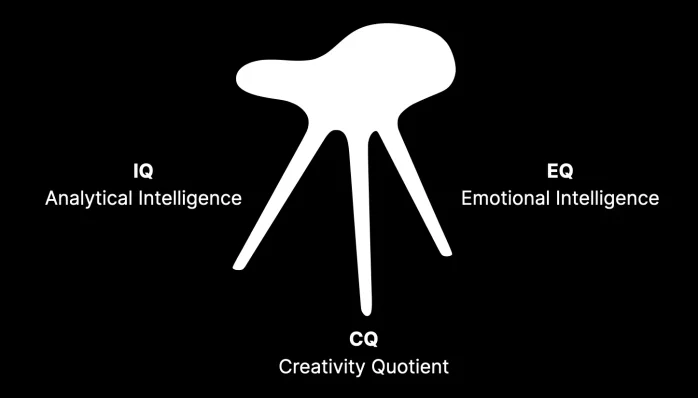
Why?
Because creativity is messy. It does not produce a neat spreadsheet. It asks questions that do not have answers yet. Also, it makes people uncomfortable — especially the people whose job it is to manage risk.
In many companies, where certainty is valued and ambiguity is discouraged, creativity can seem risky.
However, things are changing. When the future is unpredictable, creativity is not just a nice extra—it is the most genuine way to deal with uncertainty.
You cannot forecast your way to a breakthrough. You can only explore, test, and adapt. CQ is what makes that possible.
Logic will get you from A to Z; imagination will get you everywhere.
Albert Einstein
If you are still treating creativity as something you do at the annual offsite and then forget about for the rest of the year, you are not building a strategy. You are curating a museum of good ideas that never left your hard drive.
The strategic planning process is not one thing. It is a sequence of stages, each with its own logic, its own demands, and its own relationship to creativity.
When you compare the Business Strategy Canvas with CQ, you start to see a pattern. Creativity rises at certain points and fades at others. Most organizations miss this rhythm. They often use creativity where it does not help much and hold it back where it is actually needed.
Let me walk you through the six stages.
Stage 1: Vision & Purpose — The Highest-CQ Zone
This is where strategy begins. Before the spreadsheets, before the competitor analysis, before the action plans — you have to see something.
You have to imagine a future that does not exist yet.
This stage demands the highest possible CQ.
What do you see in the future? What unique way will your business make that future better?
These are not analytical questions. You cannot answer them by extrapolating last year’s numbers. You answer them by building scenarios, telling stories, and running design-thinking workshops — by generating pioneering ideas that are not bound by current limitations.
Most leaders skip this step. They start with last year’s plan and tweak the numbers. They call it “strategic planning.”
But, what they are really doing is momentum management. The vision gets reduced to a percentage growth target, and the bold future shrinks into a spreadsheet cell.
That is not vision. That is inertia dressed in a suit.
Stage 2: Market & Customer Insights — Creative Data Collection
Yes, analysis relies on facts. But choosing which facts to collect, and framing them once you have them, is a creative act.
The data on your own dashboards is comfortable. It is also incomplete — it tells you what happened inside your own world, not what is happening outside it.
The real insights live beyond your walls. In niche communities. In social media undercurrents. Also, in the complaints your competitors are ignoring. In the behavior of customers who left you and never told you why.
Collecting those signals takes creativity. It takes the willingness to look where the data is messy, unstructured, and human.
If your entire market intelligence comes from the same three dashboards you looked at last quarter, you are not researching. You are confirming.
Stage 3: Competitor Landscape — Reframing, Not Ranking
A standard SWOT analysis is a ranking exercise. Strengths, weaknesses, opportunities, threats — check, check, check, done. It tells you where you stand.
However, it does not tell you where you could go.
CQ at this stage means reframing. Reverse-engineer a competitor’s success: what assumptions did they make that you didn’t?
Imagine a startup entering your market with zero baggage — what would they attack first? What would they ignore?
These exercises do not produce a single “correct” answer. They produce new angles. And new angles are where competitive advantage lives.
Stage 4: Key Activities & Capabilities — Resource Reimagination
Most businesses have resources they aren’t using to their full potential. Sometimes, skills developed for one job could help in another area. Partnerships might just be routine when they could actually drive real change. And often, useful technology goes unused while people worry about costs.
This stage is not about listing what you have. It is about reimagining what it could become.
Combine. Repurpose. Borrow from another industry.
The highest-density energy in your business is rarely where you think it is. Your job is to find the uranium instead of the coal.
Stage 5: Value Proposition — The Second CQ Spike
Here your Creativity Quotient should spike again, hard. This is where you reimagine the value you deliver in ways competitors have not thought about yet.
Try using empathy maps and work together with your customers. Focus on creating offers that connect with people on an emotional level, not just a practical one.
What sets a brand apart from a commodity is rarely the product itself. It’s the story you build around it. Stories come from creativity, not from spreadsheets.
If your value proposition sounds like everyone else’s — “we deliver quality solutions with exceptional service” — you have not applied a single unit of CQ.
Run it through the “So What?” test. If the answer is silence, go back to the drawing board.
Stage 6: Metrics & Execution Plan — Flexible Creativity
This is where most strategy documents die.
They become rigid. They lock you into a quarterly plan that was out of date the moment it was signed.
At the execution stage, CQ is about creating roadmaps that guide you in the right direction without locking you into a fixed path.
You know where you want to go, but you do not assume you have every step mapped out. You allow space to try new things. Also, you set up feedback loops to spot new opportunities, rather than penalizing changes from the original plan.
Treat your execution plan as a living document, not a finished one.
The leader who adapts faster than the market shifts wins. The leader who clings to a frozen plan loses — slowly, then all at once.
Here is the mistake most teams make: they treat creativity as a one-off event.
You have the “brainstorming session” at the beginning. You fill the whiteboard with ideas. Also, you feel energized. And then you switch fully into execution mode for the rest of the quarter, as if creativity was a box you checked and can now forget.
That is not how CQ works. That is how you kill it.
The real skill is not a single burst of creativity. It is the rhythm — alternating between two modes at every stage of the process.
Divergent thinking is generation. It is the phase where you expand. You ask: what else? What if? Why not?
You suspend judgment. You let ideas collide.
Here, quantity matters more than quality here because the goal is to break out of the obvious.
To have a great idea, have a lot of them.
Thomas A. Edison
The first five ideas are usually the ones everyone already has. The sixth, seventh, and eighth are where the real signal lives.
Convergent thinking means making choices. This is the stage where you narrow things down. You ask yourself what matters most, what fits your resources, and what really makes a difference.
Here, you use your judgment, set priorities, and make decisions. The goal is not to limit creativity, but to guide it in a clear direction.
The process works like this: expand, then contract. You repeat this at every stage, not just at the start.
This approach helps you explore new ideas without losing your way. First, you come up with enough options to avoid the obvious, then you narrow them down so you can move forward.
The leader who masters this rhythm never gets stuck in “Wait & Watch.” They are always moving. But they are moving in the right direction.
Let me say something directly. “Wait & Watch” feels safe.
I get why leaders tend to do this. Collecting more data seems like the responsible thing to do. Asking for another round of analysis appears thorough. When the future is unclear, nobody wants to be blamed for making the wrong choice.
Here’s what “Wait & Watch” really costs you: time. In a changing market, time is the one thing you can’t get back.
Strategic exploration isn’t just guessing. It’s not about tossing out ideas and hoping for the best. Instead, it’s a focused way to learn and grow.
You run small experiments. You define clear feedback loops. And you commit to shipping something — a prototype, a pilot, a minimum viable offer — and you watch what happens. Then you adjust.
This is the difference between exploration and hesitation.
The explorer says: “I don’t know the answer, so I am going to run a test that teaches me something.” The hesitator says: “I don’t know the answer, so I am going to wait until I do.“
The explorer gets smarter every week. The hesitator gets older.
You must include testing in your regular planning. But the question is: how?
Every three months, ask yourself three questions. First: What is the one assumption we are making that might be wrong? Second: What is the smallest version we can deliver? Third: What sign will show us whether to keep going or change direction?
This is not about abandoning rigor. It is about redirecting it. Instead of spending your rigor on trying to predict the unpredictable, spend it on designing experiments that produce real learning.
The goal is not to be right. The goal is to be less wrong, faster, than your competitors.
The businesses that thrive in uncertainty are not the ones with the best forecasts. They are the ones with the best feedback loops.
And feedback loops are built with creativity, not spreadsheets.
The goal is not to become a more creative person. I am not asking you to take up painting or start journaling.
The goal is simpler and harder: build a strategic planning process that requires creativity at every step.
The other option—filling up with data, jargon, and action items that never get implemented—is not strategy. What I refer to as creating a museum of good ideas that never leave your hard drive. It is merely motion rather than actual action. It is input without any output. And it is the Busyness Paradox in its most hazardous form: high levels of busyness, low productivity, and the false impression that you are carrying out the work.
The Creativity Quotient is what turns the museum into a factory. It is the conversion mechanism. And it is what takes the stored potential energy in your business — your people, your assets, your insights — and transforms it into something that lands in someone else’s hands.
It is impossible to predict the future with complete accuracy, nor can anyone. However, it is possible to create a process that allows you to examine it more quickly than your competitors. You should alternate between divergent and convergent thinking at each stage, regard your strategy as a living document rather than one that is final, and give up on waiting for certainty to begin delivering value.
Here’s the thing concerning the ‘Wait & Watch’ leader: they aren’t incompetent when it comes to strategy. Instead, they fear it. Because they’re afraid of making a mistake, they never take a stand. Since they’re afraid of the unknown, they continue to collect data, even though it will never be sufficient.
The bold leader — the one with a high CQ — is not fearless. They are just willing to learn in public. They run the experiment. Also, they ship the prototype. They adapt when the signal tells them to.
Stop curating a museum of options. Start shipping a strategy.