

A founder builds 47 projects and still cannot pay rent. I was so shocked when I saw this with my own eyes. It’s a digging-holes trap.
Yes, forty-seven. You read it right!
If you put all the domain names, mockups, half-finished business plans, and abandoned GitHub repos into one folder, it would probably weigh more than a brick.
If you printed out all the outlines, pitch decks, and landing pages that never got any visitors, you could cover the walls of a small office. Those 47 tries took thousands of hours, with late nights and weekends given up along the way.
Conversations with friends and family where you explained, with genuine excitement, what you were about to ship.
And yet, none of it converts. None of it funds the next thing. None of it climbs.
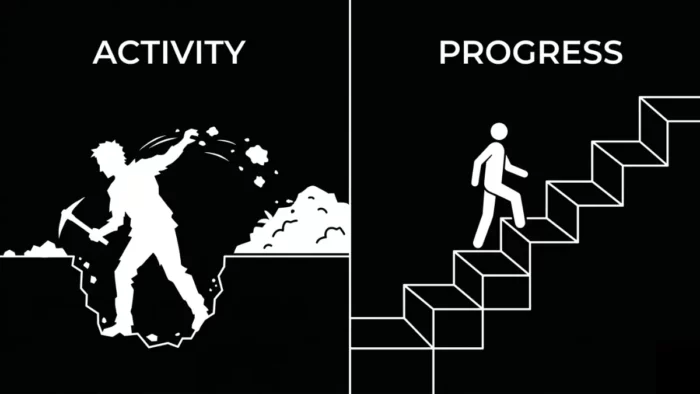
This is not a hustle story. I call this hole-digging.
A hole looks productive while you are in it. The dirt is flying. You are sweating. Your shovel is sharp.
From the outside, it even looks like someone with a strong work ethic.
But when you finish one hole, you walk five feet to the left or right and start another one. Same diameter. Same depth. Same dirt. Same result: a hole.
And at the end of the year, you have a field full of holes and nothing to stand on.
Here is the part nobody warns you about.
When you have dug forty-seven holes, you do not just have forty-seven failures. You have something worse. You have forty-seven pieces of evidence that you worked hard.
And that evidence makes it harder to admit the truth, because if you were working that hard, how could it possibly be the wrong thing?
Most founders I talk to do not actually believe they are unfocused.
They think they are productive. They show off how much they have done, and at first glance, it seems impressive.
“Look at all these projects.”
“Look at all these ideas.”
“I shipped again this week.”
They mistake activity for real progress, and this mix-up feels safe because it allows them to keep starting new things.
Never mistake motion for action.
Ernest Hemingway
Starting is the cheapest drug in entrepreneurship. It costs nothing to open a new document, register a new domain, or sketch a new vision on a whiteboard.
The dopamine arrives instantly.
You feel like a creator again. You feel like you are building.
But volume without direction is just excavation. You are not building. You are digging holes next to each other and calling it momentum.
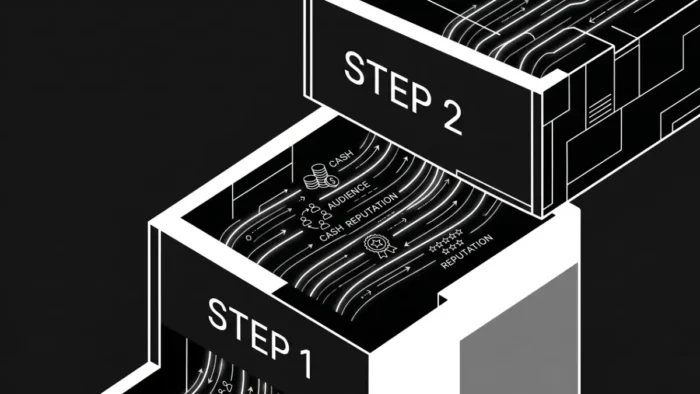
The Staircase Strategy exists because of this exact trap. A staircase works only when each step holds weight and leads directly to the next one.
You do not build step one, then walk across the yard to build step two in fresh dirt. You get to step two on top of step one. And step three on top of step two.
The climb compounds. The structure earns its height.
A hole does none of those things.
A hole is a project that begins from zero, consumes resources, and leaves behind nothing load-bearing.
You cannot stand on it. You cannot climb from it. You just dig, finish, and walk away. And because the hole looked productive while you were digging it, your brain gives you full credit for the effort.
You close the day tired. You tell yourself you grinded. But what did you actually build?
A depression in the ground.
Peter Drucker said efficiency is doing things right. Effectiveness is doing the right things.
The hole-digger is extremely efficient. He digs clean holes. Perfectly round. The edges are crisp. If there were a competition for hole-digging, he would place.
But he is not effective. He is digging the wrong holes in the wrong sequence, and he mistakes the sweat for progress.
The cost of this confusion
The cost of this confusion is not just financial, though that part is real. The cost is also temporal and psychological.
Every hole you dig steals capacity from the staircase you could have been building.
You only have so many hours. So much energy. So many moments of genuine creative momentum before burnout arrives.
When you spread that finite capacity across 47 disconnected projects, each one gets a thin, useless slice. None of them get enough weight to become load-bearing.
This is the Busyness Paradox in its most dangerous form.
High busyness plus low output.
Maximum energy expenditure with minimum structural gain.
You are not lazy. You are the opposite of lazy. You are exhausted.
But exhaustion is not the same as achievement, and the hole-digger learns this lesson the hardest way possible: by arriving at the end of another year with nothing to show except more holes.
Here is how you tell which one you are doing. Not someday. Not after the next launch. Right now.
Symptom 1: Every project starts from zero.
A staircase project picks up where the last one left off.
It inherits the audience you built. The cash you banked. The reputation you earned. The operational knowledge you gained from actually shipping, not just planning.
A staircase project does not ask you to reintroduce yourself to the market. It does not require a new brand, a new narrative, a new justification for why this time is different.
A hole project starts fresh. New name. New audience. New value proposition. New everything.
You are back at square one, digging into cold earth, pretending the previous hole never happened.
If your projects do not share a foundation, you are not building. You are excavating.
Ask yourself: Does this next project sit on top of what I just finished, or does it sit in the empty dirt next to it?
If the answer is dirt, put down the shovel. You already know how this one ends.
Simply, as a staircase builder, you understand that the hole-digger resists a truth: you do not get credit for starting over.
The market does not care how many times you have begun. It only cares what you have finished that holds weight.
Every fresh start that does not inherit something from the last project is a confession that the last project did not earn its keep.
Symptom 2: You measure input, not output.
When someone asks how things are going, the hole-digger usually talks about what they’ve been doing:
“I launched four or five things this quarter.”
“I am working on a totally new project.”
“You should see my task list.”
The list is long. The list is impressive. The list is a museum of good intentions.
The staircase builder lists outcomes. Revenue grew. Retention improved. Customers stayed and brought friends.
The step held weight, so the next step is possible. The staircase builder can point to one number and say, ” Is that number higher because of what I built last.
Busyness is input, not output. The question is not how many projects you started. The question is not how many hours you logged.
The question is whether any of what you built became a platform for the next thing.
If the answer is no, you just completed another hole. You dug it beautifully. But it is still a hole.
Here is a test I call the “So What?” test.
Look at your last three months of work. Go through each project. For each one, ask: so what?
- Did it produce revenue that funds the next step?
- Did it build an audience that carries forward?
- Did it create a reputation that opens doors?
If the honest answer is “I learned something” or “it was good practice,” you are describing a hole.
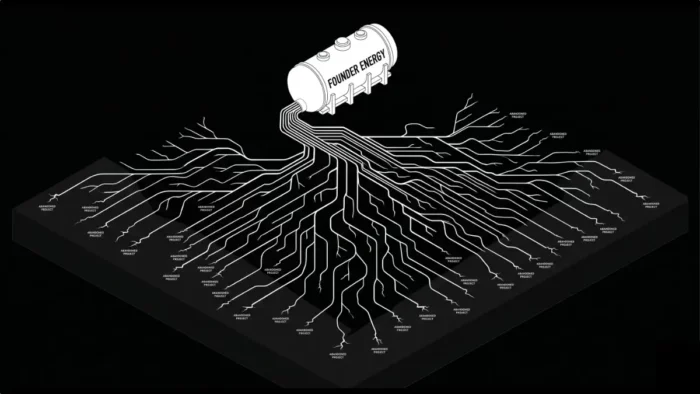
Learning is real, but learning is not a staircase. Learning is the consolation prize you give yourself when the project did not become load-bearing.
Symptom 3: You treat every idea as a mandate.
This is the symptom that separates the hole-digger from everyone else.
The staircase builder kills most ideas. He knows that every new project is a bet against the current one. He knows that focus is not the ability to say yes to the right thing.
Focus is the ability to say no to dozens of things that are genuinely interesting. Good ideas die so the best idea can live.
People think focus means saying yes to the thing you’ve got to focus on. But that’s not what it means at all. It means saying no to the hundred other good ideas that there are.
Steve Jobs
The hole-digger treats every idea like a summons. An insight arrives in the shower, or during a morning walk, or at 2 a.m., and instead of capturing it in a notebook and returning to the staircase, he drops the shovel, walks to a new patch of dirt, and starts digging.
He cannot say no because starting feels like winning.
A new project feels like a fresh identity.
For a few days or weeks, he is not the founder of a project that is stuck. He is the founder of a project that is about to take off.
But starting is not winning.
Starting is the cheapest thing you can do. Anyone can start. Starting requires no proof, no audience, no revenue, no durability.
Finishing something that actually carries weight — that requires everything the hole-digger is avoiding.
The hole-digger confuses the dopamine of a new beginning with the discipline of a completed staircase.
One feels like motion. The other is motion.
If hole-digging is so clearly destructive, why does anyone do it? Why do smart, talented, hardworking founders spend years digging craters in a field?
The answer is uncomfortable. Hole-digging protects you from the one thing that scares you more than failure: being judged on a single thing.
When you have 47 projects, no individual failure can define you.
If someone asks how project 17 is doing, you can pivot the conversation to project 24.
If project 8 dies quietly, there are 39 others to point at.
The portfolio is your shield.
You are not a founder who failed. You are a founder with a diverse pipeline. You are prolific. You contain multitudes.
The staircase builder does not have this protection. He has one thing. One audience. One reputation. One bet.
If the staircase collapses, he has nowhere to hide. The judgment is direct and final. That vulnerability is terrifying, and the hole-digger has built an entire operating system to avoid it.
But here is what the staircase builder understands that the hole-digger does not.
One thing that works is worth more than 47 things that don’t.
One load-bearing step creates genuine optionality, because it funds the next one. A field of holes creates nothing but a story you tell yourself about how busy you have been.
The vulnerability is the price of the outcome. You do not get the staircase without standing on one step and letting it be judged.
Here is what nobody tells you about the moment you recognize you have been digging holes.
It is humiliating.
You look at the field. You count the craters. You add up the months and the years.
And for a brief, painful moment, you want to defend it. “But I learned so much.” “But those were necessary experiments.” “But the skills compound.”
Maybe so.
But you can’t pay your rent with lessons you’ve learned.
Your landlord doesn’t care about the GitHub project you stopped working on back in March.
The market doesn’t value options that never turn into real results.
You can’t live off a collection of half-finished projects.
The founder’s job is not to stay busy. The founder’s job is to make the current step load-bearing.
That means one project that funds the next one. One climb that earns the height. One staircase instead of forty-seven holes.
It means killing the ideas that feel exciting but sit in fresh dirt. It means pouring concrete on top of what you already built, even when a new patch of ground looks more fun to dig.
It means accepting that the dopamine of a new beginning is not the same as the discipline of a finished staircase. One feels like progress. The other actually is.
If you are sitting on a portfolio of projects and none of them pay for the next one, you are not an entrepreneur with too many ideas. You are a hole-digger.
And the only way out is to stop digging and start stacking.
Pick one step. Not three. One.
The successful warrior is the average man, with laser-like focus.
Bruce Lee
The one that already has some weight under it — some audience, some revenue, some reputation. Pour everything you have into making it load-bearing.
Let it cure. Do not touch a new patch of dirt until this step can hold the next one.
Then pour the next step on top of it. Everything else is just a field of holes. And you have dug enough of those for one lifetime.