

The most expensive habit I ever had cost me nothing to start.
Wake up. Reach over. Unlock. Scroll. Emails first, then notifications, then whatever the algorithm decided I needed to see before I had even stood up.
I told myself I was being responsive. A founder has to be on top of things.
I was not being responsive. I was being consumed.
And my revenue proved it. It sat flat for two years while I stayed busier than I had ever been. I was clocking more hours and producing less output than at any point in my career.
The math did not add up, and the math always adds up eventually.
The shift became real the month I stopped tweaking the dashboard and spent four hours sketching the strategy for my next big thing to define the right priorities and then spend each day 4 hours working on them, one by one, from top to bottom.
That strongly focused work session led to a 30% jump in revenue in only three weeks. For the first time, I could clearly see how setting aside a quiet morning led straight to a closed deal. It ended two years of no growth.
Here is what I missed: the day is not neutral. It is a predator.
Every notification, every email, every message, every “quick check” of the feed — these are not interruptions to your work. They are the work of someone else, inserted into your morning before you have done a single thing that moves your business forward.
If you don’t prioritize your life, someone else will.
Greg McKeown
The phone in your hand at 6:47 AM is a revenue leak disguised as diligence.
I call this the First Four Hours Rule.
It is simple to describe and brutally hard to execute: the first four hours of your day belong to one thing. One high-density move. One piece of work that, if completed, pays for the rest of the day.
Not three things. Not “top priorities.” One.
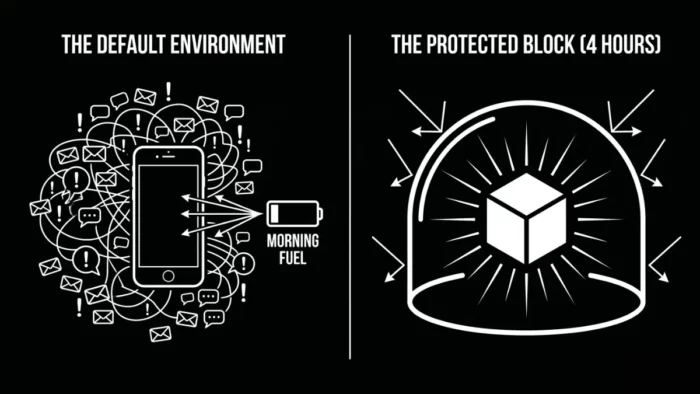
Most founders I talk to have the same morning script.
They wake up, grab the phone, and spend the first hour responding. They clear the inbox. They answer the DMs. They check the metrics dashboard. By 10 AM they have done forty small things and zero large ones.
And they feel productive. That is the trap.
This is what I call the Busyness Paradox in its purest form: high busyness, low productivity (the treadmill).

The most dangerous quadrant because it feels exactly like work. You end the day exhausted, look back, and cannot name a single thing you shipped.
You were in motion all day. You never took action.
Never mistake motion for action.
Ernest Hemingway
The phone is the delivery mechanism for this trap. It hands you a stream of inputs that all feel urgent and are almost never important. It convinces you that responding is the same as building.
It is not.
Here is how I think about it now.
Every morning, you wake up with a fixed amount of cognitive fuel. Call it your energy density for the day.
You can spend that fuel on high-density work — the kind that creates new revenue, ships a product, writes the proposal that closes a deal.
Or you can spend it on low-density work — the kind that clears notifications, answers questions that could wait, and makes you feel busy without moving the needle.
The uranium or the coal.
When you reach for the phone first, you are choosing the coal. You are burning your best fuel on inputs designed by other people, for other people’s priorities. By the time you get to your own work, the tank is half empty.
The First Four Hours Rule is the fix.
It says: before the world gets a vote, before anyone else’s agenda enters your day, you do the one thing that would make the biggest difference if it were finished by noon.
You do not need motivation to do this. You need a system. Here is what works.
Step one: the phone does not exist before noon.
Not “I’ll check it quickly.” Not “just the important ones.”
The phone stays on the other side of the room, on Do Not Disturb, screen-down.
If someone needs you urgently enough to justify breaking your protected block, they have your number. They can call. Everything else can wait four hours.
I can’t say it felt safe. My business depended on me being the founder who always replied within minutes. Just thinking about a client needing me during those four hours made my stomach drop.
My fear was clear. If I missed one urgent message, I could lose a deal and my reputation for reliability could quickly turn into a story about the guy who disappeared.
What I learned?
Here’s what I found out when I finally tried it. If a client leaves because you took four hours, they were already looking for an excuse.
The clients who stay respect your boundaries. You teach them to expect quality work at noon, not rushed results early in the morning.
If you need a concrete worst-case to hold onto, here is one day how it looked for me:
- I get an email from the client with a question at 7:00 AM.
- I get the same email at 7:30 AM by the same client with the large word “URGENT” in the subject line.
- I get the same email at 8:15 AM from the same client.
- I get a WhatsApp message from the same client at 8:30 AM.
Then, my mind’s focus shifts to the client’s needs, and I respond to the email at 9:30 AM. I leave my priority-one task for the moment to respond, and when I try to come back to it later, I find it much more difficult because I have already lost the flow.
And simply, it taught me that the cost of being always-on was higher than any single missed notification.
Other people crisis
If you have a boss who expects a reply by 7:15 AM or a client whose crisis is your crisis, four hours disconnected sounds like a fantasy.
I’ve experienced both roles, working as a founder and as an employee.
The approach can change.
Try moving your focused work time earlier—starting at 4:30 AM is tough, but it gives you two quiet hours before notifications begin. You can also ask your team for a clear block of protected time. Most people will agree if you explain it as the hours when you deliver what they need.
Another option is to set aside a single ninety-minute period with your phone out of reach.
When I missed this rule in a past job, I simply burned out. I was responding all morning and still failed the one deliverable that counted.
It is obvious that the principle survives. The exact hours and the agreement around them change.
The scaling of the rule
The rule scales more naturally than it appears at first.
If you’re working alone, it’s easy to set aside a solid four hours in the morning since you don’t have anyone waiting for your input.
But when your team grows to around ten people, you might break up that time—spending two hours working on your own before a morning meeting, and another two hours after lunch while everyone is focused on their own tasks.
If you are a founder managing the sales pipeline, try moving your protected time to match a key prospect’s time zone or set aside a fixed ninety-minute block between calls. This way, you keep your focus time without hurting your deal flow.
A founder I know who leads a team of more than twenty people split his day into two focused two-hour work sessions that fit around when his team was available. On the other hand, a solopreneur I worked with kept her full four-hour block for deep work and taught her clients to expect replies from her after noon.
Another founder I worked with set aside 9 to 11 PM after his kids went to bed and treated that time as seriously as a morning routine. Another made the most of the two hours before a 9 AM standup, then used ninety minutes after it, and still finished his deliverable by the end of the week.
You must remember that the shape changes; the non-negotiable stays the same.
When a standing 8 AM client call or daily team standup cuts into the block, shift the high-density move to the evening or split it into two two-hour pockets anchored around the interruption.
The key is naming a non-negotiable window and defending it with the same ferocity as the original rule, even if the clock says midnight instead of 5 AM.
This will feel wrong for the first week.
You will feel anxious. You will wonder what you are missing. That anxiety is the withdrawal symptom of a trained compulsion, not a signal that something important is happening. Push through it.
Step two: identify the one high-density move the night before.
Do not wake up and ask yourself what to work on.
That question is a trap. It burns your first ten minutes in deliberation, opens the door to the phone (“let me just check if anything came in”), and usually ends with you doing whatever feels easiest.
Instead, end every day by writing down one thing.
One move. The single piece of work that, if completed tomorrow, would make you feel like the day was won.
Not a category like “work on marketing.”
An exact action: “draft the launch email for the new offer.” “Finish the financial model for Q3.” “Record the first draft of the webinar.”
But how do you know that this exact action is the right one, especially when everything feels equally urgent?
Things which matter most must never be at the mercy of things which matter least.
Johann Wolfgang von Goethe
Use a two-question filter: Which move, if finished, makes the others smaller or unnecessary, and which one will you most regret not doing at 5 PM?
Working on this site 5 years ago taught me that picking the ‘safe,’ busy task feels like progress but leaves the real money unmade.
So, now I check (second question): am I avoiding this because it is hard, or because it is truly lower-leverage?
If the answer is fear, you have your high-density move.
The week I let it slide, my Tuesday began with a blank page and an open inbox. I spent the morning jumping between small tasks and by 11 AM, I still hadn’t finished anything.
Not knowing what to focus on made me more anxious than a bad night’s sleep. By the end of the day, nothing had changed on my dashboard, and I felt like I had missed what mattered most.
Some founders say they do their best thinking late at night. But really, writing things down in the evening is not about thinking—it is about passing the work to your future self.
You do the deep thinking, then if you like, but you must leave a one-line instruction for your morning self, because that self wakes up cognitively depleted and will negotiate with the phone.
When I write it down the night before, I walk into the block already aimed; when I do not, I spend the first hour wandering, and on the worst days, the block never actually starts.
If your best ideas arrive when you are not aiming at all, the evening write-down still earns its keep: it catches them.
When you stumble onto a sharp angle while scrolling LinkedIn at 8 AM, scribble it into the note you left yourself the night before.
That note acts as a guide, not a restriction. I added a lost insight to my morning block by placing it right below the main instruction, so I can work on it during my focused time.
Deep thinking can happen anywhere and anytime.
The rule just makes sure it lands somewhere you will actually use it.
Specificity is the difference between motion and action.
Step three: execute before the world wakes up.
I start at 5:30 AM. Not because I am a morning person — I am not.
I start then because the world is quiet. No one is emailing. No one is posting. No one is asking me for anything.
It is the only window in the day where my attention is entirely my own.
I do not roll out of bed and into the chair.
The first ten minutes after I wake up belong to a ritual so boring it feels stupid to mention: I fill a glass of water, step outside onto the back porch in the dark, and just stand there breathing till the cold hits my lungs.
That little jolt is what helps me move from sleep to the screen. It stops me from starting the day still half-asleep.
Even on days when I feel sick or totally drained, I still show up. If I have nothing by 9:30, I just write one bad sentence. That’s all. The rule is to spend four hours, not to make them perfect.
Four hours from 5:30 to 9:30. That is the protected block.
By the time most people are opening their inbox, my most important work is done. The rest of the day can be reactive and it will not matter, because the one move that pays for the next step on the staircase is already behind me.
Step four: let the rest of the day happen.
This is the part that surprises founders when I tell them.
The goal is not to protect the entire day. The goal is to protect four hours.
After that, you can answer the emails. You can take the calls. You can check the metrics and reply to the DMs and do all the things that feel like work.
You can afford to, because the high-density move is already shipped.
Step five: repeat until it becomes identity.
The first month is discipline.
You are fighting a habit that you spent years strengthening.
Every morning your hand will reach for the phone out of muscle memory. That is fine. Notice it. Put it back. Do the work.
By month three, something shifts.
You stop feeling anxious without the phone. You start feeling anxious without the protected block.
The wall is no longer something you build each morning. It is just how you operate. It becomes part of who you are as a founder.
Most founders do not lose to bad strategy, bad fundraising, or bad talent. They lose to the default environment.
The phone. The inbox. The notifications. The Slack channels.
These are not neutral tools. They are engineered to extract your attention and sell it.
Every minute you spend inside someone else’s platform before you have done your own work is a minute donated to their revenue, not yours.
The founders who win understand this.
They build a wall before the sun comes up. They protect the first four hours because those four hours contain the only work that compounds.
Everything after that is maintenance.
That kind of compounding happens in real life too, not just in spreadsheets.
Once I set aside the first four hours for focused work, I no longer brought that nagging feeling of an unfinished day to the dinner table. I could really be with my kids instead of sneaking a look at my phone.
For founders who want an exit or just their life back, the real risk of burning your best fuel on the coal is waking up five years later with a fatter dashboard and a thinner everything else.
You cannot outwork the default environment. You have to wall it off.
Start tomorrow. Phone on the other side of the room. One move written down the night before. Four hours of protected depth before the world gets a vote.
That is the rule. It is simple. It will change everything.