

Have you ever wondered what happens when a tax law problem simply gets too big to handle alone? If you are staring at an unexpected notice from the IRS or a state Department of Revenue, you are not the only one feeling this weight.
Countless individuals and business owners experience a real sense of dread when tax letters arrive, or complex problems surface. The initial reaction is often to ignore the mail or hope the issue resolves itself, but hiding from tax authorities is a critical mistake.
The reality is that tax laws are a moving target—they are confusing precisely because they shift from year to year. In this highly complex regulatory environment, seemingly small mistakes on a return can quickly compound into severe, budget-shattering liabilities and legal problems if they are not fixed immediately.
Today’s tax system uses automated matching and predictive tools. If even one detail on your 1099 form does not match your tax return, you could quickly get a series of notices, interest charges, and penalties.
Expert tax law representation is designed to step directly between you and the audit letters. It helps you understand the complex rules, aggressively protects your legal rights, and makes otherwise overwhelming tax issues far easier to manage.
By reading this guide, you will learn exactly how a skilled tax attorney guides you through complex rules, disputes, and back-tax debts so you can finally reclaim your peace of mind.
Waiting until a tax problem gets out of control can be very expensive. If you bring in a legal expert early, you can stop small tax issues from turning into major financial problems.
A seasoned tax attorney can look over your financial records and spot potential audit triggers before they ever catch an auditor’s eye. Taking action early saves you massive amounts of time, money, and emotional stress down the road.
Imagine a fast-growing service company that expands from serving just one area to offering digital services in several states. The company may not realize it, but this move creates a “sales tax nexus” in five new states. As a result, they now have to collect and send sales tax in those places.
If they wait for state audits to catch up to them three years later, they could face hundreds of thousands of dollars in back taxes, interest, and failure-to-file penalties.
Conversely, a proactive review by a tax attorney identifies these liabilities early, allowing the business to leverage voluntary disclosure agreements to wipe out penalties and establish compliance seamlessly.
One thing must be clear: because every single tax profile is totally unique, a one-size-fits-all checklist will never work.
You need a strategy tailored entirely to your specific situation. When you bring a tax attorney onto your team, they will explain each complex step in simple words, answer your questions directly, and give you the clarity needed to make smart choices before problems grow. Ultimately, this early guidance gives you the confidence to move forward and solve tax challenges effectively.
It is really common to find yourself in a position where you do not agree with a tax agency’s assessment of the money you owe. These disputes usually arise from missing documentation, differing interpretations of messy tax regulations, or simple accounting mistakes
When an adversarial notice lands on your desk, attempting to debate the issue directly with a trained agent can be a recipe for disaster.
When a dispute arises, a tax attorney acts as your legal shield through every single phase of the process. Here is exactly how tax attorneys handle the heavy lifting:
- Building an Ironclad File: Experienced tax attorneys collect your financial records, analyze the gaps, and draft a technically precise, authoritative legal reply to the agency.
- Direct Advocacy: Tax attorneys step in to handle all direct communication and negotiations with tax officials so you don’t have to.
- Resolving the Friction: Experts work diligently to settle the issue out of court whenever possible, protecting your interests while saving you time, money, and administrative stress.
A tax dispute can drag on for months or years if it isn’t handled correctly from day one. Clear, expert guidance outlines exactly what to expect, taking the confusion out of the equation and steering the case toward a fair outcome that prevents future issues.
Behind the Scenes: How an Attorney Builds Your Case
When you retain an attorney for a tax dispute, the work begins long before any meeting with the government.
Building a winning defense case requires a highly systematic, forensic approach to your financial history and the specific claims made by the agency.
First, tax attorneys execute a comprehensive document matching phase. They retrieve your official IRS transcripts and cross-reference them with your primary source documents—such as bank statements, receipts, canceled checks, and general ledgers.
Government systems frequently rely on automated matching that fails to interpret complex transactions correctly.
For instance, if you sold a property, the IRS might record the entire gross proceeds as taxable income because the closing agent failed to report your original cost basis.
The tax attorney job is to reconstruct that basis forensically to prove your true tax liability is significantly lower or non-existent.
Second, they conduct an exhaustive legal audit of the agency’s calculations. Government auditors make mistakes.
They review their math, verify that they have applied the correct tax rates for the specific tax years in question, and check that they haven’t double-counted income items across different accounts.
Finally, they draft a comprehensive administrative protest or formal legal response.
This document is a formal legal brief that explains the facts, highlights any mistakes made by the agency, and refers to the Internal Revenue Code, Treasury Regulations, and U.S. Tax Court decisions to back up your case.
This forces the agency to evaluate your case under strict legal parameters rather than arbitrary internal assumptions.
Settlement Mechanisms: Staying Out of the Courtroom
The ultimate goal of most tax disputes is to achieve a binding resolution without incurring the astronomical costs and public exposure of a formal courtroom trial.
Usually, experienced tax attorneys leverage specified statutory instruments to work on resolving disputes directly with tax officials. They communicate with the IRS and state authorities using the exact frameworks outlined in the Internal Revenue Manual, enabling them to identify better alternative resolution pathways that standard accounting software simply cannot access.
The most powerful settlement tools include:
- Offer in Compromise (OIC): This program allows qualified taxpayers to resolve their total tax debt for a fraction of what they actually owe. However, the IRS doesn’t grant these out of generosity. A tax attorney must mathematically prove your “Reasonable Collection Potential” (RCP). By calculating your liquid asset equity and projecting your future disposable income using strict IRS national standards, they demonstrate that the government cannot realistically collect the full debt before the statute of limitations expires.
- Partial Payment Installment Agreements (PPIA): If you don’t qualify for a full settlement, they can negotiate an agreement where you pay a fixed, lower monthly amount based strictly on what your budget allows, while the remaining balance stays on hold until the collection window closes.
- Penalty Abatement: Often, a significant portion of a massive tax bill consists of compounding penalties rather than actual taxes. A tax law attorney build petitions for “Reasonable Cause” penalty relief, showing that life disruptions—such as serious medical crises, natural disasters, or reliance on erroneous expert advice—prevented you from meeting your obligations on time, wiping out thousands of dollars in fees.
The best way to protect yourself from a tough audit is to always stay proactive. You must keep up with changing tax laws to avoid specific financial penalties down the road. For individuals and families, this means filing your taxes on time, reporting your income correctly, and planning ahead to reduce the risk of penalties.
Experienced tax attorneys actively review your past records and translate complex new tax laws before you ever sign a filing form. This high-level support keeps you highly organized and empowers you to make better financial choices.
To read more about our specific compliance services, you can explore trusted IRS lawyers to see how they help clients stay protected.
The Value of Clear Documentation
Keeping clear, systematic tax records makes it simple to file accurate forms year after year.
Those clean records are your ultimate insurance policy if questions or audits come up later; forming simple documentation habits today completely eliminates massive vulnerabilities down the road.
Planning ahead ensures you always have the time required to meet strict deadlines confidently. A legal advocate spots these structural issues early, transforming what could have been a costly mistake into minor, easily managed adjustments.
Mitigating Cross-Generational Tax Risks
Wealth preservation goes beyond this year’s tax return. It means protecting the capital your family has worked hard to build over many years.
If you do not plan ahead, a large part of your family’s estate could be lost to unnecessary gift and estate taxes or mistakes made when transferring assets.
When a family works with a tax attorney, they look at how your assets will be passed down through generations. The attorney helps you set up gifting strategies that make the most of annual exclusion limits, so you can transfer wealth to your children or heirs without causing immediate gift tax issues.
The tax law attorneys use trusts, family limited partnerships, and other holding structures to help protect your main assets from future tax issues. With this careful planning, your wealth can pass to the next generation without being reduced by old state or federal tax rules.
Action Steps for Immediate Family Protection
If your household gets a notice or has past years with unfiled tax returns, it is important to act quickly and follow a clear plan. Use this checklist to help protect your finances:
- Create a Dedicated Notice File: Do not throw away envelopes or lose any pages of the letter. The specific code numbers in the top-right corner (e.g., CP2000, LT11) tell a tax law attorney exactly where you are in the IRS collection or audit cycle.
- Request Your Official Transcripts: Pull your wage and income transcripts directly from the IRS portal. This lets your legal representatives see exactly what information third parties have reported about you before they reply.
- Isolate Personal vs. Business Accounts: If you run a side business or a 1099 contract operation, immediately halt the practice of paying personal bills out of your business checking account. Commingling funds is the number one reason auditors disallow legitimate tax deductions.
- Secure Your Deadlines: Make sure to write down the exact “response required by” date from your letter. If you miss the 90-day window to petition, you could lose your chance to challenge the tax bill before you have to pay it.
If you run a business, your compliance burdens are exponentially higher.
Business owners must balance a mountain of annual tax duties—from managing payroll and sales tax records to accurately reporting corporate income and filing complex schedules on time. Missing only one of these steps can start crippling penalties and disrupt your company’s vital cash flow.
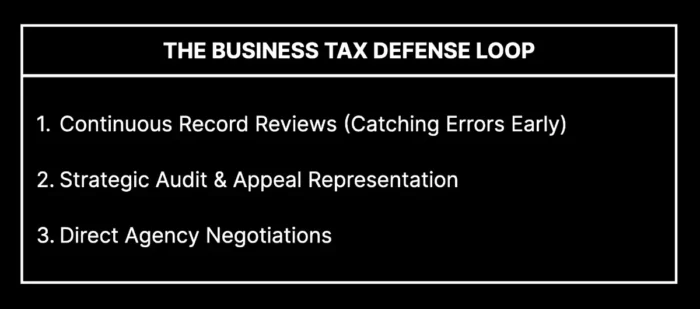
Skilled tax attorneys help businesses successfully navigate complex tax codes while managing live disputes.
If you are facing an audit, need help with formal appeals, or want someone experienced to talk to state and federal tax agencies on your behalf, legal support helps keep your business safe.
Regularly checking your records catches systemic errors before they morph into institutional disasters. This keeps your company’s finances in pristine order all year long.
Ultimately, a tax attorney provides custom advice tailored directly to your commercial goals, freeing you up to focus 100% of your energy on serving your customers and building a stronger future.
Corporate Compliance and Audit Defense
Keeping a business compliant with state and federal agencies can seem like a full-time job. While individual audits often look at specific things like charitable donations or W-2 errors, corporate tax audits review your entire operations and can be much more detailed and demanding.
One of the most dangerous battlegrounds for modern business owners is worker classification.
State agencies and the IRS aggressively audit companies that utilize independent contractors (1099 workers). If an auditor determines that you exercised significant behavioral or financial control over those workers, they can reclassify them as employees (W-2).
This reclassification triggers catastrophic retroactive liabilities for unpaid payroll taxes, unemployment insurance, and workers’ compensation premiums, going back several years.
A tax attorney defends your operational choices by drafting clear independent contractor agreements that strictly adhere to federal guidelines and presenting compelling evidence of independent operations during audits.
Additionally, tax law attorneys protect companies facing complex multi-jurisdictional and state sales tax issues. Since the landmark Supreme Court decision on economic nexus, businesses can be held liable for sales taxes in states where they have no physical offices or employees, based purely on transaction volume.
Tax attorneys build strong defenses during these multi-state audits, ensuring that state auditors do not overstep their boundaries or double-tax your revenue.
For more information on your rights under federal law, you can review the official IRS Taxpayer Bill of Rights.
Freeing Executive Focus for Growth
The true cost of a tax dispute cannot be measured solely by the dollar amount on the final settlement check; you must also calculate the severe drain on your company’s executive focus. When a CEO, CFO, or business owner spends 20 to 30 hours a week digging through historical archives, arguing with state auditors, or worrying about potential bank levies, the business halts its forward momentum.
Hiring an experienced tax attorney delivers a massive, measurable return on investment (ROI) by entirely offloading this cognitive and administrative burden.
Instead of your executive team acting as defensive coordinators against tax agencies, your attorney steps in as the primary point of contact. All phone calls, letters, and document requests go directly to the law firm. By separating these areas, owners can focus fully on their main business activities again.
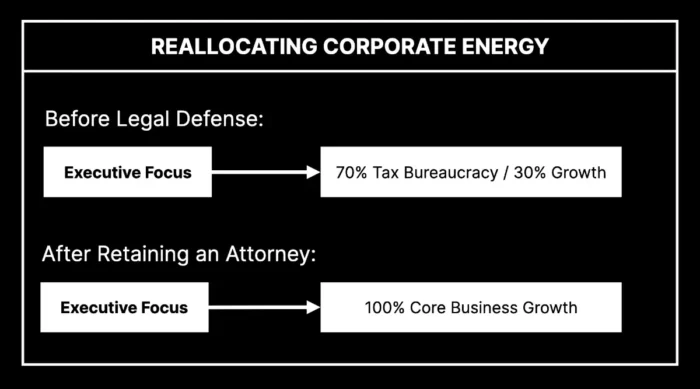
When you let a professional handle these complex legal tasks, your business can keep growing, reach more customers, and serve clients well without getting slowed down by tax issues.
Tax problems are deeply personal and frequently threaten family savings.
Many people realize they need legal backing only after receiving an aggressive tax notice or a formal audit letter. Others find themselves facing years of unpaid back taxes and require a structured way out.
A tax attorney breaks down your actual legal options and builds a simple, actionable path forward.
Whether you missed past tax deadlines, filed incorrect forms, or need help establishing sustainable payment plans, an attorney explains the situation clearly and structures the immediate next steps.
Overcoming Bank Levies and Asset Seizures
When tax liabilities go unaddressed for too long, the IRS or state agencies will transition from sending letters to taking aggressive collection actions.
This can include issuing bank levies, asset seizures, or filing public federal tax liens against your property.
A bank levy freezes the funds in your checking or savings account, and if it isn’t released within 21 days, the bank is legally required to send your money directly to the government.
A tax attorney has the legal authority to step in and halt these aggressive collection mechanisms. By immediately contacting the collections department, filing for an emergency Collection Due Process (CDP) hearing, or demonstrating that the levy creates an immediate, severe economic hardship, they work to secure a formal release of the levy.
This quick legal intervention protects your personal cash flow and buys the time necessary to negotiate a sustainable, long-term resolution without losing your family’s hard-earned savings.
Taking early, decisive action keeps collection actions from getting worse. Having an advocate who aggressively defends your family’s assets eases the immense worry of dealing with a powerful agency, giving your household the clarity needed to move forward with total confidence.
The legal advocate you choose can make a big difference in how your tax issue turns out. Look for someone with solid experience in tax disputes, regulatory compliance, and tax matters that affect your type of business.
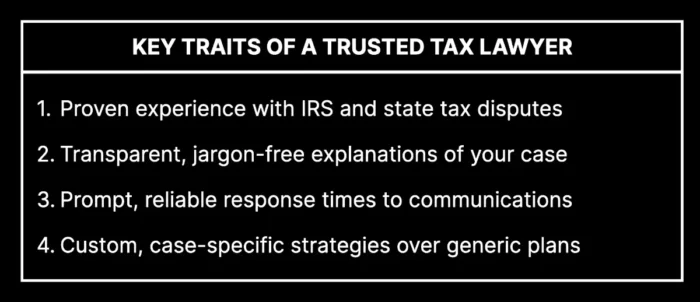
Many individuals and businesses specifically seek out trusted IRS lawyers because they understand the inner workings of hard tax cases.
A highly qualified professional takes the time to learn your unique situation, breaks down your options in straightforward language, and works tirelessly toward a fair outcome.
Essential Questions to Ask Before Retaining Counsel
When you meet with a potential tax attorney, feel free to ask clear questions to check their experience and see if they are a good match for your needs. Be sure to cover these important topics during your meeting:
- “What percentage of your legal practice is dedicated strictly to tax controversy and dispute resolution?” You want an attorney who specializes deeply in tax law, not a general practitioner who handles tax issues as a minor sideline.
- “Do you have direct experience negotiating with my local IRS appeals office or state Department of Revenue?” Local procedures can be different. An attorney who often works with local staff knows how those offices review cases.
- “Who will be conducting most of the work on my case, and how will I get updates?” You must ensure your main contact is a licensed attorney who takes your case seriously and responds to your questions quickly. When your lawyer is responsive, you can trust them more, stay informed, and feel less stressed about your legal situation.
Tax law problems don’t have to control your financial future.
Having an expert who will be on your side gives you a reliable safety net when facing disputes, audits, or legal responsibilities.
So, working with a professional tax law attorney can relieve your daily stress and protect your rights. Every tax situation is unique, but learning about your options now can lead to a better and more secure future.