

You are about to adopt another tool. You can feel the pull right now — a YouTube video, a LinkedIn post, a Substack roundup of “the 7 AI tools I switched to this month.” The current stack works fine. But this new one promises cleaner dashboards, fewer clicks, one-click automation that finally ties everything together.
You are one integration away from the life you pictured when you started this business.
But, in reality, you are not.
What you are doing has a name, and it is not strategy. I call it Organized Laziness.
Organized Laziness is the ritual of upgrading, migrating, comparing, and configuring — activities that borrow the vocabulary of progress so effectively they pass every internal gut check.
Optimization. Automation. Scale.
These words belong to the domain of real work. When you spend Tuesday afternoon migrating your project management from one platform to another, the language you use to justify it sounds like strategic thinking.
But the output tells a different story.
Nothing shipped. No customer received anything. No bottleneck was removed. You redecorated the workspace.
This is the trap. And it is the most dangerous trap in the current entrepreneurial landscape, because it is invisible to the person inside it.
Busyness registers as effort.
Configuration registers as improvement.
But neither one is output.
It is not enough to be busy. So are the ants. The question is: What are we busy about?
Henry David Thoreau
I want to go back again to when Peter Drucker said it decades ago: “There is nothing so useless as doing efficiently that which should not be done at all.”
He was not talking about AI tools. But he may as well have been.
A better dashboard does not fix a broken thesis. A faster automation does not compensate for a problem you cannot describe.
You can build the most elegant system in the world, but if the input is a fuzzy understanding of what your customer actually needs, the output will be elegant noise.
Here is what most people get wrong: they treat tool selection as a form of strategic thinking.
The market has trained them to do this. Every week, another creator publishes a stack reveal with screenshots and affiliate links.
The implicit message is clear — your results are bottlenecked by your tools. Upgrade the tools, upgrade the results.
This is not true. It has never been true. And the evidence is hiding in plain sight.
Let’s consider two founders I have worked with.
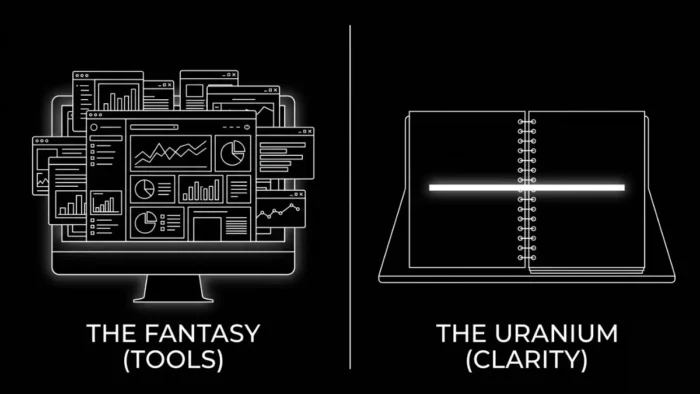
Founder A has the perfect stack.
Claude for reasoning. Notion for documentation. Make for automation. A custom GPT trained on their brand voice. A dashboard that visualizes every metric in real time.
Their setup cost them three weeks of evenings and a monthly subscription bill that looks like a car payment.
Ask them to describe the one problem their business solves, and they give you a ramble.
They mention their mission, their values, the market size, the tech stack. They cannot land the sentence.
Founder B has a notebook.
They sell a physical product through a Shopify store that has not been redesigned since 2022.
They do not use AI for anything beyond occasionally asking ChatGPT to rephrase a customer email.
Ask them to describe the one problem their business solves, and they say: “Small law firms lose 20 hours a week on client intake paperwork. We cut that to 90 minutes.”
That sentence is worth more than every tool in Founder A’s arsenal. It tells you who the customer is, what the pain costs, and what the outcome looks like.
From that sentence, you can build a sales page, an ad campaign, and a product roadmap.
From Founder A’s dashboard, you can build very little.
The difference is not intelligence or effort. It is energy density.
In my work, I talk about Business Potential Energy.
Every business is a system of elements, and not all elements carry the same potential for doing work.
Some elements are uranium — a clear problem statement, a differentiated offer, a distribution channel that reaches the right people.
Others are coal — the project management tool, the color of the dashboard, the automation that saves eight minutes a week.
The entrepreneur’s job is to identify the high-density elements and convert that potential into kinetic output.
Tools multiply clarity. They cannot generate it.
If you feed ambiguity into a sophisticated system, the system will produce sophisticated ambiguity.
The uranium is the clarity. Everything else is just a delivery mechanism.
Here is where the discomfort lives.
Configuration feels like strategy because it uses the same mental muscles in a lower-stakes environment. When you are comparing two AI writing tools, you are evaluating features, weighing tradeoffs, making decisions.
It feels like the kind of thinking that built your business.
But evaluating tools is not evaluating your business.
Being busy is a form of laziness—lazy thinking and indiscriminate action.
Tim Ferriss
One is input. The other is direction.
One is motion, not action.
You can spend a full workday in motion and end it with zero output, and your brain will still tell you that you worked hard, because the cognitive load was real. The load just was not pointed at anything that moves the needle.
I saw this pattern in myself years ago, during a period I now call The Drift.
I was chasing multiple visions simultaneously. I had the tools. I had the ambition. I had the energy.
What I did not have was a single clear sentence about which problem I was actually solving for which person. And so I burned years. Not because I was lazy — I was working constantly. But because I was investing high effort into low-density activities.
I was mining coal and calling it uranium. The cost was not immediate. It accumulated slowly, like interest on a debt I did not know I had.
If any of this lands, the question becomes: what do you do about it?
The answer is not to abandon your tools or to stop learning new ones. The answer is to stop using tools as a substitute for clarity.
Here are five steps to pull yourself out of Organized Laziness and redirect your energy toward what actually compounds.
1. Pass the one-sentence test.
Now, before you open any tool, any dashboard, any AI assistant, answer this question in one sentence:
What is the single biggest bottleneck in your business right now?
You cannot name a tool. You cannot say “I need better automation” or “my CRM is outdated.”
You must name the problem itself.
“We lose 60% of trial users in the first 72 hours because they never experience the core value.”
That is a bottleneck. “I need a better email platform” is not a bottleneck. It is a shopping list.
If you cannot write this sentence, stop everything. Do not open another tab. Do not watch another tool review.
You do not have a tool problem. You have a clarity problem, and no amount of software will solve it for you.
2. Kill one tool before you add one.
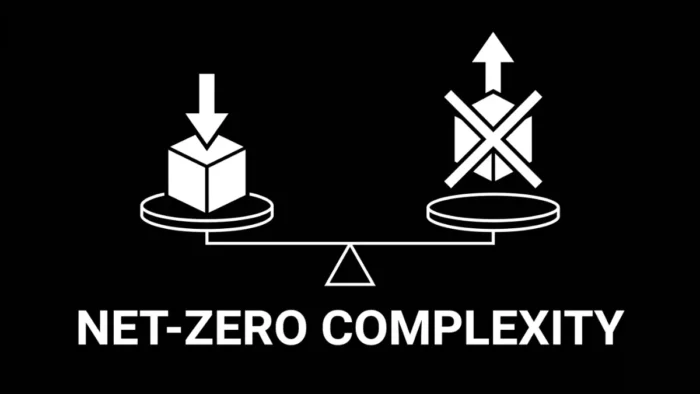
The net complexity of your stack always increases, because nobody ever retires tools. They just stack.
You add a new AI writing assistant, but you keep the old one “just in case.”
You migrate to a new project manager, but you leave the old boards intact.
Over time, your stack becomes a museum of past intentions — each tool representing a version of your business that no longer exists.
Make this a rule: for every new tool you adopt, you retire one. Not “plan to retire.”
Actually delete the account, cancel the subscription, remove the bookmark.
Net-zero complexity forces you to evaluate whether the new tool is genuinely better or just newer. Most of the time, newer is all it is.
3. Audit your last 10 hours of “setup.”
Open your calendar or your screen-time tracker. Look at the last two weeks. Find every block of time you spent configuring, migrating, comparing, or optimizing a tool. Add it up.
Then ask yourself: if I had spent those same hours talking to customers, writing my problem statement, or actually shipping something, what would be different right now?
The number will be uncomfortable. That discomfort is the point.
Organized Laziness survives on the fact that nobody measures it.
When you measure it, the fantasy collapses under its own weight.
4. Write your problem statement before you open anything.
Here is a rule I use with every entrepreneur I work with: the first 30 minutes of your day belong to thinking, not doing.
No email. No Slack. No tools of any kind.
Just a blank page and this prompt: “The one problem worth solving today is…”
You write until the sentence is clear. If the sentence is not clear after 30 minutes, that is information.
It means you do not understand the problem well enough yet, and opening a tool would be a distraction dressed as productivity.
Most people reverse this.
They open the tool first and hope clarity emerges from the interface. It never does.
Clarity emerges from thinking. Tools are for execution, not discovery.
5. Apply the “So What?” test to every tool in your stack.
Perfection is achieved, not when there is nothing more to add, but when there is nothing left to take away.
Antoine de Saint-Exupéry
Go through your current tools, one by one.
For each one, ask: if I removed this tomorrow, what would actually break? Not “what would be slightly less convenient.” What would break.
If the answer is “nothing important,” you have identified dead weight.
If the answer is “I am not sure,” you do not understand your own operations well enough, and that is a bigger problem than any tool can solve.
Most entrepreneurs who do this exercise discover that at least a third of their tools are providing fantasy benefits — the illusion of value without any measurable impact on output.
Cancel them. The money you save will matter less than the mental space you reclaim.
I hear a phrase constantly: “This is the final piece of the puzzle.”
The last integration. The one tool that finally ties it all together.
It is never the final piece. There is always another launch, another upgrade, another YouTube video promising that this one is different.
Many people believe that buying the next AI tool will finally give them traction, but this is just wishful thinking.
Getting traction is not about adding another integration. It’s about finding clarity in your message, having honest talks with your customers, and taking a hard look at how you spend your time.
The founders who win are not the ones with the best tools.
They are the ones who can articulate the problem so sharply that the tools become almost incidental. Better reasoning will outperform better tools every time.
It’s not just sometimes, but every time. Reasoning is the real fuel, and everything else is just the machine that uses it.
Before you install something new, ask yourself one important question: Can you explain the main problem in one sentence without mentioning any tools?
If you can’t do that, then the tool was never the real issue.