

You have thirty tabs open. You are not reading any of them.
Three of those tabs are articles about pricing strategy. Two are deep dives on content monetization. One is a Twitter thread about real estate syndication. Four are YouTube videos queued up on product-led growth.
The rest are a mix of frameworks, case studies, and newsletters you told yourself you would “get to this week.”
You have not shipped anything in any of these domains. But you feel productive. You feel informed. You can hold your own in conversations about CAC payback periods, the creator economy, and cap rate calculations. Your brain is a well-stocked library, and you are the proud curator.
Here is the question that should keep you up at night: Is anything in that library converting into output?
Into revenue?
Into a mechanism that somebody outside your own head is actually receiving?
If the answer is no, you are not learning. You are collecting. And the difference between the two is the difference between a business and a hobby.
I call this horizontal motion disguised as vertical progress.
It is the single most expensive habit among founders who work hard and have nothing to show for it. And it is almost impossible to diagnose from the inside, because it feels exactly like work.
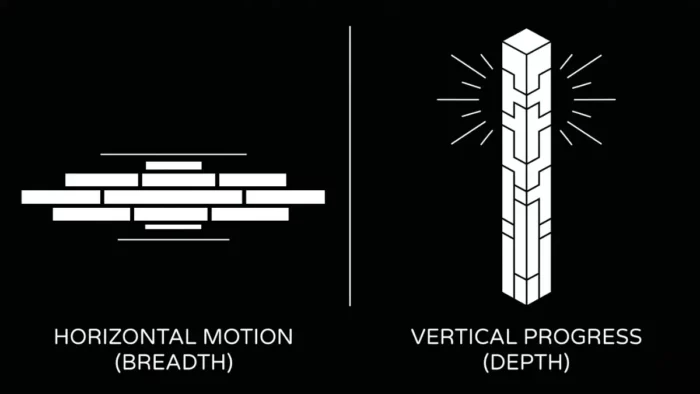
There are two kinds of learning available to you right now.
One expands your surface area.
It gives you more domains, more frameworks, more mental models. It makes you feel dangerous in conversations. It fills notebooks and Notion databases and bookmark folders.
The other kind of learning creates depth.
It takes one domain, one staircase, and pushes you all the way to the top floor. It is slower. It is less glamorous in the early months.
And it is the only kind that builds the pattern recognition you will use for the rest of your career.
Most founders are deep in the first kind and calling it the second.
They are learning backwards: breadth first, depth maybe later, and only if there is time after all the tabs have been read.
The result is not optionality. The result is a founder who knows a little about twelve things and enough about nothing to build anything that ships.
By the end of this piece, you will understand exactly why your library is growing faster than your output, and you will have a protocol for reversing that equation.
The mechanism is something I call the Staircase Strategy. But before we get to the fix, we have to be honest about the trap.
The trap is subtle because the behavior itself looks virtuous.
You are curious. You are hungry. You are consuming high-quality material from people who have actually built things.
What could possibly be wrong with that?
The problem is not the quality of your inputs. It is the direction they are moving you.
Imagine a founder. Let’s call him Alex.
Alex is smart, disciplined, and genuinely wants to build something meaningful. On any given Monday, Alex is reading a book about SaaS metrics.
By Wednesday, he is watching a masterclass on real estate deal structures.
On Friday, he is taking notes on a newsletter about building a media company.
Each of these domains is legitimate. Each of them could, in theory, become a viable business.
The problem is that Alex is treating them as if they are all on the same staircase. They are not. They are three different staircases, and Alex has placed one foot on the first step of each without ever climbing to the second floor of any.
This is what I call visionary multitasking.
The greatest enemy of knowledge is not ignorance, it is the illusion of knowledge.
Daniel J. Boorstin (Often attributed to Stephen Hawking)
Visionary Multitasking
Visionary multitasking is the belief that you can chase multiple visions simultaneously and somehow arrive at all of them without burning out.
You cannot.
What actually happens is that you expend enormous energy moving horizontally across domains and almost zero energy moving vertically within any single one.
You collect fragments. You accumulate surface knowledge.
But you never complete the causal chain that runs from idea to execution to feedback to iteration. And without that chain, you have never actually learned anything you can use.
Related: The Physics of Entrepreneurship: Why You Must Build Potential Before You Can Create Motion
Pattern Recognition
The cost of this is not just wasted time. Wasted time you can recover.
The real cost is that you never develop the meta-skill that makes all future learning faster: pattern recognition.
Here is what I mean.
When you commit to mastering one domain fully, you do not just learn that domain. You learn the structure of mastery itself.
You experience the arc: early confusion giving way to clarity. A plateau that feels like stagnation, followed by a breakthrough you did not see coming.
The moment when the principles stop being abstract and become instinct. The feedback loop where you ship something, the market responds, and you iterate.
You see the whole thing from end to end.
Once you have seen that arc once, you can recognize it anywhere.
You know what the first month of a new domain you are learning is supposed to feel like. You know when a plateau is actually a plateau versus when it is the prelude to a breakthrough. You know the difference between “I am stuck because I do not understand the mechanics yet” and “I am stuck because I am avoiding the hard part.”
These are not insights you can read in a book. They are insights that only become available after you have completed something.
Scanning VS. Mastering One Staircase
I fear not the man who has practiced 10,000 kicks once, but I fear the man who has practiced one kick 10,000 times.
Bruce Lee
This is why the founder who masters one staircase learns faster than the founder who is scanning ten at once.
The scanner has a thousand data points with no organizing principle.
The master has one complete causal chain, and every new domain she approaches gets mapped onto that chain automatically.
She sees: this is the part where I am supposed to feel confused. This is the part where I need to ship something small. This is the part where the feedback loop kicks in.
The scanner, by contrast, is perpetually at step one of everything.
You already know Peter Drucker’s saying that there is nothing so useless as doing efficiently that which should not be done at all.
I would add a corollary: there is nothing so misleading as learning broadly that which you will never apply deeply.
It looks like education. It tastes like growth. And it keeps you exactly where you started.
This is where the Staircase Strategy enters the picture.
The core insight is simple, but the application will force you to make hard choices.
Here it is: you cannot chase multiple visions at once without burning out.
Prioritize not by fantasy benefits but by executable sequence. Each step must be achievable, and each step must pay for the next. Use the A.D.A.P.T. execution framework to make the hard, but most important, choices.
The real question isn’t “Which vision is most exciting?”
Instead, ask yourself, “Which staircase has a step I can actually finish this quarter, and what does that step make possible?”
It’s easy to believe that learning a little about everything gives you more options. You might think you’re keeping your options open, and that when the right opportunity comes along, you’ll be ready because you’ve done your homework.
The reality is that having lots of options but never acting on them (optionality without execution) just leads to being stuck, even if you have plenty of resources.
You haven’t kept your options open. Instead, you’ve created a collection of unused possibilities (museum).
The fantasy is seductive because it plays to your strengths. You are curious. You are a fast learner. You can absorb complex ideas quickly and connect dots that other people miss.
These are real advantages, and they are exactly what make the trap so dangerous. Your ability to learn quickly convinces you that you are making progress even when nothing is shipping.
So how do you break the loop?
Here is a five-step protocol for replacing breadth-first learning with depth-first execution.
Step 1: Run the Staircase Audit.
Open a blank document. List every domain, vision, or skill you are currently “learning about.”
SaaS pricing. Content monetization. Real estate. AI automation. Product-led growth. Crypto. Coaching. E-commerce.
Whatever is on your mental dashboard, write it down.
Now apply the only question that matters: Have I shipped anything in this domain that someone outside my head received, used, or paid for?
Not “have I taken notes on it?” Not “have I had interesting conversations about it?” Not “do I feel confident I could do it someday?” Have I SHIPPED it?
If the answer is no, that domain is not a staircase. It is a tab.
Move every “no” to a separate list called the Holding List.
This list is not a graveyard. It is not permanent. But you cannot touch anything on it until your current staircase is complete.
The Holding List exists to protect you from yourself.
Most founders will find that after this audit, their active staircase list shrinks from twelve items to one or two.
That is not a failure. That is clarity.
Step 2: Identify the uranium.
Not all of your remaining staircases have equal energy density.
One of them carries the highest combination of three factors:
- your existing skill advantage (what you are already unusually good at),
- market demand (what people are actually paying for right now), and
- leverage potential (what can generate revenue or attention without requiring your constant presence).
This is the same principle as Business Potential Energy, but applied to your own learning strategy.
Every domain on your list contains stored potential. But one of them is uranium and the rest are, at best, coal.
Your job is to put your limited time and attention into the element with the highest energy density and convert it into kinetic output.
Everything else waits.
The hard truth is that picking one staircase means saying no to ten others that are genuinely interesting.
That hurts. But it hurts less than spending another year being interesting at dinner parties and broke on paper.
Step 3: Define “done” before you move.
Most founders never complete a staircase because they never defined what the top floor looks like.
Without a vision and target, every new book, course, and framework looks like a valid next step. You drift. You optimize for feeling productive instead of being finished.
Write down your definition of done in one sentence. It should be concrete and falsifiable.
Not “I will understand SEO.” That is a feeling, not a finish line.
Try this: “I will have completed this staircase when I have shipped a product that generates its first $5,000 in revenue, or when I have built an audience of 1,000 subscribers who open my newsletter, or when I have launched a service that has five paying clients.”
The metric does not have to be revenue. It has to be external. Someone outside your head needs to receive what you built.
Without this sentence, you will keep learning forever. With it, you have a finish line that cannot be faked by reading more books.
Step 4: Ship something that forces a market response.
Knowing is not enough; we must apply. Willing is not enough; we must do.
Johann Wolfgang von Goethe
Depth is not consumption.
Depth is output meeting reality and returning data.
Reading ten books about copywriting is not depth. Writing copy that a real audience sees, clicks, or ignores is depth. The difference is feedback.
The fastest way to build pattern recognition is to ship something that forces the world to respond.
Put out an offer. Publish the essay. Launch the minimal version of the product.
You will learn more from one real response (even a negative one) than from ten theoretical frameworks.
The market doesn’t care about what you’ve read. It only cares about what you’ve built. The feedback you get from the market is the only kind that really teaches you something you can use elsewhere.
There was a time when I tried to pursue three different visions at once. I believed I was being strategic and protecting myself from risk.
What I was actually doing was avoiding the moment where the work meets the world, and I find out whether it is good enough. That moment is uncomfortable. It is also where every real lesson lives.
Step 5: Apply the “So What?” test to every new input.
Before you open a new book, article, course, or thread, ask yourself one question: Does this directly serve the staircase I am currently climbing?
If the answer is yes, consume it.
If the answer is no, it does not matter how good the resource is. It does not matter how famous the author is. It does not matter how many smart people recommended it.
If it does not serve the current staircase, it is coal. Put it on the Holding List and walk away.
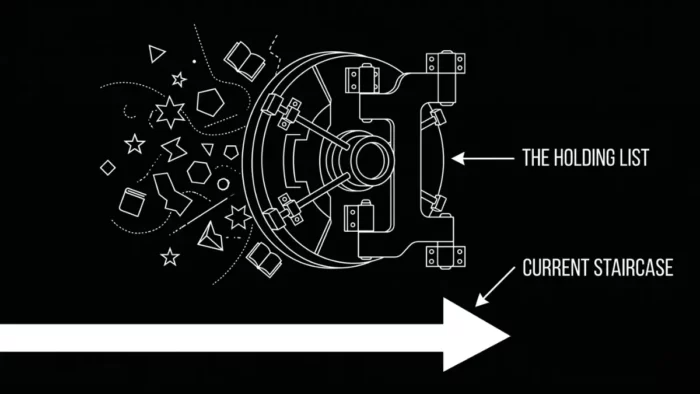
This filter sounds brutal because it is.
But consider the alternative: you keep consuming everything that interests you, and twelve months from now you have twelve new tabs, four new frameworks, and the same staircase you were standing on today.
The “So What?” test is not about being narrow-minded. It is about being finished with something before you die of distraction.
Here is what progress actually looks like, and it is almost certainly not what you have been measuring.
Progress is not more inputs. It is not a denser library. It is not the ability to reference more frameworks in conversation.
Progress is one complete mechanism shipped.
One causal chain you have seen from end to end.
One staircase you can point to and say: I built that. I know how it works because I finished it. Now I can build the next one faster.
The founder who masters one staircase and ships something real has earned the right to climb another.
The founder who is still reading about twelve staircases has not earned anything except a well-organized browser.
You already know which one you are.
The only question is whether you are willing to close the tabs.