

There are few things more Miami than spending longer looking for parking than actually driving to your destination. Whether it is circling Brickell, waiting behind a South Beach valet line, or squeezing an SUV into a tight garage, the final stretch of a trip can feel like the hardest part.
Jameson Detweiler thinks that is backward.
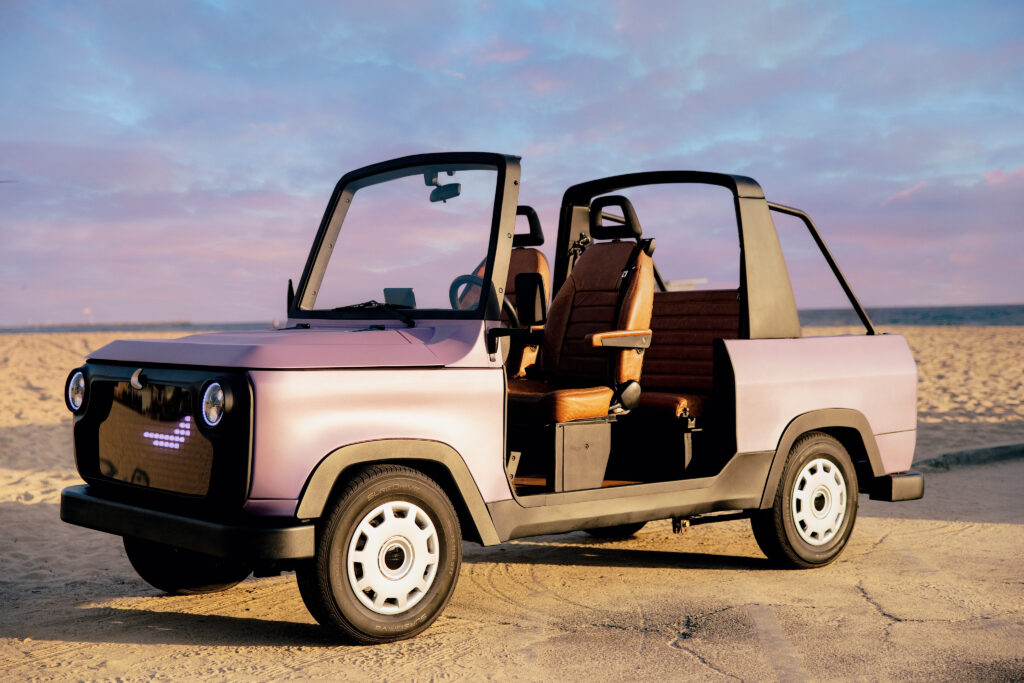
The Miami-based founder and CEO of Chip Motors is building what the company calls a “Life Utility Vehicle,” or LUV: an electric vehicle made for short, local trips that sits somewhere between a traditional car and a golf cart, while aiming to be safer and more practical than the latter.
“The mission of the business is to democratize access to point-to-point transportation in a way that considers people inside and outside the vehicle,” Detweiler told Refresh Miami. “It needs to be light. It needs to be safe. It ultimately needs to be autonomous. And it needs to be economically accessible.” The starting price point for Chip will be $15,000.
The idea grew partly from Detweiler’s years in Los Angeles, where he relied on Uber, Lyft, and scooters instead of owning a car. Becoming a father changed the equation.
“I really loved the lifestyle of not having that overhead of owning a vehicle,” he said. “But now I’m 40 with two kids.”
Detweiler now lives in Edgewater and owns a Tesla Model Y, but many of his regular trips are only a few blocks.
“My kids are four blocks away at daycare,” he said. “Sometimes you still need a vehicle because of the weather or everything else. But it’s a lot to get into my Tesla Model Y just to go four blocks.”
Chip is built for school drop-offs, grocery runs, beach trips, and other daily drives. The six-seat vehicle weighs about 1,500 pounds, uses four in-wheel motors, includes secure storage, and is designed with a far simpler parts count than a standard car.
“One thing an autonomous vehicle will never do is speed,” Detweiler said. “So why would we put all that power into it?”
Instead, Chip Motors is focusing first on a less exciting but highly practical problem: parking.
Its Chip Go service will allow owners to step out while a trained remote operator parks the empty vehicle, sends it home, takes it to be cleaned, or handles a curbside pickup. Each remotely driven mile will also help the company gather data for its longer-term goal of Level 4 autonomy.
“We like to say Chip is fun to drive, but parking never is,” Detweiler said.
The human operator is meant to help with the messy details that autonomous vehicles still struggle with, including gates, busy curbs, bike lanes, pedestrians, and unclear pickup areas.
“If a vehicle is going to drive itself, it should be able to communicate with people,” he said. “There’s still a lot more training data that needs to happen.”
Florida’s strong market for low-speed vehicles made Miami a logical launch point, but Detweiler also sees the city as a cultural testing ground. His mother grew up in Coral Gables, and his great-grandfather founded Miami Country Day School.
“I think Miami is absolutely this beautiful hodgepodge of different cultures,” he said. “It’s the most interesting place in the United States as it relates to culture today.”
The company is also giving Chip a personality. It is designed to communicate through the car and a family group chat, connect to calendars, track traffic, and eventually act more like a private driver or family assistant.
Detweiler said the friendly design reflects his childhood visits to Disney World and a view of the future that felt more hopeful than many modern science-fiction visions.
“There was a time when the future looked promising and happy,” he said. “I think we’ve lost that today.”
Chip Motors currently has around eight full-time employees, plus contractors. Ilan Penn is the company’s co-founder, while its leadership team also includes former Tesla and Canoo engineer Gareth “Gaz” Lee and CTO Chris Abrams, whose experience includes NASA and Ledger.
The company plans to begin low-volume production, with its first units targeted to ship in Miami this winter. Broader distribution is expected in 2027. Customers can reserve a Chip now with a fully refundable $250 deposit.
Chip may look friendly, but the question behind it is serious: How much car do families really need when most of their lives happen only a few miles from home?
Pictured at the top of this post: Chip Motors Co-founders Jameson Detweiler (CEO) at left and Ilan Penn, at right.
READ MORE IN REFRESH MIAMI:
- Miami’s newest app wants to fix your commute, without adding another car to the road
- Could on-demand AI-powered Glydcars drive the future of Miami transit?
- It’s electric! Miami mobility innovation on display at CoMotion
- PriorityEvac is building a smarter way to evacuate before hurricanes hit
- Oasis is building a smart ring that wants to replace your keyboard

- Chip’s EV is taking a different road to autonomy – August 13, 2026
- ImaageQ wants to give homebuyers a better view of the future – August 11, 2026
- Commas is building the operating system for making money online – August 10, 2026