

Fairchild Tropical Botanic Garden is gearing up for a busy school year, as middle and high school students will need to figure out which crops grow best in outer space – to help feed astronauts on long space missions.
In the 11 years since Fairchild’s Growing Beyond Earth (GBE) started, in partnership with NASA, “four of the cultivars students tested through GBE have been grown on the ISS,” said Amy Padolf, Growing Beyond Earth’s founder and director. She leads the research design, the NASA partnership and the funding for the program. The International Space Station is a habitable, modular space station in low Earth orbit that serves as a microgravity laboratory for scientific research.
“Astronauts have eaten crops that our students helped identify,” Padolf said of produce like Extra Dwarf Bok Choy, Red Robin tomatoes, Mizuna mustard greens and Chimayo peppers. “The work now points toward Artemis and eventually Mars, where astronauts will need to grow a meaningful portion of their own food, and GBE sits in the early-stage pipeline feeding those missions,” she said about the program’s aspirations.
This past school year, about 100 South Florida public, charter, and private schools took part in the program across Miami-Dade, Broward and Palm Beach counties.
“The program has two goals, and neither works without the other,” Padolf said. The first goal is scientific – to identify which crops can reliably sustain astronauts on long-duration missions and generate the data NASA needs to make those decisions. The second goal is educational: to “give students a genuine role in that effort,” said Padolf. “The science needs the scale that only classrooms can provide, and students need work that is actually worth doing,”
Padolf said that when GBE started in 2015, “we were already thinking about how to connect students to real scientific work rather than classroom approximations of it, and NASA had a problem that classrooms could actually help solve.” She and her team connected with a senior scientist on NASA’s Space Crop Production team and with a research advisor, who then met with their team at the Kennedy Space Center to build the program.
GBE students document which crops grow best, analyze data, collaborate with students nationwide and communicate the results with researchers. Every participating classroom receives a Fairchild-designed growth chamber comparable to NASA’s Veggie system on the ISS. Fairchild provides all the instructions and materials for the project, and both Fairchild and NASA scientists train teachers together before each program year.
What began as a local Miami-Dade program now reaches more than 10,000 students in more than 500 schools across the U.S., Puerto Rico, and 13 other countries. “The local impact is hands-on student science,” said Padolf of the controlled crop experiments that generate the early-stage data NASA uses to evaluate which plants are viable for spaceflight. Funding came first through NASA’s Office of STEM Engagement and now runs through NASA’s Science Mission Directorate via the Science Activation program.
Padolf explained that the technology behind growing crops for long space missions has two parts. The first is the clinostat, also called a random positioning machine. “It simulates microgravity here on Earth by slowly rotating a plant across multiple axes so that gravity never registers as a consistent directional signal,” she said.
Rather than responding to a single downward pull, like Earth’s gravity, the plant experiences an “averaged-out gravitational environment that approximates the conditions of spaceflight,” she said. “We use it to study how plants respond to the absence of normal gravity, which is central to figuring out how to grow food in space.”
The second part is the classroom growth chamber, which Padolf and her team designed at Fairchild to replicate the Veggie system aboard the ISS. Each chamber holds six plants grown in a clay-based medium and uses a programmable LED panel that can be tuned for specific light wavelengths and photoperiods, along with a fan for airflow, she said.
A microcomputer automatically logs environmental data, including temperature, humidity, CO2, and barometric pressure. “That combination is what lets hundreds of classrooms generate research-grade, comparable data at the same time,” Padolf added.
Guests at Fairchild can visit the Innovation Studio (across from the butterfly garden) to see the clinostat up close and to see the different stages of crop growth.
The Crop Readiness Level framework is how NASA evaluates whether a plant is ready for spaceflight, said Padolf. Schools like BioTECH, St. Agatha Catholic School, and Palmer Trinity have conducted drought and salinity trials and light-intensity experiments on crops. “To date we have tested more than 275 edible plant varieties through GBE, and around 40 of those have been down-selected by NASA for further testing at Kennedy Space Center,” she said.
Every year, students present their original experiments to NASA scientists and judges at the Growing Beyond Earth Student Research Symposium at Fairchild’s Arts Center.
Schools interested in participating in the Growing Beyond Earth Program can fill out the application form on Fairchild’s website. Applications are due by July 31, 2026.
***
Pictured at the top of this post: Students from Ponce de Leon Middle School in Coral Gables collect weekly observation and measurement data from their Growing Beyond Earth research plants.
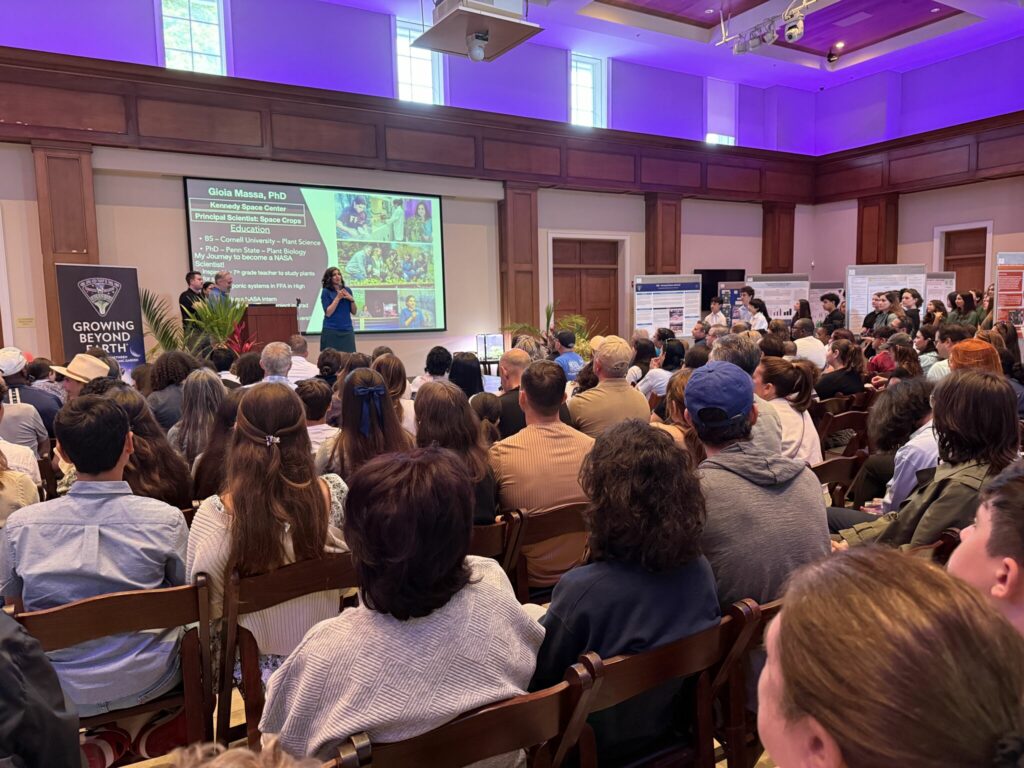
Pictured above and below: Above, the 10th Annual Growing Beyond Earth (GBE) Student Research Symposium this spring at Fairchild’s Arts Center. Below, a student from Henry S West Laboratory School in Miami-Dade prepares to harvest her plants. All photos provided by GBE.

READ MORE IN REFRESH MIAMI:
- Stratos Ventures launches with $50M and a plan to help make Miami a defense-tech gateway
- Latitudes wants to make West Palm Beach a company-building engine for the New York–South Florida tech corridor
- Founders Rise Miami launches free workshops for women and minority founders
- FIU club helps build next generation of aerospace engineers
- Miami again ranks in top 25 in the world in Startup Genome’s GSER ranking