

Most people will not finish the staircase (part of the staircase strategy) they are on. They will abandon it somewhere around step three, seduced by a new vision that glows brighter than the one they are standing on.
This is not a motivation problem. It is a structural one. And it is the single biggest reason entrepreneurs stay stuck while telling themselves they are making progress.
Let me explain what I mean.
The Structural Shift Nobody Is Talking About
You can’t build a reputation on what you are going to do.
Henry Ford
Something in the economy has shifted. Quietly. Permanently.
For a long time, the market rewarded starters. Raise your hand first. Ship the MVP. Be the first mover. The energy was in the launch. If you launched enough things, the thinking went, something would eventually stick. Volume was the strategy.
That calculus is dead.
Today, the economy rewards finishers.
Not the ones who start the most projects. The ones who close them. The ones who ship something so complete that the market cannot look away.
The ones who stay on a staircase long enough for the step they are standing on to pay for the next one.
Here is the uncomfortable question most founders will not ask themselves: How many staircases have I started and abandoned before step three?
If the answer makes you wince, you are in the majority. But the majority is losing.
I call this framework the Staircase Strategy, and it is simple to explain and brutal to execute.
Every business vision is a staircase.
At the top is the outcome you want: revenue, freedom, impact, legacy. It is your desirable outcome, your vision, and your goals what you want to achieve at the end of the staircase.
At the bottom is where you are standing right now. Or, more accurately, at which stair you are standing.
The steps between are the work. Not the glamorous work. Not the visionary work.
The actual, unglamorous, nobody-will-clap-for-this work.
The trap most entrepreneurs fall into is treating the staircase as optional. They believe that if they just get a running start, they can jump to the top.
So, they search for shortcuts. They scan the horizon for neighboring staircases that look shorter or shinier.
And when the step they are on feels boring, or hard, or unrewarding, they step off entirely and start climbing something new.
What many people don’t realize is that every time you give up on a staircase, you start over from the beginning.
It’s not that your effort was wasted. You learned along the way and gained experience.
But you haven’t moved any closer to your goal.
You find yourself at the bottom of a new staircase, while the old one becomes just another idea that never made it off your computer.
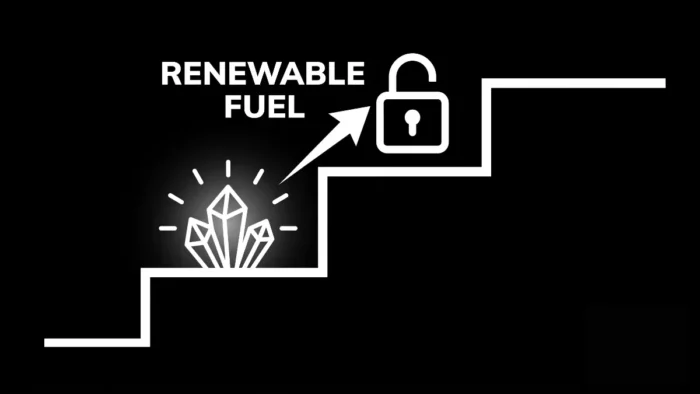
A staircase you can actually finish has three must-have qualities.
First, every step should be something you can actually do. Not just something you hope for. Not “raise a Series A in six months.”
Achievable means you can finish it this quarter, this month, or even this week.
If a step is too big, you’ll just look at it and start to feel stuck. That’s when people give up.
The step doesn’t have to be easy, but it does have to be possible.
Second, every step must pay for the next one. This is the rule that changes everything.
Most entrepreneurs sequence steps by what excites them.
The sexy step goes first. The boring infrastructure step goes last.
But if the sexy step does not generate revenue, or attention, or some form of renewable fuel, you have nothing to power step two.
You are running on willpower. And willpower is a finite resource. Revenue is renewable.
Sequence your steps so that each one unlocks the resources the next one requires. Cash. Attention. Reputation. Trust.
Whatever currency your next step demands, the step before it must produce it.
Third, you cannot see the whole staircase.
This is the hardest part for people who think in systems.
You want the full map. You want to know what step seven looks like before you commit to step one. But you will not know.
The staircase reveals itself as you climb. Step two becomes visible only after step one is finished.
The founder who demands full visibility before moving is the founder who never moves at all.
If the Staircase Strategy is so logical, why does almost everyone abandon it?
The answer is not laziness. It is not a lack of discipline. The answer is dopamine.
The Dopamine Trap
A new vision is a dopamine hit. It is clean. It has no problems yet. It has not disappointed a single customer. It lives entirely in the imagination, where everything works perfectly and the market applauds on day one.
The step you are currently on is the opposite of that.
It is dirty. It has problems you did not anticipate. It has disappointed you, and probably a few customers, too.
But it is real. And reality is always less attractive than the version of it that lives in your head.
So here is what happens.
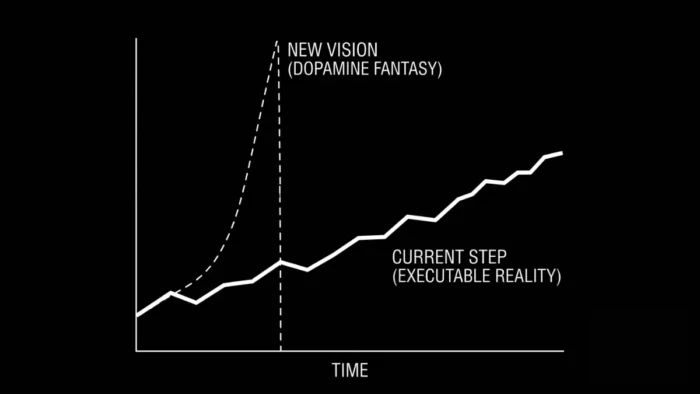
The dopamine of your current step fades. And the work becomes routine. The initial excitement dries up.
In such a way, your brain, always scanning for a better source of reward, offers you an escape: a new vision.
Something fresh. Something that feels like progress even though it is actually retreat.
I think of this as trading fantasy benefits for real, actionable steps.
The fantasy benefit is the reward you picture when you come up with a new idea.
The executable reality is the real, often unexciting work you need to do right now.
If you keep choosing the fantasy, you lose progress and have to start again from the beginning.
There is a second layer to this trap, and it is more dangerous because it wears the mask of virtue.
You can abandon a staircase without ever admitting to yourself that you abandoned it. You just fill your days with activity.
Meetings. Research documents. Planning sessions. Rebranding the website. Reorganizing the Notion workspace.
You are “working on the business.” You are “strategizing.” You are very, very busy.
I call this the Busyness Paradox. When you are very busy but not productive, it is the most dangerous situation because it feels just like real work.
You come home tired and tell your spouse it was a long day. You feel the kind of exhaustion that comes from putting in the hours.
But nothing was delivered. Nothing was completed. The task is still unfinished. You mixed up being busy with being productive, and the work is still waiting.
The market does not pay for your effort. It pays for what it receives.
So the question becomes practical: how do you stay on a staircase when your brain is screaming at you to start a new one?
Kill the Backup Staircases
If you chase two rabbits, you will not catch either one.
Russian Proverb
Most entrepreneurs keep backup visions and plans and project ideas alive in their heads.
They are not committed to the current staircase. They are “testing it.” They are “keeping options open.” They tell themselves this is strategic flexibility.
And the moment the current step gets hard, they activate the backup.
This is not flexibility. This is premeditated quitting with better branding.
Peter Drucker said: “There is nothing so useless as doing efficiently that which should not be done at all.”
I would add this: there is nothing so expensive as doing many things inefficiently while finishing none of them.
Pick one staircase. Kill the others.
Not “pause.” Not “put on the back burner.” Kill.
Delete the domain. Archive the Notion page. Close the tab.
If you cannot bring yourself to kill a vision, you are not serious about the one you claim to be climbing.
Make the Current Step Ugly Enough to Ship
Real artists ship.
Steve Jobs
Perfectionism can feel like procrastination dressed up as achievement.
You convince yourself you are not giving up on the staircase. Instead, you focus on perfecting each step, polishing it, and making sure it is just right.
But the market does not grade on effort. It grades on delivery. A finished step that is 80% polished is worth infinitely more than an unfinished step that is 95% of the way there.
Here is a rule I apply: if the step is good enough that a customer would pay for it, ship it. If it is not, ship it anyway and fix it afterward.
The feedback you get from a shipped step is worth more than all the perfection you add to an unshipped one.
Thomas Edison said it differently, but the principle holds: “The value of an idea lies in the using of it.”
An unused staircase, no matter how elegant the design, has a value of exactly zero.
Measure Altitude, Not Activity
Most entrepreneurs measure the wrong things. They count hours. They count tasks completed. They count meetings attended. They count how tired they feel at the end of the day.
None of that tells you whether you are climbing.
Focus on what you actually shipped this week. What did your customers receive? Which step did you finish?
If your answer is, “nothing shipped, but I was busy,” you did not make progress. You just stayed in the same place. That is not moving forward. That is just running in place.
I call this the “So What?” test. At the end of each week, look at what you produced and ask yourself: so what? If you just shrug, you know what that means.
You traded activity for real progress. You mixed up being busy with moving up. You convinced yourself you were working hard, but you stayed in the same spot.
There’s something people don’t usually mention about finishing a staircase.
When you finally finish one, something changes. It’s not just your business that’s different. You are, too.
Finishing your first staircase changes how you see yourself. You go from being someone who just starts things to someone who actually finishes them.
That new sense of identity builds over time.
The next time you take on a staircase, it feels different. Deep down, you know you can reach the top. The doubt is gone—not because of a motivational quote, but because you have real proof.
The market pays attention. It simply recognizes people who finish what they start. These finishers earn trust, build a strong reputation, and attract the kind of attention that money can’t buy.
In a world where many people only begin things, those who see them through stand out. Being rare makes them even more valuable.
Warren Buffett once said: “The difference between successful people and really successful people is that really successful people say no to almost everything.”
But I think he was only half right.
The real difference is that really successful people say no to almost everything so they can say yes to finishing one thing at a time.
I will leave you with the only question that matters:
What is the one staircase you are on right now, and which step are you going to finish before you allow yourself to look at another one?
Be honest with yourself.
Now, close everything else. Close every tab, every Notion page, every unfinished prototype you have started and are keeping for any case.
Also, shut down every domain name you bought late at night for an idea you never started. Close every business plan PDF you promised yourself you’d look at next month.
Shut them all down.
Then move forward.