

It is 2 AM on a Thursday and you are thirty browser tabs deep. Three articles on pricing strategy. Two dives on content monetization. One thread about something you will never build. You have been “working” for hours, and you have shipped nothing. Your brain is a well-stocked library and you are the proud curator, walking the aisles every night, never checking a single book out. And you are asking yourself why you procrastinate and how to stop procrastinating.
There’s something people rarely mention: you’re not lazy. You’re just tired. It’s not because you’ve done too much, but because you’re weighed down by everything left undone. All your life, you’ve heard that the answer is more discipline, more willpower, or stricter routines. But that advice is actually wrong, and it can be proven.
So this is not another pep talk wearing the costume of a system. This is a full answer, step by step: why you procrastinate, why it is not your fault, and exactly how to stop procrastinating for good.
By the time you finish, you will have a method you can run this week, not another reason to feel bad. Read it like you mean it.
Why Procrastination Isn’t Your Fault
The Lie You’ve Been Telling Yourself
Most people think of procrastination as a character flaw. You put off the important thing, therefore you’re lacking in discipline, therefore there’s something wrong with you, therefore you just need to try harder. That’s the story we all learned on day one and it’s the story that makes sense because it does appeal to that part of us which wants a simple answer.
The science says otherwise, and it has been saying it for decades.
In one of the most cited summaries of the entire field, psychologist Piers Steel looked across hundreds of studies and found that procrastination has almost nothing to do with poor time management and everything to do with self-regulation. People delay most when a task feels unpleasant, when they doubt they can actually do it, and when they are easily distracted.
Notice what is missing from that list. Laziness. Laziness is not in it.
Here is the sharper version, from two of the leading researchers in the field. Sirois and Pychyl argue that procrastination is fundamentally an emotion problem, not a time problem. When you sit down to do the hard thing, you do not feel bored first and delay second. You feel a flash of dread, or overwhelm, or self-doubt, or plain discomfort, and you delay to escape that feeling.
We suffer more often in imagination than in reality.
Seneca
You’re not avoiding the task. You’re avoiding the feeling the task induces. Procrastination is mood repair. It just so happens to be the most expensive form of mood repair in your life as the future you is left to pay the bill.
There are two founders, and only one of them will ever stop procrastinating.
Founder A looks at the avoided task and thinks, “I’m weak. I need to try harder.” Founder B looks at the same avoided task and thinks, “Something about this is making me feel something, and I need to find what that feeling is.”
And Founder A will spend the next decade grinding against his own shame and losing. Founder B just became the one who can actually fix it.
The difference is not discipline. It is whether you understand the mechanism.
Why Your Brain Picks the Escape Hatch
Once you see procrastination as mood repair the question becomes why is the escape hatch so hard to resist? The answer is that your brain is hardwired to value now over later and to treat future you as a stranger.
Psychologists call it temporal discounting. A reward six months down the track is worth less than the same reward today. The discomfort you can get rid of right now is going to be far more important than the benefit you’ll get in the future.
In one study people who were less concerned about distant rewards procrastinated significantly more on the long-term real world tasks. The twist that makes it so much worse is that research into how we model our own decisions has shown that we consistently expect future tasks to be easier than they actually are. You’ll say to yourself “I’ll be in the mood tomorrow” as if the you of tomorrow is some rested, motivated pro. It isn’t. It’s just you, plus a day of accumulated dread.
At the root of all of it sits a quiet fact about identity. Hal Ersner-Hershfield and his colleagues found that people who feel their future self is fundamentally the same person as they are right now save more and act more patiently, while people who feel their future self is a stranger are the opposite.
That’s precisely how procrastination works at the level of the wiring. You don’t harm yourself by putting it off. In the moment you’re harming a stranger. The you of next Tuesday is someone else’s problem. It’s not a moral failing at all. It’s a wiring issue and once you name it you can route around it.
The Two Faces of Procrastination You’re Overlooking
The obvious face is the doomscroll. That one is easy to catch. The face that destroys founders is the one disguised as work, and it has three masks.
I call that first one Template Hoarding. One founder I met had 43 pitch deck templates. The Airbnb deck, the Uber deck, the Sequoia deck, three versions of the Kawasaki 10/20/30, all of them reformatted in his own brand colors.
When I asked him what his company actually did he went on for 11 minutes and never got to the point. His templates were spot on. His business was completely invisible. Collecting systems is the most seductive form of avoidance as it produces output which is precisely the same as input. If your ratio of templates owned to templates shipped is above 3:1 you’re not preparing at all. You’re just hiding.
The second is Organized Laziness: the ritual of upgrading, migrating and reconfiguring your tools, so thoroughly and completely that you’ve actually internalised the language of progress to the point where it all passes every internal test.
Optimization, automation, scale. A faster automation doesn’t fix a problem you can’t describe. To treat tool selection as strategic thinking is the single most dangerous trap for a founder as it’s completely invisible to the person actually in the room.
The third one has the longest name because it goes back the furthest. I call it simply the Diversification of Accountability. It’s like a spreadsheet that gets a new column every week, or a plan that splits into three different strategies so that if one doesn’t work, there are others. You might think you’re spreading out your chances for success. Really, you’re spreading out your accountability so that if something fails, your name isn’t attached to it.
The spreadsheet isn’t a strategy at all. It’s an emotional hedge. Each additional column is an escape hatch and each escape hatch is a vote of no confidence in the staircase you’re standing on.
How to Actually Stop Procrastinating
Forgive Yourself First (Yes, Before You Do Anything)
Every article about beating procrastination starts by telling you to make a plan. This one starts somewhere harder, because it has to. The plan does not work while the shame is still running.
Tim Urban, whose “Why Procrastinators Procrastinate” essay on Wait But Why is probably the most-read thing ever written on the subject, describes the procrastinator’s brain as a tug-of-war between a Rational Decision-Maker and an Instant Gratification Monkey who only wants easy and fun now (waitbutwhy.com).
His explanation shows that this cycle is emotional at every stage. You avoid the task, then feel guilty, and that guilt makes the task seem even worse, so you avoid it even more. Guilt doesn’t help you fix things; it just leads to more delay.
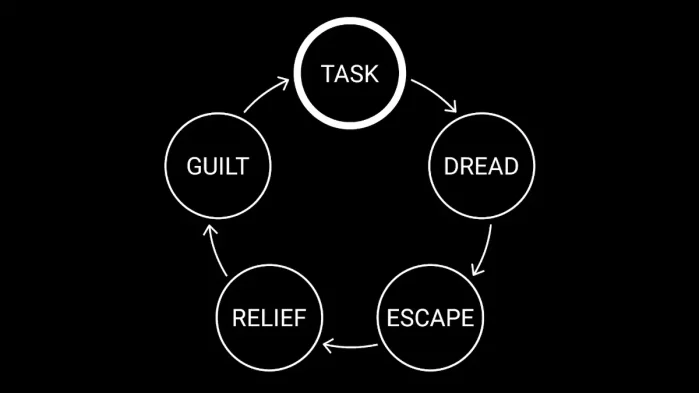
Why self-blame keeps you stuck?
Here is the finding most people refuse to accept, because it feels like letting yourself off the hook. Researchers studying self-forgiveness found that the people who forgave themselves for a past episode of procrastination were significantly less likely to procrastinate on the next task.
Read that again because it completely inverts the whole thing. Self punishment doesn’t stop you from procrastinating in the future. It causes you to procrastinate. The shame you’re heap on yourself tonight is exactly the burden that makes the task of tomorrow completely unmanageable and the cycle is self fulfilling.
There’s a very important distinction here and if you get it wrong the whole step comes to nothing. Self-forgiveness is not excusing. The researchers are very clear on this distinction: forgiveness requires taking responsibility, excusing is simply a way of avoiding blame.
The move is not “it’s fine that I didn’t do it”. The move is “I didn’t do it. I accept that. I’m not going to carry that into the next attempt”. You stop the procrastination of tomorrow by refusing to punish today’s.
The curious paradox is that when I accept myself as I am, then I change.
Carl Rogers
Name the Emotion Before You Touch the Task
If procrastination is mood repair then the skill that breaks it is emotion regulation not time management. One study looked at this very specifically and trained people in exactly that skill (learning to tolerate and change the unpleasant feelings a task provokes) and their procrastination dropped significantly as a result. The mechanism is the one you’ve been ignoring your entire life: the feeling comes first, the delay comes second. So you have to deal with the feeling first.
The two-minute diagnostic: “what am I actually avoiding?”
Before you start the task, try this: sit for two minutes and ask yourself, either out loud or in writing, one question. What am I actually avoiding? It’s not the task itself, but the feeling behind it.
The answer is almost always one of five things: it feels too big, I do not know where to start, I am afraid it will not be good enough, I resent that I have to do it at all, or I am not sure I even want this.
Name it in a single sentence. “I am avoiding this because it feels too big.”
Just naming the emotion moves it from a fog you are drowning in to an object you can look at, and research on how we handle aversive feelings says the simple act of tolerating the discomfort, instead of fleeing it, is the regulating move itself.
You cannot fix a feeling you refuse to look at. Now you can look at it.
Shrink the Task Until It Can’t Hide
Once the feeling has a name, the next move is to starve it. Big feels happen around big, vague, intimidating tasks. So you do not try to want it. You make it smaller.
The initiation threshold
There is a well-established principle in the science of goal pursuit, discovered by psychologist Peter Gollwitzer and confirmed across thousands of studies: deciding in advance exactly when and where you will start something, in an “if this, then I do that” form, makes you dramatically more likely to actually do it.
The reason for this has nothing to do with motivation. The if-then plan takes the decision out of the moment of action which is precisely where the dread resides. You’re not asking your brain to feel like you’re going to start. You’re telling it that the starting has already been decided. When the cue appears the behavior follows almost automatically.
James Clear turns this same logic into a rule you can use today: the Two-Minute Rule (jamesclear.com). Scale the task down until the first version of it takes under two minutes.
The goal is not to finish. The goal is to start, because starting breaks the spell. One page instead of the book. One sentence instead of the essay. One email instead of the launch.
One is not almost as good as two, but one is infinitely better than zero.
Each step must pay for the next
Here is where I bring in my own operating system, because the two-minute rule, on its own, shrinks tasks but does not tell you which task to shrink.
I call that the Staircase Strategy. You simply can’t chase three visions at the same time without stripping the gears. I know this having done it myself and the ROI was a massive identity crisis and a hell of a lot of burnout. The way to do it is to prioritize by executable sequence.
Each step has to be small enough that you can’t say no to it and each completed step has to pay for the next one.
You don’t try to get to the top of the staircase all at once and you don’t plan the whole staircase out in advance. You take one step that you’ve earned and that step gives you both the confidence and the means to take the next.
Simply, procrastination absolutely loves a staircase with no tangible first step. Give it one tonight in under two minutes.
Find the Load-Bearing Move and Ship It
Shrinking the task solves the first problem. It doesn’t solve the second one which is that we’re not actually procrastinating on the right things. We’re procrastinating on one task while being busy with a dozen others and we call that a productive day.
I call this the Output Density Principle. Four hours of one thing is better than twelve hours of everything. Output density is one piece of output that counts, one instance of potential energy being converted into something real and actually landing in someone else’s hands.
Most entrepreneurs have their foot on the gas in neutral, and they measure the wrong unit: hours burned instead of value shipped. That is like measuring a car’s speed by how much fuel it drinks.
The single action that makes everything else irrelevant
The load-bearing move is the answer to one question: what is the single action that, if I ship it today, makes everything else irrelevant?
A founder I respected ran a smaller operation than mine with a narrower focus, and her numbers were climbing while mine were flat. When I asked what changed, she said: “I cut my workday to four hours.” Every morning she asked that one question, shipped one thing, and was done. Four hours. One shipment. While she doubled revenue, I was optimizing my morning routine for the eleventh time. She was not working harder than me. She was converting denser material. And she found the uranium, and I was busy mining coal.
Procrastination almost never manifests itself as a completely empty day. It manifests itself as a day full of low-density activity. The solution isn’t to do more. The solution is to find that one load-bearing activity buried under the pile and just do that one thing first, in one go, before the day has a chance to get itself full of everything else.
Build the Rails for Tomorrow (So You Stop Needing Willpower)
Every move so far is operating in today. The last piece is the one that works on tomorrow and it’s that one which makes the others permanent. You don’t win this with daily willpower. You win by creating the structure so that the productive path is the default and you only have to be strong at the moment when the rails are being laid.
Environment over discipline
The research is very straightforward on this. One study into academic procrastination found that people procrastinate more when they’re in an environment which gives them freedom, long deadlines and easy distractions. The study concluded that it’s the small changes to that environment which make the biggest difference rather than trying to just ‘get on with it’. In other words your environment is doing the procrastinating for you.
Your phone on the desk is not neutral. It’s a vote. The twenty tabs are a vote. The task which has no fixed place in your day is a vote in favor of never doing it at all. You don’t need any more self-control. You need an environment which doesn’t require such a high level of self-control.
You do not rise to the level of your goals. You fall to the level of your systems.
James Clear
Nir Eyal in Indistractable makes the case that the most effective antidote is timeboxing: you simply decide in advance what you’re going to do and when you’re going to do it and then you treat that calendar slot as a contract with yourself (nireyal.com). Anything you’ve scheduled is not a choice you have to re-make in the moment. The moment you’re re-making the choice is where the escape hatch is.
Schedule the load bearing move into a named block, guard it and the decision’s already been made before the feeling ever comes in.
Anti-Vision as the rubber band’s other end
Positive visualization is a trap that pretty much all goal setting advice walks you into. If you go down the route of vividly imagining the goal achieved then your brain gets the reward hit without you actually doing the work and the motivation just oozes out. So I did the opposite. That’s the A.D.A.P.T. method and the first step in it is the one that actually creates tension.
Define your Anti-Vision. Simply write it down in the most specific, uncomfortable detail imaginable on what an average Tuesday would look like five years down the line if nothing at all changes: the project still not launched, the debt, the resentment, the version of you that’s still going “after this next tool”. Don’t sanitise it. Pin it down at the other end of the rubber band.
A rubber band only stores energy when both ends are fixed. Most entrepreneurs have only ever defined the dream end. Now the nightmare end is pinned too. You’re not being pulled towards something nebulous any more. You’re being pushed away from something very real and that’s what creates the tension that gets you out of bed on the hard days. Use what you hate as fuel.
The P.E.N.C.I.L. Framework
There’s one final way in which founders wreck the rails and it’s the one that’s hardest to spot because it’s dressed up as virtue. It’s the notion that passion alone will get them through year five and all the sleepless nights in between. Robert Vallerand’s work shows that passion is in fact two things. There’s harmonious passion which exists alongside the rest of your life and protects you from burnout. There’s obsessive passion which consumes you and which to all outward appearances is just as much dedication as anything else. The difference is structure, not intensity.
That’s why I built the P.E.N.C.I.L. Framework: passion is a wildfire so you need to build the rails. It hardwires harmonious passion into the way you actually run your days and puts the guardrails in place to stop the obsessive kind which will burn the house down with you in it. You don’t need a bigger fire. You need the rails to turn the fire into momentum rather than ash.
A founder who cannot stop working is not beating procrastination. They are procrastinating on the rest of their life.
The 7-Day Protocol (Exactly What to Do This Week)
You now know why you procrastinate and what all the levers are that you can pull to combat it. Here’s how to stop procrastinating in practice, all condensed into a sequence you can run from tonight. Don’t just read this and then go “ahh”. Do it.
Step 1–2: Name it and forgive it
First, you must run the two-minute diagnostic on the one thing you’ve been avoiding the longest.
Simply write one sentence stating the exact feeling. Then write one more: “I accept that I have avoided this and I am not carrying it into tomorrow.” Mean the second one as much as the first. Responsibility without punishment. That’s the doorway.
Step 3 & 4: Shrink and schedule it
Take that task and reduce it right down to the point where the first step is under two minutes. Also write it as an if-then: “When I sit down at my desk tomorrow at 9am I will open the document and write the first sentence.”
Then you can schedule it as a simple fixed block on your calendar (like a meeting with yourself).
The decision is now in. The feeling doesn’t get a vote anymore.
Step 5–7: Find the load-bearing move and ship
Each evening you must ask the one question: what is the single thing I can ship today which, if I do it, makes everything else completely irrelevant?
Do that thing first in a clean block, before the day is filled up. One shipment. Then stop. Measure output density not hours. Let the staircase do its job: each step you actually earn pays for the next.
The loop is: name the feeling, shrink the task down until it can’t hide, find the load-bearing move, ship it and build the rails so that tomorrow will need less willpower than today.
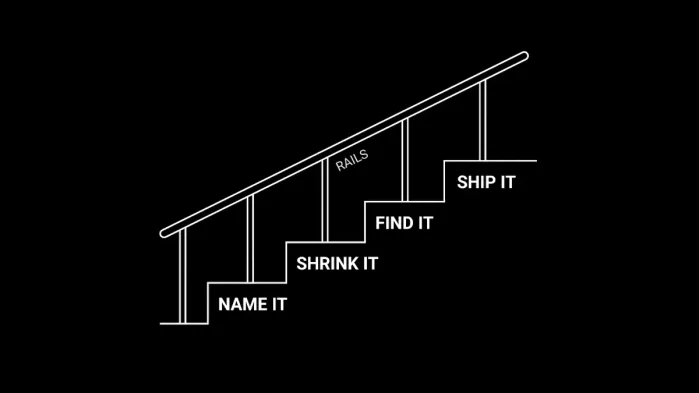
Simply, that is the whole system and the system is the answer.
Procrastination never survives once you stop treating it like a sin and start treating it like a mechanism. You do not need more discipline. You needed a map. Now you are holding one.
So stop reading about how to stop procrastinating. Close twenty-nine of those tabs. Ask yourself which one of these tasks is the uranium. And go ship the first two minutes of it, tonight.