

Ken Griffin is committing $2 billion to a 35-acre Miami campus as part of a record $3 billion gift to the university
By Riley Kaminer and Nancy Dahlberg
Miami doesn’t have a Stanford. It doesn’t have an MIT. For years, that has been one of the favorite knocks against Miami Tech. Now, Miami finally will have an answer: Carnegie Mellon University Miami.
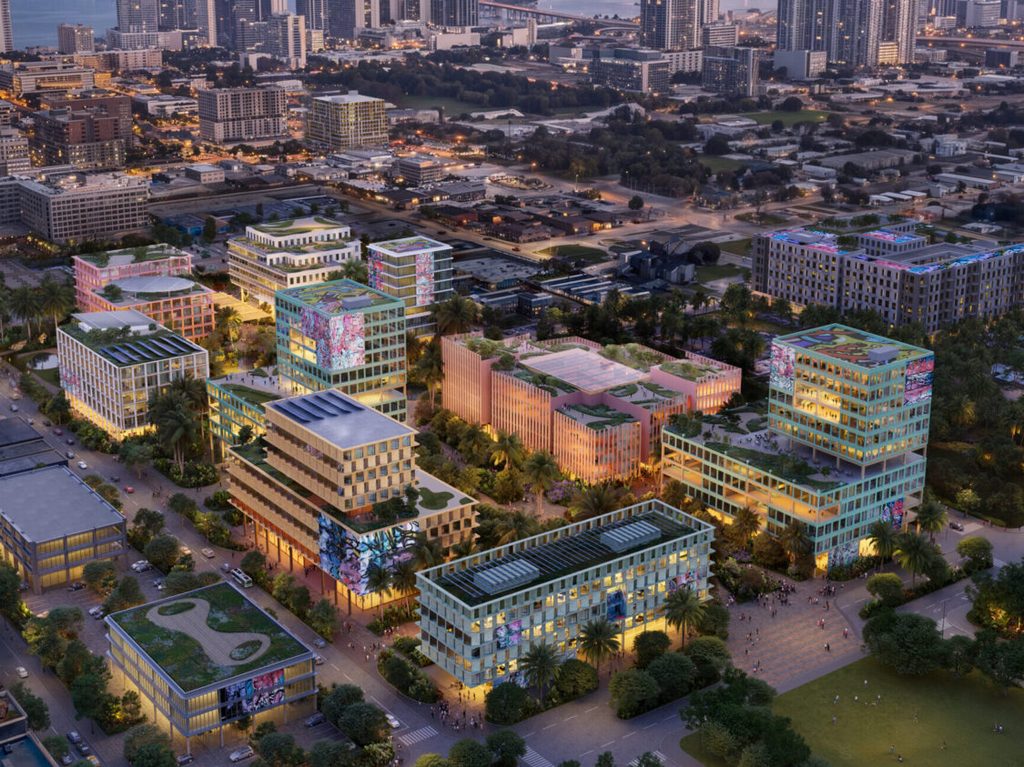
Carnegie Mellon University, the elite private research institution renowned for its strengths in computer science, AI, engineering and robotics, is planting a major new campus in Wynwood, the street-art-filled neighborhood that has become one of the centers of Miami’s tech scene.
Announced Wednesday by Carnegie Mellon and Citadel founder and CEO Ken Griffin, the 35-acre campus is expected to break ground in 2027 and begin enrolling students in 2028, eventually serving more than 3,500 undergraduate and graduate students.
Griffin is committing $2 billion to the Miami campus as part of a $3 billion gift to the university, with his contribution including the value of Wynwood real estate that will be donated to Carnegie Mellon. This donation represents the largest individual gift to a higher education institution. It also secures Griffin a seat on Carnegie Mellon’s Board of Trustees.
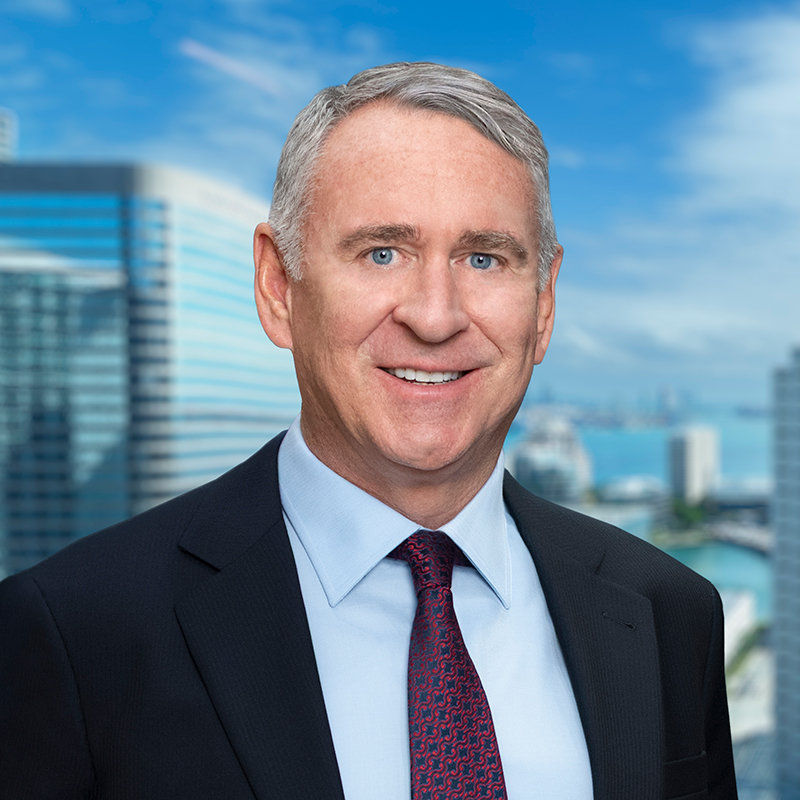
The campus is the product of a years-long push by Griffin [pictured above], who helped broker the deal with Carnegie Mellon and acquired the Wynwood property where the university plans to build. The agreement took two years to negotiate, while Griffin’s $2 billion contribution toward the Miami campus includes the value of land purchased from developer Moishe Mana.
Mana is Wynwood’s largest property owner, with vast holdings from Northwest 20th Street to Northwest 24th Street, and from Northwest Sixth Avenue to Northwest First Place, according to TheRealDeal. The property Griffin purchased for Carnegie Mellon, 318 NW 23rd St., was most recently a convention center hosting a wide range of events, including in the tech and startup space.
Griffin has also been actively purchasing additional property in Wynwood, including the 10-story office building 545 Wyn in a deal completed alongside Miami-based Goldman Properties, the development company that helped shape today’s Wynwood, including a pioneer of the region, The LAB Miami.
Ken Griffin’s community involvement
Griffin, of course, moved his family and his companies, Citadel and Citadel Securities, from Chicago to Miami starting in 2022, and is planning to build Citadel’s 54-story global headquarters at 1201 Brickell Bay Dr. The planned bayfront tower will include office space, a hotel, restaurants, retail and other amenities.
In addition to business, Griffin has become a significant local philanthropist. His giving in Miami-Dade spans education, health, housing/homelessness, youth access to sports, cultural assets and more, often through large leadership gifts to local nonprofits and institutions. What’s more, Griffin joined with fellow billionaire Stephen Ross putting $10 million into a new initiative by the Florida Council of 100 called Ambition Accelerated, with the aim of encouraging more CEOs and their companies to move to Florida and more specifically the Gold Coast – Palm Beach County to Miami.
“Great American cities are anchored by great universities, with almost no exception,” Griffin told the FT. “And the opportunity to bring one of the greatest universities in the United States of America to Miami will change the very fabric of this city for centuries to come.”
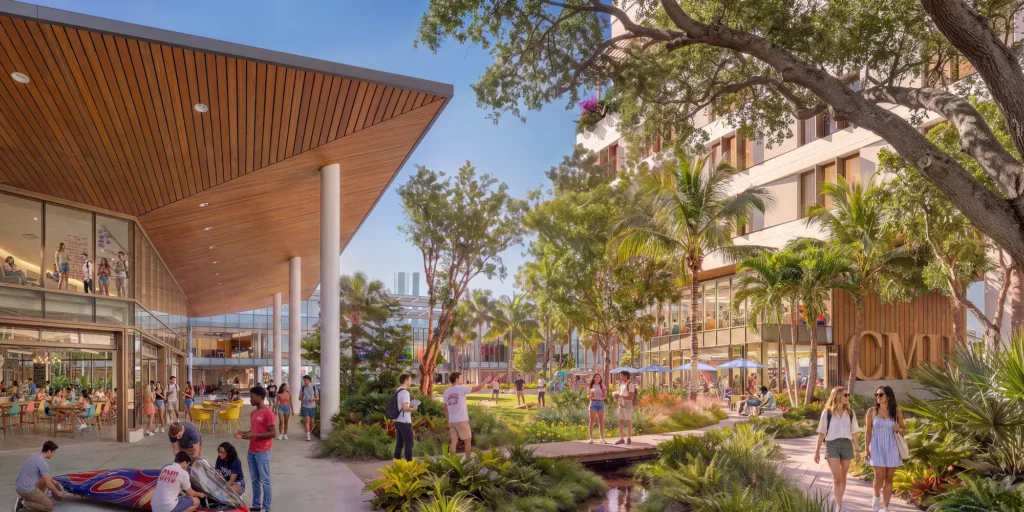
This won’t be a small satellite outpost. Carnegie Mellon University Miami is planned as a 35-acre campus that will eventually serve more than 3,500 undergraduate, master’s and doctoral students, supported by nearly 300 faculty and more than 600 staff. Construction is expected to begin in 2027, with the university targeting 2028 for its first students.
“This will be in some sense the East Coast answer to what happens in Silicon Valley,” added Griffin.
The university also plans to depart from the usual academic model. Rather than organizing the Miami campus primarily around traditional departments and majors, Carnegie Mellon said teaching and research will center on major challenges including human health, national security, energy and climate resilience, and advanced manufacturing. Plans also call for research labs and venture studios, creating a potentially significant new link between the university and Miami’s startup and business communities.
Wynwood, a neighborhood best known for turning warehouses into murals, restaurants, and startup offices could soon add something rather different to the mix: one of the world’s top tech universities.
Carnegie Mellon’s rise to world-class research university
Carnegie Mellon University, founded in 1900 by industrialist Andrew Carnegie in Pittsburgh, is today considered a world-class research university known for blending rigorous theory with hands-on application. This practical, interdisciplinary ethos, with a strong emphasis on entrepreneurship and industry collaboration, has been central to CMU’s rise as a global leader in science, engineering, and technology.
“In launching Carnegie Mellon University Miami, we have the rare opportunity to reimagine what a great university can be in the age of emerging technology,” Carnegie Mellon president Farnam Jahanian shared. “Our answer is an institution that is purpose-built for academic excellence and discovery, grounded in human judgment and dedicated to impact at the scale society now demands.”
Its School of Computer Science at Carnegie Mellon University is consistently ranked among the top computer science programs in the world. The school has played a foundational role in shaping modern computing, contributing breakthroughs in AI, programming languages, cybersecurity, robotics, and human-computer interaction. CMU researchers were among the earliest pioneers in AI research, dating back to the mid-20th century, and the university remains at the forefront of machine learning and autonomous systems.
The university is also home to the Carnegie Mellon Robotics Institute, one of the largest and most influential robotics research centers globally. CMU has led advances in self-driving cars, field robotics, space robotics, and medical robotics, often collaborating with government agencies and industry partners. In Pittsburgh, its close ties to technology companies and startups have fostered a strong culture of commercialization, with faculty and alumni founding numerous influential tech firms. Beyond technical innovation, CMU is also known for integrating technology with other disciplines, including business, design, public policy and the arts.
In the US, Miami will be Carnegie Mellon’s third campus, joining the main campus in Pittsburgh with around 17,000 students and a Silicon Valley branch with 350 students. Carnegie Mellon also has locations in Qatar, Portugal, and Rwanda, according to its website.
Impact on Miami and community reaction
For years, Miami Tech leaders have heard what’s become a common refrain: South Florida doesn’t have enough tech talent. That can certainly be debated. The region already has a strong university system with a growing slate of tech-focused programs, and Vanderbilt University is moving ahead with plans for a graduate campus in West Palm Beach focused on fields including engineering, AI and data science, finance and other emerging industries.
But Carnegie Mellon’s arrival takes those efforts to another level. Miami is set to gain a major campus from one of the country’s leading research universities, and one with deep roots in computer science, robotics, AI and engineering. For Miami Tech, that could mean thousands of students coming through the city, hundreds of new faculty, and a much stronger pipeline connecting research, talent, startups, and established companies.
The partners of innovation hub The LAB Miami said they have long believed Miami, and specifically Wynwood, had the ingredients to become a major technology hub, even while others underestimated the tech ecosystem taking shape. “Thanks to the vision and extraordinary generosity and commitment of Ken Griffin to our city, and the bold leadership of Carnegie Mellon, we will soon be welcoming to our backyard and community thousands of the brightest minds in the world to solve the most important challenges of our time,” Scott Srebnick, Ayal Stern and Danny Lafuente said in a joint statement to Refresh Miami.
For her part, Miami-Dade County Mayor Daniella Levine Cava shared her excitement in a social media post: “Carnegie Mellon’s work in education, research and solving major challenges will only strengthen Miami-Dade as a leading destination for technology and innovation.”
“Today the ceiling of what Miami can become just moved higher,” proclaimed #MiamiTech bull Saif Ishoof. “For years we’ve talked and worked on Miami becoming one of the world’s great centers for technology, entrepreneurship and innovation. Increasingly, the institutional infrastructure is catching up with the ambition.”
Indeed, Wynwood has spent the past decade evolving from an arts district into one of Miami’s main startup and business hubs. Adding Carnegie Mellon to the neighborhood marks another rather significant turn: from a place where tech companies set up shop to one where the next generation of technologists is trained.
This is a developing story. Check back for updates.
Maria Derchi Russo contributed to this story.
READ MORE IN REFRESH MIAMI:
- Palantir plants its HQ flag in Miami
- Brazil-based digital bank Nu prepares to start US operations, building from its US headquarters in South Florida
- a16z plants American Dynamism base in West Palm Beach
- Brazil’s innovative Link School of Business to launch in Miami, drawn by the area’s rising tech scene
- Google more than quadruples its office space in Miami – who’s next?
- Full office, big plans: Simpro Group’s Miami growth story is just getting started
- D-Wave’s HQ move to Boca Raton puts South Florida firmly on the quantum map

- doxx.net raises $38M to put AI agents on a shorter leash – October 1, 2026
- Jeeves raises $110M to take its stablecoin play global – September 30, 2026
- It’s a deal, #MiamiTech! Carnegie Mellon to open a Wynwood campus – September 30, 2026