Miami has become the premier destination for already wealthy Americans since the pandemic, while international migration of the wealthy has accelerated in parallel. The city has established itself as a high-end destination in the same category as Dubai, Monaco, and Singapore: sunshine, lifestyle, lower taxes, and a culture that treats success and capital as features.
The United States has long sorted ambitious young people into a small number of major cities. It used to be New York, Los Angeles, and Chicago. For the past 25 years it’s been New York, Los Angeles, and San Francisco. These cities are large metropolitan spans: the New York tri-state area, the Bay Area, and Greater Los Angeles. Young professionals constantly rotate through them, currently with a rapid flow from New York to San Francisco for the AI boom, and from Los Angeles to New York for entertainment and fashion. These three metros are also the primary destinations for well-educated immigrants.
Miami is not yet part of the coastal metropolis rotation, and our huge opportunity is to change that.
There is already a steady stream of finance professionals arriving. The larger task is to become a full metropolitan area that young professionals treat as a default option rather than a later-career choice. Miami is now expanding into a combined Miami-Palm Beach span some are calling the Gold Coast, with the Brightline train tying it all together. Young people move for the density of peers, jobs, neighborhoods, and optionality, not for a single downtown. It’s normal for people to move to the San Francisco and New York city centers and then out to the suburbs after they get married and have children.
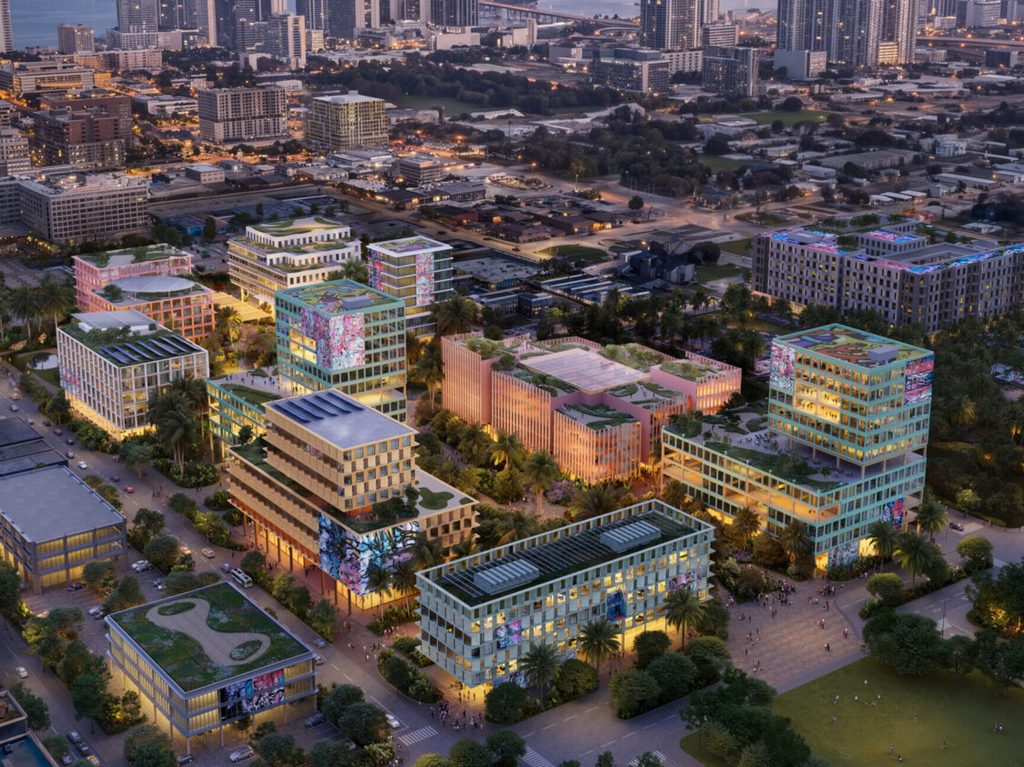
Carnegie Mellon’s arrival is a huge accelerator, and not just because CMU is a top ten technical university. The plan is to build an ecosystem with defense technology, energy, and advanced manufacturing as focus areas. These sectors do not have a single dominant U.S. cluster like software in San Francisco and finance in New York. They are all about to grow exponentially, and the location is up for grabs.
Rendering by Wynwood Catalyst of Carnegie Mellon University Miami
Austin and El Segundo are the current emerging competitors in these sectors, and both are relatively new to them. El Segundo, in particular, has materialized only in the last four years with fewer than 100 startups. Young people are moving to Austin and El Segundo for these types of next generation tech jobs. Ken Griffin is writing checks not only as an education donation, but to create an ecosystem in Miami that will compete head-to-head with Austin and El Segundo. An interesting sign of broader ecosystem development is Alex Slusky joining the Board of Trustees of CMU and the Oversight Board of CMU Miami. Slusky is a hands-on, operations-focused private equity investor who participated in the entire growth cycle of Silicon Valley since the 1990s and moved to Miami a few years ago.
Stay ahead of Miami Tech
Join 16,000+ founders, investors, and tech professionals.
✓
Check your inbox for a confirmation email.
CMU is not the only educational advancement for Miami, The University of Miami and the broader South Florida set of institutions have become top destinations for strong students in recent years. The upcoming Vanderbilt campus in West Palm Beach is a meaningful addition: two of the top 20 universities in the country will sit inside the Gold Coast, nearly comparable to the concentration found in the New York, San Francisco, and Los Angeles metros. For young professional families, private schools have been a persistent complaint. Alpha School could be the unlock: AI-driven, high-quality education delivered in a project-based environment, with a major campus opening in Miami Beach, in addition to two existing campuses in North and South Miami.
Miami’s technology startup ecosystem wasn’t on the radar a few years ago, and it’s already comparable to Seattle and Denver. Organizations like The Lab Miami and eMerge Americas are helping drive a healthy tech ecosystem (yes, the “emerge” in the title of this article is intentional). More industry of the kind CMU is targeting will keep more young people here after graduation and pull additional ones in. The finance sector continues to grow with more firms moving to and expanding in the Gold Coast every month. Space companies are starting to set up around Kennedy Space Center farther to the North.
Miami needs to become part of the coastal metropolis rotation for young people. There is a realistic chance to displace Los Angeles as the sunny coastal option, the same way San Francisco displaced Chicago 25 years ago as a primary destination for ambitious young people. Industry is leaving Los Angeles, and the city continues to struggle with basic services and crime.
The combination of a comprehensive Gold Coast metro area, continuing to grow in AI and software tech, better education options for families, and a serious university-driven industrial base in defense, energy, and advanced manufacturing is the practical kindling needed to make Miami part of the coastal metropolis rotation. The wealthy already treat Miami as a primary destination, and it will soon be a primary destination for the young and motivated.
Peter Yared is a serial tech entrepreneur who moved to Miami Beach 5 years ago after 23 years in San Francisco. He is the founder and CEO of InCountry, a global data management company.