

If you’ve spent a rainy season in South Florida, you know the feeling of watching streets fill with water that has nowhere to go. One Miami startup believes it has a solution to the problem, and it’s not where most people are looking.
Sealor, a coastal resilience technology developed by Miami-based climate-tech venture studio Nexuma, has won a National Science Foundation Small Business Innovation Research (SBIR) Phase II award. The $1.1 million funding will push the company from lab validation into field pilots across South Florida, where aging seawalls, erosion, saltwater intrusion, and bottom-up flooding are becoming a problem that’s hard to ignore.
The technology targets this problem in an innovative way. Seawalls, drainage systems, and roads tend to fail from below, as water moves through porous ground and erodes the support behind coastal infrastructure.
Alexander Suma, founder and CEO of Nexuma and Sealor, brings a background in infrastructure engineering to the problem.
“Florida’s coastal infrastructure is often failing from the ground up,” said Suma. “By the time that cracks, erosion, or seawall collapse become visible, the underground damage may already be advanced. Sealor is designed to address that root cause by turning vulnerable, porous ground into a stronger, sealed, mineralized barrier, using a process inspired by nature.”
Instead of replacing seawalls or patching visible damage, Sealor injects behind existing structures and grows limestone-like material inside the ground itself. The process fills pores and voids, cutting soil permeability and strengthening the ground so water has a harder time moving through it. For property owners and municipalities, that means addressing erosion and void formation without the disruption of a full seawall replacement.
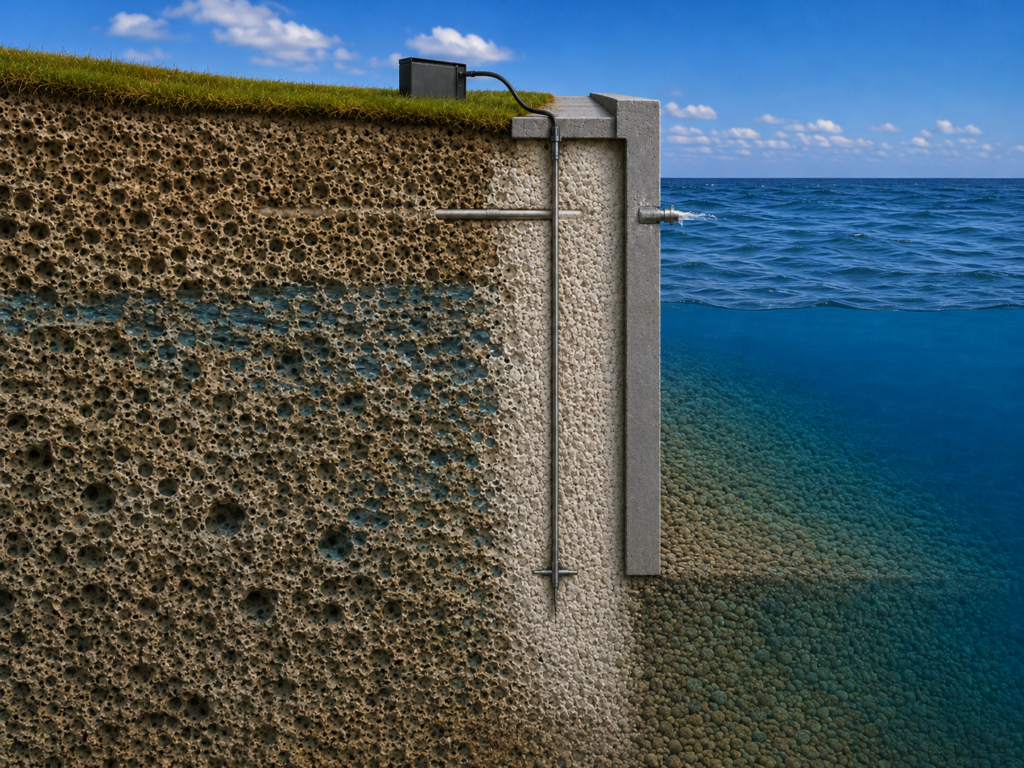
Sealor treated seawall.
Speed has been a major hurdle for this kind of underground treatment, and Sealor just made real progress on it. The company recently cut its treatment time from around 12 weeks down to 8 to 14 days, a shift that matters for anyone weighing reliability and minimal disruption against cost.
Robert P. Smith, the company’s lead microbiologist and a research collaborator at Nova Southeastern University, leads the experimental work behind that biological mineral-formation process.
“Reducing the process time from months to days is a critical achievement for Sealor,” said Smith. “It brings the technology significantly closer to practical implementation and allows us to prepare for pilot projects that can demonstrate performance under real coastal conditions.”
The Phase II award follows a successful Phase I project, where the team validated the technology in the lab and showed it could mineralize and strengthen porous sand and limestone. With seawalls expected to last only about 15 years and repairs often costly and invasive, Sealor is betting that treating the ground itself, rather than the structure sitting on top of it, is the more durable fix.
The company’s initial focus is seawall rehabilitation and coastal ground stabilization here in South Florida. Longer term, Nexuma sees applications extending to foundation protection, saltwater intrusion mitigation, groundwater control, and contamination containment, positioning Sealor as an early entrant into what it calls a new category of subsurface coastal resilience solutions.
For a region facing rising water on nearly every front, that root-cause approach might be exactly the kind of infrastructure innovation South Florida needs.
Pictured at the top of this post: Alexander Suma (left) and Robert P. Smith (right).
READ MORE IN REFRESH MIAMI:
- Inside MOBY Robotics, the Miami startup rethinking how we get critical minerals
- Seaworthy Collective’s Startup Showcase put South Florida’s bluetech scene on full display
- Living seawall: How a waterfront church in Fort Lauderdale is making a historic impact on the environment
- D Squared aims to solve the power and water crisis one microgrid at a time