

The cost of building something has collapsed to near zero.
You can build a full-stack app in just one afternoon. Before lunch, you might have a marketing site, a CRM, a payment system, and an onboarding flow ready to go. While you sleep, AI agents can handle your coding, design your graphics, and even draft your launch emails.
A sixteen-year-old with a laptop and a Claude subscription can ship more in a weekend than a funded startup team could ship in a quarter five years ago.
That sounds like good news. And for a certain kind of founder, it is.
But it also makes one skill dramatically more valuable than it has ever been. And most founders do not have it.
For the last two decades, technical skill was the premium. If you could build, you had leverage. Investors backed engineers.
The founder who could ship code was the founder who got the check.
Marc Andreessen’s “software is eating the world” was not just a prediction. It was a hiring mandate. Every venture firm on Sand Hill Road wanted the same thing: a technical founder who could build fast and iterate faster.
That era is ending.
Not because technical skill is worthless. Because it has become the floor. Everyone has it.
AI has democratized execution to the point where being able to build something no longer signals anything. It is the baseline. It is table stakes.
When every founder in a pitch meeting can say “I shipped an MVP in three days,” that sentence stops being impressive and starts being the price of admission.
Think about what that does to the talent market. In 2015, a full-stack engineer who could build a SaaS product from scratch was a unicorn.
In 2025, you can replace that engineer with a prompt. The value of pure execution has been arbitraged to zero.
AI makes you dangerously efficient at doing things that should not be done.
That is the trap. And it is a trap most founders are walking into with their eyes wide open.
I have been watching the language shift.
A year ago, investors asked founders: “What have you built?”
Now they ask: “What do you see that nobody else sees?”
The difference is everything.
The first question tests for competence. The second tests for something rarer: the ability to read the future before you start digging.
The first question assumes the hard part is execution. The second question acknowledges that execution has been solved, and now the hard part is creativity, ideation and selection.
Every business is a system with stored potential energy. I call this Business Potential Energy. It is the capacity for doing work that sits dormant inside your market, your audience, your product, your distribution channel.
Not all of it has the same energy density. Some of it is coal. It burns, but it takes enormous volume to produce meaningful heat. Some of it is uranium. A small amount, converted correctly, powers everything.
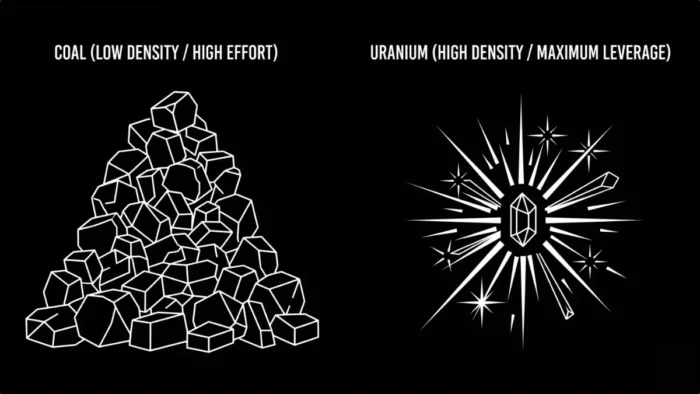
AI can help you mine anything. But it cannot tell you where the uranium sits.
It cannot tell you which vein in your market has the highest energy density.
It cannot tell you which customer segment, if you loaded it first, would make every subsequent move ten times easier.
It cannot tell you that the feature you are about to spend three months building is coal, not uranium.
That is still a human skill. And it is becoming the only skill that commands a premium.
I call it sequencing intelligence.
Sequencing intelligence is the ability to look at a business system, identify which element holds the highest potential energy density, and load that element first. Before anything else.
Before the brand refresh. Before the new feature. Before the podcast. Before the funding round. Before the hire.
Most founders do the opposite.
They see ten opportunities and try to mine all ten simultaneously. They call it ambition. I call it the Busyness Paradox: high input, low output, maximum exhaustion.
They are working harder than anyone in their industry and producing less than the founder who spent six months doing nothing but assaying the deposit.
The founders who win are the ones who can assay before they dig.
They spend more time figuring out what really matters than most founders spend on launching their whole business.
Give me six hours to chop down a tree and I will spend the first four sharpening the axe.
Abraham Lincoln
They don’t start by launching or building. Instead, they begin by studying. They ask questions that might seem slow, and they run experiments that could look like procrastination to people who think being busy means making progress.
This is not a technical skill. It is not something you learn in a coding bootcamp or an MBA program.
It is pattern recognition built through exposure to enough business systems that you develop a feel for where the energy sits.
You cannot prompt your way into it. You cannot automate it.
You have to earn it through reps, through failure, through watching enough businesses succeed and fail that the pattern becomes visible before the outcome.
The ore is always visible in retrospect. After someone strikes it, everyone says “of course.” The money is made by loading the mine before the assay report comes back.
So how do you build this skill – sequencing intelligence?
It starts with a discipline most founders resist: deliberate non-action.
The hardest thing for a builder to do is to not build. To sit with the system. To map it. To ask, before writing a single line of code or recording a single piece of content: “Where is the energy here? What is the one element that, if I loaded it first, would make everything else easier?”
Here is a framework I use with my clients.
When you are staring at a business system with multiple opportunities, run each one through three questions:
First, the energy density question.
What is the potential output of this element if I convert it fully?
Not what I hope it will produce.
What the physics of the system says it can produce. Be honest.
Second, the sequence question.
Does loading this element first pay for the next one? Or does it leave me in a position where I need external fuel to keep going?
The Staircase Strategy demands that each step be achievable today and fund the next.
If loading this element drains resources without generating a return, I can reinvest, it is not the first step. It might be the third step. But it is not the first.
Third, the conviction question.
Do I really think this is the uranium, or am I just choosing it because it looks the best?
Most founders go for the shiniest rock. But the shiniest rock is usually just coal. Uranium doesn’t stand out. It often seems dull. It’s the less exciting distribution channel.
It’s the customer segment that doesn’t get much attention. It’s the feature no one wants to build because it seems boring. But that’s where the real energy is.
If you cannot answer all three questions with clarity, you have not assayed.
You are guessing. And guessing with AI as your execution engine is like giving a sports car to a driver who does not know where the road is. You will go fast. You will crash faster.
The cost of poor sequencing intelligence has always been high. But AI has made it catastrophic.
In the old world, building the wrong thing was expensive but slow.
You would spend six months and a hundred thousand dollars. You would feel the pain. You would learn. You would course-correct.
The friction of execution gave you time to notice you were heading the wrong direction.
In the AI world, you can build the wrong thing in a weekend.
You can build ten wrong things in a month. You can ship an entire portfolio of products that nobody wants, all optimized, all polished, all perfectly useless.
And the worst part: it feels like progress.
You are shipping. You are moving. Your GitHub is green. Your Notion is full. Your team is busy.
But you are burning potential energy at an extraordinary rate without converting any of it into kinetic output.
You are not moving forward. You are just stripping the gears at higher RPM.
I have seen this play out. Founders who used to take three months to build something mediocre now take three days to build something mediocre.
The speed has multiplied. The quality of the output has not. And the quality of the input (the decision about what to build) has not improved either.
They have just accelerated the production of things that do not matter.
This is the Busyness Paradox at AI scale. It means more input. More motion. Same output. More exhaustion.
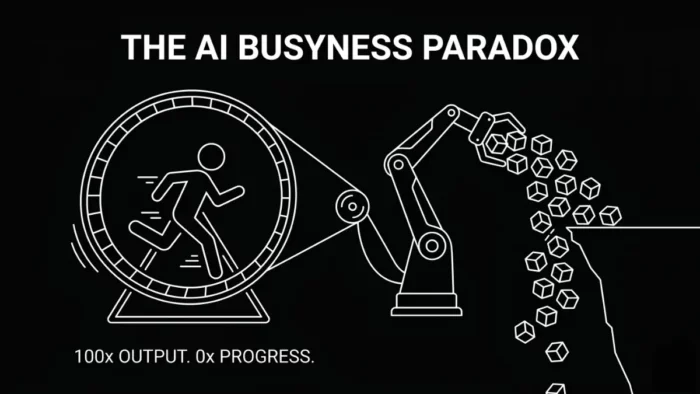
You cannot mine everything at once. You will strip the gears.
The Staircase Strategy says you prioritize not by fantasy benefits but by a specific and executable sequence.
Each step must be achievable today and must pay for the next one tomorrow.
You do not jump to the top of the staircase. You earn each step. You build the foundation. You convert the first deposit. You reinvest the returns. You load the next element.
AI makes it tempting to try to skip. When the cost of building is zero, the temptation to build everything is overwhelming.
Why not launch the product, the newsletter, the podcast, the course, and the community all at once?
Because the physics of business have not changed.
A system can only convert so much potential energy into kinetic output at one time. Overload it and you get heat, noise, and burnout.
The founders who understand this will thrive. They will use AI not as a machine gun but as a sniper rifle. One shot. One target. One conversion. Then the next.
The ones who do not will build more than anyone in history and ship less than a sole proprietor in 1994.
The founder archetype is splitting.
On one side, you have the builder. The builder can ship anything. The builder’s AI stack is immaculate.
The builder launches weekly. The builder’s GitHub is a work of art. The builder is drowning in projects and starving for traction.
On the other side, you have the assayer. The assayer ships slowly. The assayer spends more time studying the system than building inside it.
The assayer asks uncomfortable questions about energy density. The assayer’s GitHub is quiet. But the assayer’s bank account is not.
The builder is the old ideal. The assayer is the new premium.
Investors are already making this distinction. They are not saying it out loud yet, because the language has not caught up to the reality. But watch how they allocate capital.
They are backing founders who demonstrate sequencing intelligence, not just shipping velocity.
They are asking “what is the one thing you chose not to build?” instead of “what have you built?” They are testing for the discipline to say no.
The essence of strategy is choosing what not to do.
Michael Porter
The assayer wins the funding round. The builder wins the GitHub stars. Those are not the same currency.
Right now, sequencing intelligence is underpriced. Most investors are still catching up. They still default to “show me what you’ve built” because that is the heuristic they learned in 2015.
They still get impressed by shipping velocity because most of them have never run a business themselves and they mistake motion for momentum.
But the smart money has already moved. PE firms are training their associates to identify founders who can assay, not just execute.
The question is shifting from “can you build?” to “do you know what is worth building?”
The firms that figure this out first will capture the best founders. The founders who figure this out first will capture the best terms.
If you’re a founder today, the most important thing you can work on isn’t a new technical skill. It’s not building a better AI stack or speeding up your shipping process, either.
What matters most is having the discipline to pause your building and really study what you have. Take time to understand your system, ask the key questions, and spot the valuable parts before you move forward.
Because AI can build anything now. That means everybody can build anything now.
And when everybody can build anything, the only thing that separates the founders who win from the founders who stay busy is the quality of their decisions about what is worth building.
That skill has a name. It is sequencing intelligence. It is underpriced. And the window to develop it before the market catches up is closing.