

I once met a founder who owned forty-three pitch deck templates.
He had the Airbnb deck. The Uber deck. The Sequoia “what we look for” deck. Three different versions of the Guy Kawasaki 10/20/30.
He had reformatted every single one into his company’s brand colors, swapped in his logo, and saved them in a folder called Fundraising — Final.
When I asked him to tell me what his company did, he talked for eleven minutes.
Yes, eleven minutes. And after the first two minutes, I simply lost the track.
He couldn’t do it in one sentence. He couldn’t do it in three.
His answer was a maze of qualifiers, pivots, and market-sizing statistics that never arrived at a point.
But his templates? Immaculate.
I call this Template Hoarding.
And if you recognized yourself in that story, you are not alone. You are part of a generation of entrepreneurs who have confused accumulation with preparation, and the cost is higher than you think.
The Quiet Addiction Nobody Talks About
Template Hoarding is the act of collecting frameworks, swipe files, pitch decks, Notion dashboards, and productivity systems as a substitute for doing the actual thinking your business requires.
It wears the costume of preparation. It looks like diligence. It feels like progress.
However, it produces nothing.
Here is how I know you have it.
Open your hard drive right now. Count the number of templates you have downloaded and never used.
Count the saved or bookmarked tweets you told yourself you would “come back to later” and instead turned into a second feed to scroll.
Count the Notion dashboards you spent a Saturday building, convinced you were setting up infrastructure, when what you were really doing was avoiding the one decision you were afraid to make.
The first principle is that you must not fool yourself — and you are the easiest person to fool.
Richard Feynman
If the ratio of templates owned to templates shipped is higher than three to one, you are not preparing. You are hiding.
Template Hoarding is efficiency without direction. It is motion, not action.
Yes, you are moving. But, you are not arriving anywhere.
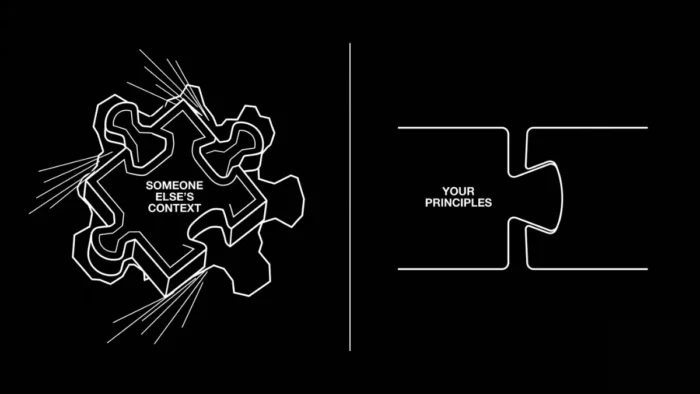
The psychology is not complicated.
Every template is a promise: someone already figured this out, so you don’t have to.
That promise is intoxicating to an entrepreneur who is already drowning in decisions.
Why think when you can copy? Why invent when you can inherit?
But here is what the template does not tell you.
It was built for someone else’s context. Someone else’s assumptions. Someone else’s constraints.
The Airbnb pitch deck worked because Airbnb had already proven product-market fit before they put a single slide together.
The framework you downloaded from a LinkedIn influencer was extracted from a business at a different stage, in a different market, with a different team, facing a different set of problems than the one sitting on your desk right now.
When you apply a template without understanding the principles underneath it, you are not solving your problem.
You are solving someone else’s problem and hoping yours disappears in the process. It never does.
This is the dangerous part.
Template Hoarding is not laziness. It is productive procrastination: the most seductive form of avoidance because it generates output that looks like input.
You can point to the deck. You can show someone the dashboard. You can say “I’ve been working on our strategy” and mean it.
But strategy is not a document. Strategy is a set of choices you make when the situation is ambiguous and the right answer is not obvious.
A template removes the ambiguity by pretending it does not exist. A principle equips you to navigate it.
A principle is a constraint you apply when the situation is ambiguous.
As to methods there may be a million and then some, but principles are few. The man who grasps principles can successfully select his own methods. The man who tries methods, ignoring principles, is sure to have trouble.
Harrington Emerson
That is the definition I work from.
It is not sexy. It will not go viral on its own. But it is the difference between founders who build things and founders who rearrange other people’s building blocks.
When you have a principle, you do not need the situation to match the template-maker’s assumptions. You bring the rule with you and apply it to whatever is in front of you.
Here is an example.
If you read my articles you already know that one of my principles is the “So What?” test.
Every piece of work I conduct has to survive a single question: so what?
If the answer is not immediately obvious to the person receiving it, the work is not ready.
That principle applies to a pitch deck, a product launch email, a hiring decision, and a pricing strategy.
It does not care about format. It does not care about industry. It travels.
Now contrast that with a template.
A pitch deck template tells you to put the problem on slide three and the solution on slide five.
It does not tell you whether your problem is worth solving. It does not tell you whether your solution is differentiated.
It cannot. Templates are rules about arrangement.
Principles are rules about judgment.
Arrangement without judgment is decoration.
If you are sitting there with a hundred templates and the uncomfortable feeling that I am describing your last six months, here is what you do next.
1. Audit the hoard.
Go to your hard drive, your Notion, your Google Drive, your saved tweets, your bookmarked LinkedIn posts.
Count every unused template, framework, and swipe file. Do not justify any of them. Do not tell yourself “I’ll need that one later.” Just count.
The number will embarrass you. That is the point.
You cannot fix a problem you refuse to look at.
Template Hoarding survives on self-deception. Counting breaks the spell.
2. Extract the principle.
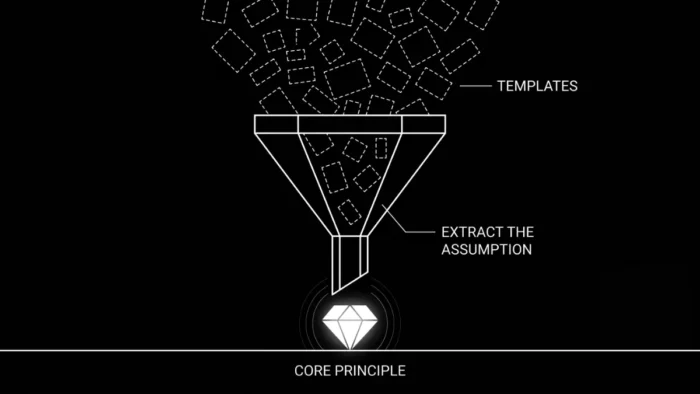
For every template you have kept, ask one question:
What does this assume to be true?
Not “what does this say.” Not “how do I fill it in.”
What does it assume about the world, about customers, about what matters and what does not?
That assumption is the principle the template was built on. The template itself is just the decoration.
You will find that most templates rest on three or four principles at most.
The Airbnb deck assumes investors care more about traction than vision at the early stage.
The Kanban board assumes that visualizing work reduces the cost of coordination.
The Notion dashboard assumes that clarity of inputs produces clarity of outputs.
Write down the assumptions. Throw away the template.
3. Condense to one page.
It is not a daily increase, but a daily decrease. Hack away at the unessential.
Bruce Lee
Take every principle you have extracted and put them on a single page. Not a document. Not a folder. One page.
If a principle does not survive the compression, it was not a principle. It was a preference dressed up as a rule. Kill it.
The goal is not to preserve everything you collected.
The goal is to surface the five to ten rules you would actually stake a decision on.
My page has nine principles on it.
Yours might have seven or twelve.
The number does not matter. What matters is that every entry on that page is a rule you trust enough to override your instinct when the two disagree.
4. Consult the page, not the folder.
The next time you face an ambiguous situation, a decision with no obvious right answer, do not open your template folder.
Open the page.
Run the situation through each principle. Does it pass the “So What?” test?
Does it respect the Staircase Strategy, or are you trying to jump to the top?
Is it high energy density or is it coal?
Templates answer “how.”
Principles answer “whether.”
Most entrepreneurs spend their careers optimizing the “how” of things that should never have been started. The page protects you from that.
5. Let principles evolve.
Here is the final difference between a template and a principle.
A template is frozen. It was built for a moment that has already passed by the time you download it. You cannot improve a template without breaking its structure.
A principle sharpens with use. Every time you apply a principle and it fails, you learn something about its limits.
Every time you apply it and it works, you learn something about its range. Over time, your page gets shorter and sharper. The weak principles fall off. The strong ones become instinct.
This is why one page of principles beats a hundred templates.
Templates accumulate. They do not evolve. They sit in folders, multiplying, while your judgment stays exactly where it was when you downloaded the first one.
Principles, applied over years, become the thing templates try and fail to replicate: a mind that knows what matters without being told.
There is a moment every entrepreneur faces, usually alone, usually late at night, when the template folder is open and the cursor is blinking and something inside you whispers that this is not really work.
That rearranging someone else’s structure is not the same as building your own.
Most people close the whisper and keep formatting. It is easier. It looks responsible. Nobody can accuse you of not trying when you have eighty slides to show for it.
By now, you probably realize that templates can be an excuse to stop thinking for yourself. You also know that judgment is your most limited resource.
It’s not information, time, or money that’s most scarce. It’s judgment—the skill to recognize what matters when the answer isn’t obvious.
One page of principles forces you to exercise that muscle every single day. A hundred templates let it atrophy.
So here is the choice.
You can keep collecting.
The internet will never run out of templates for you to download. There will always be another deck, another dashboard, another system that promises to solve your problem if you just borrow someone else’s thinking hard enough.
Or you can close the folder.
Open a blank page. And write down the rules you are actually willing to be governed by.
Templates are the comfort of imitation. Principles are the discomfort of having to think.
Pick one.