

Most entrepreneurs are not experimenting. They are “trying things out” and calling it strategy.
They launch a feature, tweak a landing page, run a few ads, and when nothing moves, they try something else.
That is not experimentation. That is only motion, because there is no action.
Experimentation, or better said, real experimentation, is a discipline. Simply, it has a method, a structure, and a score you can measure and compare.
And when you treat experimentation in such a way, you simply stop burning cash on prognostications and start building an engine that converts uncertainty into validated learning.
In God we trust, all others must bring data.
W. Edwards Deming
Working with hundreds of clients, I built the C.A.L.I.B.E.R. Experimentation Framework to give them exactly that: a simple scientific operating system for running high-velocity, risk-calibrated experiments.
This article walks you through the entire framework, the Strategic Action Matrix, and the North Star metric I call the Exploration Efficiency Index.
Before you run a single experiment, you need to know which world you are operating in.
Most founders skip this step entirely, and it is the reason half their experiments produce garbage data.
Modern management science distinguishes between two fundamentally different venture contexts.
If you apply the wrong method to the wrong context, you are not just wasting time. You are making decisions on false signals.
Type I: The Uncertainty World.
Here, there is no existing market data.
Nobody has built what you are building. You cannot survey customers because they do not have the language to describe what they need.
The future is simply genuinely unknowable.
Your job in this world is not to validate a hypothesis. It is to create opportunity through action, co-creation, and conversation.
You move like someone navigating a dark forest with a flashlight: you only go as far as the beam reaches, and you bring partners who can help you find solid ground.
Type II: The Risk World.
Here, the market exists.
Customers exist. The opportunity is real, but it is hidden behind information you do not yet have.
Your job is to run quasi-scientific experiments, collect data, and systematically reduce uncertainty.
Think A/B testing, customer discovery interviews, and the Lean Startup method.
The mistake I see most often is what I call the Visionary Trap: an entrepreneur operating in the Uncertainty World tries to run Type II experiments.
They ask customers for feedback on a product the market has no language to understand. The data comes back clean, and it is completely meaningless.
The opposite mistake, the Execution Trap, is just as lethal: building a full team and organizational structure before the core business math has been validated.
The C.A.L.I.B.E.R. Framework exists so you never fall into either.
The engine of the framework is a 2×2 matrix.
On the vertical axis, you plot your level of environmental uncertainty: Knightian Uncertainty at the top, Objective Risk at the bottom.
On the horizontal axis, you plot your mode of action: Prediction-Oriented on the left (goal-driven, analytical), Control-Oriented on the right (means-driven, co-creative).
This gives you four quadrants, and each one demands a different set of tools.
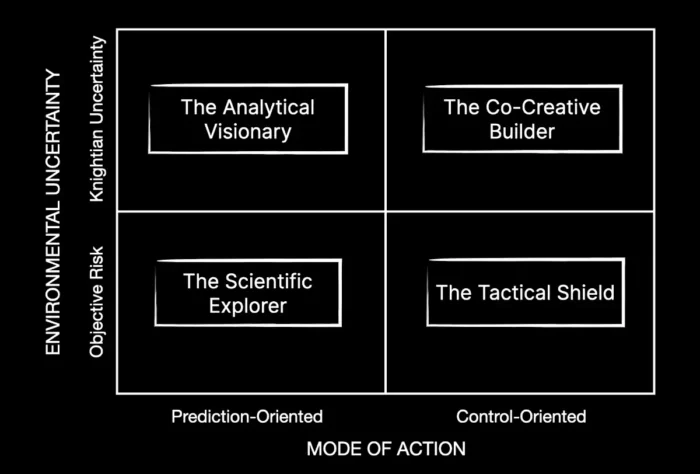
Quadrant I: The Analytical Visionary (Top-Left).
You are in the Uncertainty World but you are taking an analytical approach.
This is where you formulate a contrarian belief about unobserved value and deploy backward planning to verify the structural math.
You are not asking customers what they want. You are building a theory and stress-testing it from the top down.
Quadrant II: The Co-Creative Builder (Top-Right).
The best way to predict the future is to create it.
Peter Drucker
Same Uncertainty World, but now the approach is control-oriented.
Simply, you limit your risk by setting an affordable loss, and you bring in committed stakeholders who offer resources, feedback, and help shape the process together.
Instead of making predictions, you work alongside people who are already involved.
Quadrant III: The Scientific Explorer (Bottom-Left).
You are in the Risk World with an analytical posture.
This is Lean Startup territory.
You isolate your leap-of-faith hypotheses, define Learning Junctions with clear IF/THEN thresholds, and you do not move forward until the data tells you to.
Quadrant IV: The Tactical Shield (Bottom-Right).
You are in the Risk World but you are taking a control-oriented approach.
Here, you balance the three dimensions of your MVP (Aesthetic, Functional, Symbolic) and you tighten your experimental scope to protect against appropriation and reputation risk.
Every initiative on your plate belongs in one of these four quadrants.
If you are running Quadrant III experiments on a Quadrant I problem, stop. You are in the Visionary Trap.
If you are building organizational structure before your Quadrant III math is solid, stop. That is the Execution Trap.
Now let us walk through each component of the C.A.L.I.B.E.R. mnemonic. These are the operational tools that live inside the matrix.
C — Contrarian Belief.
Economic breakthroughs do not come from looking at existing customer data. That data leads to safe, incremental, and highly contested ideas.
The real breakthroughs come from a belief asymmetry: a theory you hold that the rest of the market has not yet seen.
Imagine looking at a starry night sky without a map. You see chaotic bright dots.
Now imagine you have a specific astronomical theory. Suddenly, you see constellations.
The theory dictates what stars become visible in the first place.
Your contrarian belief is that theory. Without it, you are just staring at noise.
A — Affordable Loss Envelope.
When you cannot predict the future, do not pretend you can. You must set a strict cap on time, money, and reputation before you start.
How many hours are you prepared to spend?
How much money are you prepared to risk losing completely?
Which of your main assets are essential and must be protected?
You are not reducing risk; you are setting limits on it.
You are saying: “I can lose this much, and I will still be in the game.”
L — Learning Metric.
Early-stage ventures die because they track financial metrics too early.
When you are testing an experimental airplane, you do not measure ticket sales. You measure wing-stress indicators and drag coefficients.
Ticket sales are meaningless if the wings snap off mid-flight.
Your Learning Metric is the user behavior that tells you whether your riskiest assumption is holding.
Signups, not revenue. Preorders, not profit.
And you set a Learning Junction: IF the metric hits X, we learn Y. IF it fails, we learn Z.
No ambiguity.
I — Identify Stakeholders.
In many ventures, the people who benefit from your product are not the people who pay for it.
The C.A.L.I.B.E.R. Framework simply recognizes two groups of stakeholders: Entitled Stakeholders, who are the beneficiaries your venture serves, and Enfranchised Stakeholders, who provide resources like capital, labor, and commitment.
The main idea is straightforward: work together, not alone.
Invite both groups to join the conversation and create together. One group can provide the soil, another can bring the seeds, and the people who benefit can design the playground.
The output is built from committed, local resources, not speculative fantasies.
B — Backward Planning.
Conventional plans start at the bottom and project upward. They are optimistic fiction.
Backward planning starts at the top, with the required net income target, and works backward to calculate the exact number of transactions, the unit economics, and the market realities needed to make success possible.
It is like planning a high-altitude climb from the summit, not the base camp.
You calculate exactly how much oxygen the final push requires, and that dictates every camp placement and every dollar of your starting budget.
If the math does not close, you know it before you spend a cent.
E — Experimental Realism.
An MVP is not one thing. It is a tangible representation of your concept along three dimensions: Aesthetic (how it looks), Functional (how it works), and Symbolic (how it feels).
The danger is the Reputation Exposure Gap.
If your Symbolic and Aesthetic realism are sky-high (gorgeous trailer, emotional promises, slick branding) but your Functional realism is near zero, you are priming your venture for a public collapse.
Imagine a video game that launches with an amazing trailer, gets millions of preorders, but ends up being released in a broken, unplayable state.
When there is a gap between what a brand promises and what it delivers, that is often where brands fail.
R — Risk Mitigation.
You do not test an unproven pharmaceutical drug on the entire global population. You test it transparently with a small, voluntary cohort.
The same logic applies to your MVP.
Keep your experimental scope narrow. Limit your sample size. Disclose, explicitly, that what people are seeing is an experiment.
This protects you from appropriation risk (incumbents copying your concept) and reputation risk (users feeling misled when the product is not yet finished).
A framework is only as good as the score you can attach to it. I call the C.A.L.I.B.E.R. North Star the Exploration Efficiency Index, or EEI.
The formula is: EEI = (Vc × La) / (C_test × R_cap)
Let me translate each variable into plain language.
- Vc (Velocity of Learning Checkpoints): How many structured experiments did you complete this quarter? This is an important number because the more experiments you complete, the more you learn.
- La (Leveraged Assets): How many stakeholder commitments did you secure on your own? Each committed partner helps you multiply your impact by bringing resources, feedback, and distribution.
- C_test (Cost per Test) is the total amount spent on experiments divided by the number of experiments you finish. A lower number is better because you want your cycles to be cheap and fast.
- R_cap (Reputation Exposure Gap) is your Symbolic Realism score minus your Functional Realism score. If your product seems impressive but does not work well, this gap will be large. If the gap is zero or negative, use 1 instead to keep the math working..
A score above 10 means you are operating a high-velocity experimentation engine.
Your experiments are fast and cheap. Your stakeholders are multiplying your effort. And your promises are tightly aligned with your functional reality.
A score below 1 means you are a capital drain.
Your experiments are slow and expensive. You are running them in isolation. And you are making aesthetic promises your functional product cannot keep.
Your venture is structurally primed to collapse.
The EEI does not lie. It tells you whether you are learning or just spending.
A framework without habits is a museum piece.
It looks good on the shelf and changes nothing. The C.A.L.I.B.E.R. Framework is powered by four recurring ceremonies.
The Monday Morning Huddle (15 minutes).
Every team member reviews their core metric.
If something is lagging, the question is not “Who is responsible?” The question is “What small experiment can we run this week to solve this subproblem?“
No blame. Just obstacles and testable solutions.
The Friday Afternoon Demolition Check (30 minutes).
Review the data from the week’s micro-experiments.
Document and celebrate the failed hypotheses. Say it out loud: “We spent $100 and learned that customers do not value X. We have successfully cleared away a wrong option.”
Failure is not a mistake. It is a necessary byproduct of business R&D.
I have not failed. I’ve just found 10,000 ways that won’t work.
Thomas Edison
The Monthly Crazy Quilt Stakeholder Alignment (1 hour).
Gather your enfranchised and entitled stakeholders. Share your raw, unpolished experimental learnings.
Ask for feedback and encourage everyone to share resources. This way, they can help shape new features and changes to the business model together.
The crazy quilt principle says that the best ventures come from committed, local contributions rather than following just one plan.
The Quarterly Real Options Board Review.
Treat your internal project pipeline like a venture portfolio.
Stop funding projects based on political alignment or elegant slide decks.
Release the next stage of capital only to teams that provide objective experimental evidence that their riskiest assumptions have been resolved.
You do not need to adopt the entire framework on Monday morning. Pick one letter. Run one micro-experiment. Measure one thing.
Here is a starting point: grab a blank sheet of paper. Draw the 2×2 matrix. Plot your three current initiatives on it.
Ask yourself: “Am I in the right quadrant for each one?“
If you find yourself in the Visionary Trap, where you are running Type II experiments on a Type I problem, pull the plug. Switch to an affordable loss envelope and a stakeholder conversation.
That single move will save you months of wasted motion.
The C.A.L.I.B.E.R. Framework is a system for converting your business’s stored potential energy into kinetic output. But it only works if you use it. A framework is not a book you read. It is a machine you run.
Stop trying things out. Start experimenting.