

Let’s be honest about something most strategy consultants will never tell you: traditional strategic planning is broken.
If you have ever spent weeks or months creating a five-year plan, adjusting spreadsheets, and putting together impressive slide decks, only to see a sudden circumstance change, a supply chain problem, or an unexpected competitor destroy your main ideas in the third month, you know exactly what I mean.
You get that familiar, sinking feeling. Another elegant model defeated by a messy, unpredictable reality.
We sit in our boardrooms and pretend we have a crystal ball, but here is the uncomfortable truth: we are often flying blind, and the forecast we just signed off on is little more than a sophisticated guess dressed up in financial modeling.
A recent survey found that 88% of executives report their organizations face unprecedented levels of uncertainty, and it’s so hard to manage risks.
And yet, when the pressure mounts, most teams members fall back on the same tired tools: last year’s numbers plus 5%, a linear projection extended three years out, a “worst case” that is really just the base case with slightly smaller font and lower margins.
This is not strategy. This is procrastination disguised as planning.
Plans are worthless, but planning is everything.
Dwight D. Eisenhower
The world’s most resilient organizations do something fundamentally different. They change the question driving their strategy. They stop asking “What will happen?” and start exploring “What could happen?“
This is the power of scenario thinking. In this guide, I’ll explain what it is, why it can feel challenging, how to create scenarios that lead to real decisions, and a framework you can use with your team right away.
Scenario thinking is a structured process for exploring multiple plausible futures.
It allows you and your team to manage uncertainty and prepare for a range of possible developments, rather than betting the entire organization on a single-point prediction.
This approach was not created by a Silicon Valley startup or found in an agile coaching guide. Simply put, it started as a military plan at the RAND Corporation in the 1950s and 1960s, when experts dealt with the serious challenges of Cold War nuclear threats.
When the consequences of being wrong include global catastrophe, you learn very quickly that a single forecast is not enough.
By the 1970s, Royal Dutch Shell famously adapted scenario planning for business. While other energy companies were building rigid financial models based on the assumption that oil prices would remain stable, Shell’s planners were creating narratives about what might happen if a geopolitical crisis choked off supply.
When the 1973 oil crisis happened, Shell did not rush to come up with a new strategy. They had already thought through this kind of situation in advance. As a result, they quickly outperformed competitors who were still relying on forecasts that no longer matched what was happening.
But to use scenario thinking effectively, you need to understand what separates it from the tools you are probably using right now.
| Feature | Traditional Forecasting | Risk Management | Scenario Thinking |
| Core Question | Feature | Traditional Forecasting | Risk Management |
| Foundation | Core Question | “What will happen?” | “What could go wrong?” |
| Best Used When | Foundation | Extrapolating historical data and current trends | Quantifying the probability and impact of discrete, known threats |
Here is the simplest way to remember the difference.
Forecasting tries to predict the exact weather. Risk management buys umbrellas just in case. Scenario thinking builds a business model that thrives whether it rains, snows, or the sun shines perfectly.
The first two treat uncertainty as an enemy to be eliminated. Scenario thinking treats it as a feature of the landscape, something to be understood and adapted to, not wished away.
If the business case for scenario thinking is so clear, why do most organizations still default to single-point forecasting?
The answer is not a lack of intelligence or data. It is human biology.
The brain is wired with cognitive biases that systematically limit our ability to anticipate uncertainty, and most corporate cultures actively reward the very behaviors that make these biases worse.
Doubt is an uncomfortable condition, but certainty is a ridiculous one.
Voltaire
Simply, when you use scenario thinking, you are staging a psychological intervention for your leadership team.
Here is how it rewires the three most dangerous mental traps.
Confirmation Bias
We naturally seek out evidence that confirms what we already believe, while dismissing or ignoring information that contradicts it.
If your team believes your flagship product is the gold standard, they will subconsciously dismiss every possible warning sign of a disruptive competitor. They will interpret flatlining customer retention as “a seasonal trend” and a startup’s Series B raise as “overhyped noise.”
Scenario thinking forces your team to construct alternative futures where your core assumptions are wrong.
By making it safe to talk about a world where your product is obsolete, you strip the ego out of the conversation. You stop defending the forecast and start examining it.
Anchoring Bias
We over-rely on the first piece of information we receive.
In budgeting, we look at last year’s revenue and add or subtract 5%.
In strategy, we look at last quarter’s market share and project forward.
We are anchored to the recent past, and every “future state” we imagine is really just the present with slightly “beautifully” adjusted numbers.
Scenario development deliberately disrupts this anchor. By exploring how different starting conditions lead to fundamentally different worlds, it forces the team to build the future from the ground up rather than projecting the past forward.
The Availability Heuristic
We overweight recent or emotionally charged events.
If a supply chain shock just cost you three months of revenue, you spend all your energy planning for the next supply chain shock, while a looming cybersecurity threat goes completely unexamined.
Your attention follows the last crisis, not the next one.
Building multiple scenarios forces your team to look at the “long tail” of possibilities: developments that are not obvious today but could have massive consequences tomorrow.
When you often think about these stories, you strengthen what researchers call prospective memory. This is the skill of using imagined futures to guide your choices right now.
So, when a real crisis hits, your organization does not freeze. You shift from a culture obsessed with “being right” to a culture defined by “being prepared.”
Let me give you one specific example. To protect client confidentiality, I’ve combined details from several real projects.
In early 2023, one B2B software company had problems responding to the rapid rise of Generative AI. Each strategic meeting ended in a heated argument without any clear solution.
The CTO simply suggested shifting the whole engineering team to develop a proprietary AI model. On the other side, the CFO preferred to set aside the AI trend and concentrate on the company’s profitable core features. Meanwhile, the VP of Sales pushed to quickly partner with a major tech conglomerate before competitors secured all the valuable partnerships.
Three credible strategies. Zero alignment. Total paralysis.
Instead of letting the debate drag on for another quarter, they ran a rigorous scenario thinking workshop. They identified two critical uncertainties:
- AI Regulation: Will governments impose heavy restrictions, creating high barriers to entry? Or will the space remain largely unregulated?
- AI Adoption Rate: Will B2B customers demand AI features in every tool immediately? Or will trust, privacy, and hallucination concerns cause slow, gradual adoption?
By simply plotting these on a 2×2 matrix, they were able to create four distinct futures:
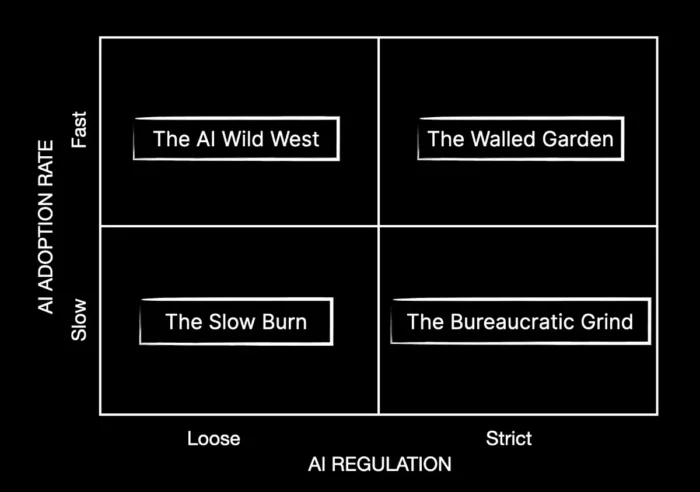
- The AI Wild West (Loose Regulation, Fast Adoption): Company’s core product becomes obsolete within 18 months. Survival requires acquiring an AI startup immediately just to keep pace with the feature race.
- The Walled Garden (Strict Regulation, Fast Adoption): Large corporations are terrified of data leaks. CloudSync’s biggest advantage lies in building the most secure, compliant, closed-loop AI tool on the market, avoiding open-source models entirely.
- The Bureaucratic Grind (Strict Regulation, Slow Adoption): AI proves to be a costly distraction buried under red tape. The winning move is to double down on traditional core features and let competitors burn cash on AI compliance.
- The Slow Burn (Loose Regulation, Slow Adoption): If customers are curious but cautious, the best strategy is to slowly integrate third-party open-source AI features as optional beta tests, without gambling the entire R&D budget of the company.
Here is where the exercise paid for itself ten times over. When the executive team studied all four scenarios side by side, they had a massive breakthrough.
In three out of the four futures, heavy immediate investment in building a proprietary AI model was a losing bet.
They found a strategy that works for many possible futures. By building a secure and flexible API structure, they can connect to any AI model, whether it is proprietary, open-source, or tightly regulated.
Also, they stopped arguing about predicting the future and built an adaptive strategy that thrived regardless of which reality emerged.
That is the difference between forecasting and scenario thinking.
One gives you a number. The other gives you a capability.
Are you ready to try this on your own? Here’s how the system works.
Step 1: Define the Focal Question and Scope
A good scenario exercise starts with a clear, specific problem. If your scope is too broad, like asking “What is the future of our business?”, the exercise won’t work well.
Start with a specific question and a concrete timeline. Align your time horizon with your industry’s pace of change.
A tech company might look 3 to 5 years out. An infrastructure or energy firm, given long asset lifecycles, might look 15 to 20 years ahead.
For example: “How will changing data privacy laws impact our primary revenue streams in North America by 2028?“
That is specific. It has boundaries. It forces the conversation toward actionable insights instead of vague philosophizing.
Step 2: Map the Driving Forces
Now look outside your four walls.
Catalog every macro and micro force that could influence your future. Use the PESTLE framework (Political, Economic, Social, Technological, Legal, Environmental) to force your team beyond their departmental silos.
Do not just list the obvious trends everyone is already talking about.
Hunt for “weak signals”: a small piece of pending legislation, a fringe social movement that could gain mainstream traction, a technology in its earliest adoption phase.
Step 3: Identify Critical Uncertainties
Use each driving force from Step 2 and place it on an impact-uncertainty matrix. Look at each factor based on how much it could affect your business and how uncertain its future is.
You are hunting for the variables that are both highly impactful and highly uncertain.
A trend like “aging population” is highly impactful but highly certain. We know it is happening; the question is not if, but how fast. It does not belong on your matrix.
The top two forces that score high on both dimensions become the X and Y axes of your 2×2 scenario framework.
Step 4: Develop Scenario Narratives
This is where the work transforms from analysis into strategy.
Construct internally consistent, plausible stories for each of your four quadrants. These must not be lazy “optimistic” and “pessimistic” versions of the same future. They must represent fundamentally different ways the world could work.
Give each scenario a memorable name. “The AI Wild West.” “The Fortressed World.” “The Slow Burn.”
The name matters because it becomes shorthand your team can use in future conversations. A good scenario name carries the entire narrative in two or three words.
Write a story that shows how these trends connect. Describe the path from today to this future. What events changed things? Who came out ahead, who fell behind, and what made the difference?
Step 5: Test and Validate
Don’t just rely on your first draft. Challenge your scenarios to make sure they are believable, clear, and meaningful.
Invite a Red Team—people who are not part of your planning group, or even from outside your company—to look for weaknesses in your plans. Ask questions such as, “Do these stories genuinely challenge our existing assumptions?” and “Do they cover the full range of possibilities, or did we leave out the future where we lose?”
If your Red Team cannot find at least one uncomfortable truth in each scenario, the scenarios are not doing their job.
Step 6: Derive Strategic Insights
The goal of forecasting is not to predict the future but to tell you what you need to know to take meaningful action in the present.
Paul Saffo
Scenarios are useless if they do not change how you act today.
Look for moves that are robust: actions that benefit your company in multiple scenarios, not just one.
These are your no-regret investments.
Identify “signposts”: early warning indicators that suggest one specific scenario is starting to materialize in the real world.
If Scenario B begins with a specific competitor acquiring a specific technology, set up a system to track that trigger point so you can shift strategy immediately when you see it.
Even experienced teams stumble when learning this skill. Watch for these five failure modes.
Disguised Predictions
This is the most common trap. Teams create scenarios that are just linear variations of the same basic trend.
Scenario A is 5% growth. Scenario B is 10% growth. And scenario C is 2% growth.
This is not scenario thinking. This is lazy financial forecasting with better slide design.
You must explore fundamentally different futures, not just different numbers inside the same future.
Analysis Paralysis
Your team might get excited and try to map out twelve different futures.
Do not.
Research consistently shows the optimal number of scenarios is three to four.
Any more than that, and decision-makers get overwhelmed, fail to extract clear strategic insights, and walk away from the exercise thinking it was an interesting academic exercise with no practical application.
The Gray Rhino Blind Spot
Planning for wild Black Swan events like alien invasions, global EMPs, or asteroid strikes can be entertaining.
However, when teams focus on these unusual scenarios, they often overlook the obvious and likely threats that are right in front of them.
These are the Gray Rhinos: the demographic shift you have known about for a decade, the regulatory change that has been in committee for two years, the competitor who has been hiring away your talent for six months.
Make sure your scenarios include both dramatic possibilities and the trends that are already happening.
The Superhero Syndrome
I notice this all the time. In every scenario, the team ends up writing a story where their company comes out on top, often without realizing it.
You must be willing to write a scenario where your company gets destroyed. Not because you believe it will happen, but because that is the only way to honestly identify the vulnerabilities you need to address today.
The “One and Done” Failure
Static scenarios lose relevance quickly.
You must establish a rhythm: quarterly reviews, annual full refreshes, continuous monitoring of signposts.
Scenario thinking is a process, not a document. The scenarios you build this quarter are a snapshot of your thinking at this moment. They must evolve as new information and new patterns emerge.
You do not need to rent a hotel ballroom for a three-day offsite to start rewiring your team. Run this exercise at your next leadership meeting.
- Step 1 (5 minutes): Simply, start by setting the scene. Say to your team: “It is exactly three years from today. Our core product has completely failed. Our market share is close to zero. Our biggest competitor just bought our remaining assets for pennies on the dollar.”
- Step 2 (10 minutes): Here, ask everyone to write down three distinctive external reasons for why this happened. Don’t allow typical excuses such as “we did not have enough budget” or “marketing dropped the ball.” You must encourage them to focus on external factors, such as new regulations, technological changes, shifts in customer behavior, or global political events.
- Step 3 (10 minutes): Put every reason on a board. Group them into common themes. You will naturally surface your top critical uncertainties without ever using the word “scenario.”
- Step 4 (5 minutes): Ask the room two questions. “What is one thing we are doing today that leaves us completely vulnerable to these forces?” And then: “What is one strategic move we could make tomorrow to build resilience against them?“
That is it. Thirty minutes.
You have just introduced scenario thinking to your organization without a single consultant, framework, or slide deck.
Let me close with something I believe deeply.
Scenario thinking is not an academic exercise meant to kill time at an executive offsite. It is an indispensable tool for building sustainable competitive advantage.
The true return on investment is not found in the alternative plans you generate on paper. It is found in the organizational resilience you build into your culture.
Teams that regularly use scenario thinking have much better strategic conversations, face fewer unexpected planning issues, and adapt more quickly when surprises happen. Surprises are bound to happen.
When the next disruption hits, your competitors will panic. They will call emergency board meetings. They will scramble to rewrite forecasts that are already obsolete.
Your team will simply open the narratives you have already explored, identify which scenario is playing out, and execute the moves you have already debated.
The illusion of certainty is dead. Stop betting everything on a single, fragile prediction. Start building the capabilities to thrive no matter which version of the future actually arrives.