

You don’t have too many ideas. You have one idea you are too scared to put on a single staircase and test to completion.
I know this because I was you.
At one point, I found myself chasing three completely different visions simultaneously.
I wanted to be Person A (the Tech Entrepreneur), Person B (the Thought Leader), and Person C (the Investor), all at the same time.
It was a massive identity crisis. I was like trying to drive three cars at once. But, I do not move forward; I just strip the gears.
The return on investment? A lot of burnout.
But here is what I did not admit to myself at the time: I was not being ambitious. I was being careful.
I had constructed a portfolio of futures so carefully that no single failure could be attributed to me. If the tech venture failed, I could say I was always more of a thought leader anyway.
If the thought leadership did not gain traction, I had the investing thesis in my back pocket.
If all three collapsed, I could always point to the fact that I was “spread too thin.”
The failure, in that version of the story, would not be about my execution. It would be about my ambition being too big for one person to hold.
This is what I now call the Diversification of Accountability.
It is the entrepreneur’s most sophisticated defense mechanism. It turns your inability to commit into a story about how much vision you have. And it is killing your ability to ship anything that matters.
The Spreadsheet Is Not a Strategy
Multi-vision chasing feels like ambition. It gives you the adrenaline of possibility without the terror of exposure.
You can walk into any room and introduce yourself as “working on a few things.” You can scroll your own spreadsheet of business ideas and feel like a genius.
Every new column is a new future, and every new future is a new reason to avoid asking yourself the only question that matters: which one am I actually going to finish?
But the spreadsheet is not a strategy.
It is an emotional hedging instrument. Every additional column is another escape hatch, and every escape hatch is a vote of no confidence in the staircase you are standing on.
When it comes to efficiency and effectiveness, the multi-vision founder is obsessively efficient. They can build a financial model for five different businesses in a single weekend.
They can register domains for three brands before breakfast. They can design pitch decks that would make a venture capitalist weep.
But they are strategically ineffective, because they have spread their energy across so many escape routes that none of them can accumulate enough momentum to become real.
Being efficient without being effective just means doing busywork that looks better on the surface.
Here’s a tough truth: if you split your attention equally across five goals, you won’t achieve even one. None will get enough focus to succeed.
People think focus means saying yes to the thing you’ve got to focus on. But that’s not what it means at all. It means saying no to the hundred other good ideas that there are.
Steve Jobs
You are not diversifying your upside.
You are diversifying your accountability so that no single failure has your name on it.
Read that again.
You are constructing your professional life so that failure can never be pinned on you.
That is not an entrepreneurial mindset. That is a risk-management department dressed up as a founder.
The culture celebrates the multi-vision founder. “You have so many ideas.” “You are so creative.” “You are a true polymath.”
Even if it is OK to be that, still, these are compliments that function as traps. They make you feel seen while keeping you stuck.
The person who tells you that you have too many ideas is not insulting your ambition. They are observing, correctly, that none of your ideas have been forced to survive contact with reality.
I call this curating a museum of good ideas that never left your hard drive.
Every founder I have ever worked with who claimed to have “too many visions” was, upon honest examination, hiding from something.
Sometimes it was the fear that their best idea was not good enough. Sometimes it was the fear that they were not good enough. Or, sometimes it was the fear that success on one staircase would come with new pressures they were not ready to face.
But the common denominator was always the same: they had never put a single idea on a staircase with no escape route and no backup plan. They had never said to themselves, “This is the one. If this fails, I fail. And that is fine.”
Coal Vs. Uranium
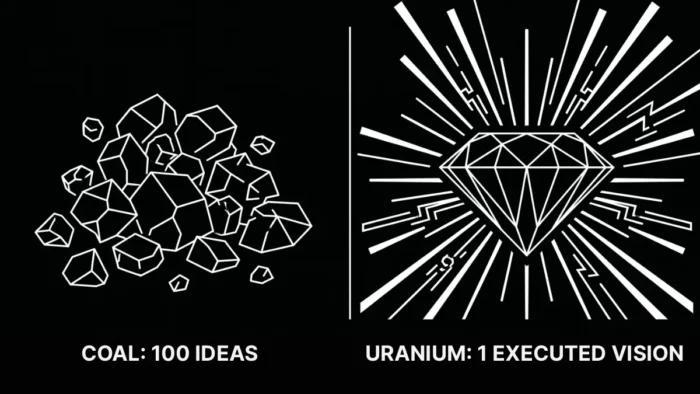
This is where the Business Potential Energy framework becomes useful.
Not all ideas have the same energy density.
Some ideas are uranium: they have the potential to power an entire business if you can convert their stored potential into kinetic output.
Other ideas are coal: they might burn, but they will never produce enough heat to move the needle. And still others are just decorative rocks that look impressive on your spreadsheet but contain zero convertible energy.
What is Your Job Then?
The entrepreneur’s job is not to nurture every idea equally. The entrepreneur’s job is to identify the uranium and ignore the coal.
But you cannot do that while you are maintaining five different mines at once. You have to pick one and dig.
Here is the trap most founders fall into: they mistake the number of ideas they have for the quality of their thinking. They believe that a person with ten business concepts is ten times more valuable than a person with one.
But value is not stored in concepts.
Value is stored in shipped products, served customers, solved problems. A concept on a spreadsheet has not yet done any work.
It is potential energy that may never become kinetic.
There is a fear behind the idea of spreading out accountability, but most people do not want to talk about it.
If just one staircase would be enough, then everything else was a distraction you picked yourself.
Every year you spent rotating between visions was a year you could have spent climbing. Every domain you registered for a business you never started was a receipt for time you chose to waste.
Every “strategy session” you held for a product that never launched was procrastination disguised as planning.
That is a devastating thing to admit. So most people do not.
They keep the spreadsheet open. They keep the escape hatches polished. They keep one hand on three different steering wheels and call it “keeping their options open.”
They are the Frustrated Genius: the person who knows they are capable of building something extraordinary, but who cannot bring themselves to risk being wrong about which something to build first.
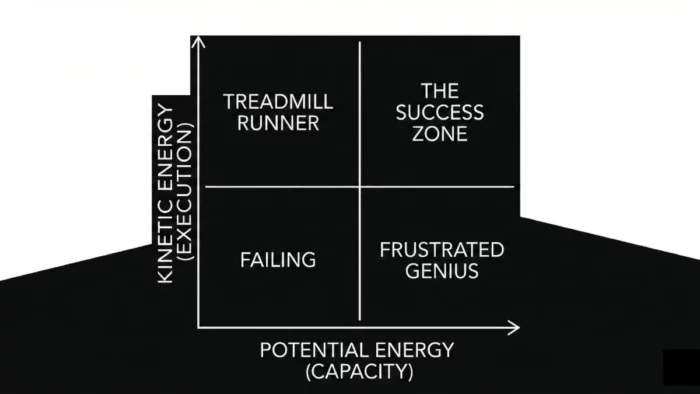
You can read more about this in my article about the modus operandi of growth. I honestly recommend checking it out.
Warren Buffett once said that “the difference between successful people and really successful people is that really successful people say no to almost everything.”
He was not talking about declining party invitations. He was talking about saying no to perfectly good business opportunities that would have made perfectly good money, because they would have drained energy from the one opportunity that could change everything.
The multi-vision founder says yes to everything and commits to nothing.
That is not ambition.
That is an inability to make a decision and live with the consequences.
Until one is committed, there is hesitancy, the chance to draw back, always ineffectiveness.
William H. Murray
When you remove the escape routes, something counterintuitive happens.
You get faster. Much faster.
Speed is not just a function of effort. It is a function of concentration.
When you stop splitting your energy across five directions, the velocity on your one staircase compounds in ways that feel almost unfair. Decisions that used to take a week take an afternoon, because you are no longer evaluating them against five different future selves.
Execution that used to feel heavy becomes light, because you are no longer carrying the weight of four other businesses you might someday start.
You also get clarity.
When there is no backup plan, the quality of your thinking improves.
You stop asking “which of my five ideas should I work on today?” and start asking “how do I make this one idea work better?“
The first question is a luxury that keeps you in motion without requiring action. The second question is a business.
And you get learning. Real learning.
The kind of learning that only happens when failure is actually possible.
When you have four escape hatches, you never truly fail. You just pivot. You reroute. You rebrand. And so you never learn the lesson that only comes from betting everything on one staircase and watching what happens.
The Staircase Strategy exists for exactly this reason. You cannot chase multiple visions at once without burning out.
You prioritize not by fantasy benefits but by executable reality. Each step must be achievable, and each step must pay for the next one.
The other visions are not dying. They are waiting their legitimate turn.
But you do not get to skip the staircase. And you do not get to stand on step one of five different staircases and pretend you are climbing.
If you recognize yourself in what I have described, here is exactly what to do next.
This is not theory. This is the sequence I have walked founders through, and it works if you run it clean.
Step 1: Name the escape hatches.
Open a blank document and write down every alternative vision you are keeping warm.
Not the spreadsheet of ideas you might pursue someday. The ones you are actively maintaining as backup plans.
For each one, complete this sentence honestly: “If my main thing fails, I can always fall back on…“
Do not skip this step.
Seeing the list on paper is sobering in a way that thinking about it never is.
Most founders I do this exercise with discover they are maintaining three to five active escape routes. Every single one of them is draining energy from the one staircase that matters.
The escape hatch you think is protecting you is actually the thing slowing you down.
Step 2: Identify the highest-density move.
Apply the Business Potential Energy lens. Take your list of visions and ask three questions.
First, which of these ideas has the shortest path to someone paying you?
Not the most elegant path. Not the path with the most fantasy benefits. The shortest one.
Second, which of these ideas can you ship a version of in 90 days?
Not a perfect version. A version that exists in the world and can be evaluated by a real customer.
Third, which of these ideas would teach you the most if you succeeded, and the most if you failed?
The idea that scores highest across all three questions is your uranium. Everything else is coal. Treat it accordingly.
Do not treat the coal politely. Do not give it a “maybe someday” folder. Call it what it is: low-density material that will never power the business you say you want to build.
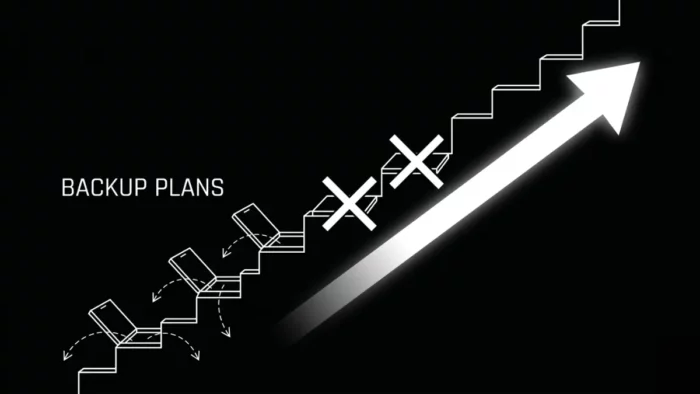
Step 3: Remove the backup plans.
This is the hard part. I am not going to pretend it is easy.
Close the tabs. Archive the domains. Delete the placeholder social accounts. Tell the people who expect the other versions of you that you are doing one thing for the next 90 days.
This will feel like a loss. It is supposed to.
You are giving up the psychological comfort of knowing you have somewhere else to go if this fails. But that psychological comfort is exactly what has been keeping you from moving fast enough to succeed.
Sun Tzu said to “burn your boats.” His point was that soldiers fight with more determination when they have no way to retreat.
Entrepreneurs work with the same intensity when they have no backup plan, but faster. So, when you close off your escape routes today, you move faster tomorrow.
Step 4: Ship value on one staircase.
This is where the Value Shipper framework comes in.
Every email, every product release, every client conversation, every decision is a shipment. The question is not “am I working hard?” The question is “is anyone receiving what I am shipping, and does it matter to them?“
Apply the “So What?” test to everything you do this quarter.
If the answer is “so what,” stop doing it. If the answer is “this changes something for someone,” ship it.
Shipping beats perfecting. Every time.
A shipped product with flaws teaches you more than a perfect product that never leaves your hard drive.
The museum of good ideas does not pay rent. It does not generate revenue. It does not build a reputation. It just sits there, looking impressive, doing nothing.
Step 5: Run the 90-day test.
At the end of 90 days, you will have one of two outcomes. Either you have traction you can build on, or you have data you can learn from.
Both outcomes beat the alternative.
The alternative is spending 90 days rotating between five fantasies and arriving at the end of the quarter with five half-built things and zero momentum on any of them.
If you have traction, keep climbing.
If you have data, use it to adjust your staircase.
But you do not get to open the escape hatches again. The test only works if you run it clean. One staircase, 90 days, no backup plans.
I want to be clear about something, because founders misunderstand this point constantly.
Picking one staircase does not mean you are trapped on it forever. It does not mean the other ideas were bad ideas. It does not mean you have to abandon your other interests and become a one-dimensional person.
It means you are respecting the architecture of execution.
The Staircase Strategy says that every big vision is reached one earned step at a time.
You cannot jump to the top. You cannot climb five staircases simultaneously and expect to reach the top of any of them.
But here is what the strategy also says: each step you complete pays for the next one.
The traction you build on staircase one creates the resources, the skills, and the credibility you need to ascend staircase two faster than you ever could have if you had tried to climb them both at once.
But remember, the other visions are not dying. They are waiting for their legitimate turn. And when their turn comes, you will approach them not as a hopeless founder hedging your bets, but as an operator who has already proven you can climb one staircase from bottom to top.
That is not a setback. That is your advantage.
Take a real look at things today. Open your spreadsheet. Notice the ways you’ve been giving yourself an easy way out. Ask yourself the question you’ve been putting off:
If one staircase is all I need, how have I really been spending my time?
Now close your tabs. Choose what matters most. And get started.