

Let’s start with the most cited things in business. Peter Drucker gave us the clearest distinction in business: “Efficiency is doing things right; effectiveness is doing the right things.”
For decades, that sentence has been the north star for managers, founders, and entrepreneurs.
The 2×2 matrix that follows from it (low and high efficiency on one axis, low and high effectiveness on the other) has been printed in every MBA textbook and sketched on every whiteboard.

And it has a hole big enough to drive a company through.
The matrix is flat. The world is not. Drucker’s framework assumes something that is almost never true: that time is neutral.
That if you execute well on the right things, the outcome follows. But the same action, the same resource allocation, the same level of execution produces radically different results depending on when you do it.
Launch a brilliant video conferencing tool in 2015, and you are fighting for enterprise contracts nobody wants. Launch the same tool in March 2020, and you become a verb.
Same efficiency. Same effectiveness. Different universe of outcomes.
The missing variable is the timing axis.
Adding it does not just add four more quadrants. It upends what you optimize for.
Let me start with the map everyone knows.
The classic matrix gives you four quadrants:
High efficiency + high effectiveness = Thrive. You do the right things and you do them well. This is the promised land every entrepreneur is running toward.
Low efficiency + high effectiveness = Survive. You picked the right mountain but you are climbing it with bad gear. You make progress, just slowly.
High efficiency + low effectiveness = Die Slowly. You are a machine optimized for the wrong output. You can build the wrong thing faster than anyone. The treadmill is smooth. It just leads nowhere.
Low efficiency + low effectiveness = Die Quickly. No explanation needed.
Every framework, every book, every coach tells you the same thing: get to the top-right quadrant.
That is the game. That is where you win.
Here is what they do not tell you.
You can sit perfectly in the Thrive quadrant and still lose everything.
You can be both efficient and effective, doing the right things in the right way, and watch your business drain resources until there is nothing left.
The variable that the 2×2 ignores is the one that makes the difference between Zoom in January 2020 and Zoom in January 2019.
Time.
Time isn’t the main thing. It’s the only thing.
Miles Davis
I do not mean time management or working faster. I mean strategic timing: the alignment between what you are doing and when the world is ready to receive it.
When you add one more axis (z-axis – right timing versus wrong timing), the four quadrants double to eight. And four of them hide in the blind spot of everyone who ever memorized the Drucker quote without asking what it leaves out.
Let’s look at what we get when we add the third axis (timing).
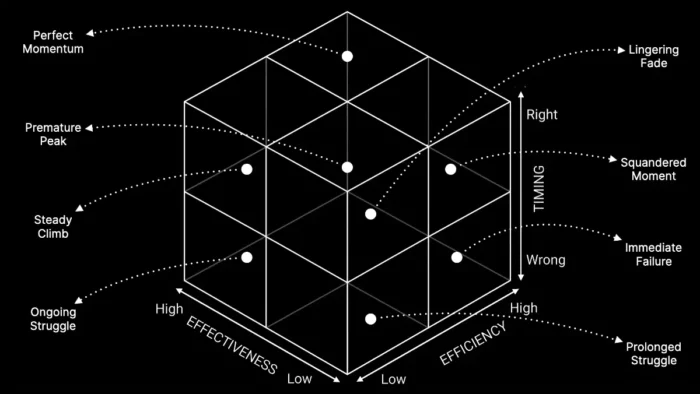
1. Thrive in Right Timing — Perfect Momentum
High efficiency, high effectiveness, and the market pulls you forward.
This is where every founder wants to be. Zoom during the pandemic. Slack when remote work went mainstream. Shopify when e-commerce exploded.
These companies did not just execute well. They executed well at the exact moment the entire market tilted in their direction.
Nothing is more powerful than an idea whose time has come.
Victor Hugo
The result is not just growth. It is acceleration.
Every unit of effort returns more than one unit of result because timing multiplies output. You are not pushing a boulder uphill. Gravity is doing half the work.
Perfect Momentum is rare.
But when you study the companies that hit it, you notice something in common: most of them did not predict the timing. Simply, they were already built. They were already good. The moment arrived, and they were the ones standing closest to it.
The lesson is not “predict the future.” The lesson is “be ready when the future arrives.”
2. Thrive in Wrong Timing — Premature Peak
This is the quadrant nobody warns you about.
You executed brilliantly. You built something excellent. Your team operated at high efficiency and high effectiveness. And then you crashed anyway.
Apple’s Newton in 1993. Sony’s e-reader years before Kindle made e-books a market. The first wave of VR companies in the 1990s.
Even the first generation of 3G phones from Nokia: technically impressive, beautifully engineered, and completely useless to a market that had no reason to use mobile data yet.
Premature Peak is devastating precisely because the execution was good.
If you had been incompetent, you could blame yourself, fix the failure, and move on.
But when you did everything right and still lost, the lesson your brain learns is dangerous:
“Frameworks do not work. Strategy does not work. I did everything right, and it did not matter.”
That lesson is wrong. But it feels true. And it is the reason so many founders who hit Premature Peak never try again.
The market was not ready. That is not a failure of your execution. It is a failure of your model to account for the third dimension. You built a bridge to a city that did not exist yet.
3. Survive in Right Timing — Steady Climb
Moderate execution with a tailwind.
Think of the local coffee shop that opened during the third-wave coffee boom. Nothing special. Not trying anything new. Just good coffee at the right time when everyone suddenly cared about where their coffee came from and how it was made.
The right timing does not make you a market leader if your execution is average. But it gives you something almost as valuable: a safety net.
You get to climb slowly while the market pulls you upward. You have room to improve because the external conditions are not fighting you.
Steady Climb is where you buy yourself time to get better. If you use that time, you can eventually reach Perfect Momentum.
If you waste it coasting on the tailwind, you eventually slide backward when conditions shift.
4. Survive in Wrong Timing — Ongoing Struggle
Moderate execution in a market that does not want what you are selling.
Mid-tier phone manufacturers launching into a saturated smartphone market. A decent consulting firm opening during a recession when nobody is hiring consultants.
The work is fine. The strategy is fine. But the timing makes “fine” feel like failure.
Ongoing Struggle wears you down slowly. You don’t fail quickly enough to make a change. You don’t grow fast enough to feel progress. You just stay stuck in the middle, using up resources, watching competitors with better timing move ahead.
This situation is dangerous because it feels like you can survive. You tell yourself next quarter will be better. It rarely is. The timing doesn’t change just because you lasted long enough.
5. Die Slowly in Right Timing — Lingering Fade
Poor execution with a temporary tailwind.
A small DVD rental shop opens during the brief nostalgia wave for physical media. A bookstore with no competitive advantage opens during a resurgence of interest in print.
The favorable timing buys them months. Maybe a year.
But low efficiency and low effectiveness do not reverse themselves. The tailwind masks the problems, and when it dies down, the decline resumes.
Lingering Fade is the most deceptive quadrant because the first few months feel like validation.
“People are showing up. We must be doing something right.”
No. The market is carrying you, and it will put you down eventually.
6. Die Slowly in Wrong Timing — Prolonged Struggle
Weak execution combined with a shrinking market.
Traditional taxi companies making incremental improvements while ride-sharing apps take over.
Print newspapers adding color photos while the world moves to digital.
You are dying slowly while the ground beneath you is also dying. Every improvement you make is too small, and applied in a context that no longer values what you offer.
Prolonged Struggle is what happens when you refuse to recognize that the timing dimension has shifted permanently.
The market is not coming back. Your marginal improvements will not save you.
The only winning move is a complete reinvention.
7. Die Quickly in Right Timing — Squandered Moment
The market was ready. The moment was perfect. And you blew it.
There is a tide in the affairs of men, Which, taken at the flood, leads on to fortune; Omitted, all the voyage of their life is bound in shallows and in miseries.
William Shakespeare (Julius Caesar)
A highly anticipated gadget launches at peak demand but is riddled with bugs. A team raises millions for a concept everyone wants and ships an unusable product. The timing advantage that could have carried a mediocre team instead becomes a spotlight on how badly they executed.
Squandered Moment is uniquely painful because you cannot blame external conditions. The world gave you a window. You failed to climb through it.
The market does not wait. It moves on to the next thing, and by the time you fix your product, nobody cares anymore.
This is the quadrant that separates operators who are merely lucky from operators who are ready.
Luck opens the door. Competence walks through it.
8. Die Quickly in Wrong Timing — Immediate Failure
Every factor against you. Poor execution. Wrong thing. Hostile timing.
A badly run restaurant opens during a local economic downturn in an area with no customers. A gadget with poor advertising is released just as the whole market falls apart.
There is no safety net, no second chance, no lesson you can learn quickly enough to help.
Immediate Failure is merciful in exactly one way: it is fast.
You do not spend years bleeding out. You do not convince yourself next quarter will turn it around. You fail, and you know you failed, and you can move on.
The strategic lesson of this quadrant is simple but rarely followed: sometimes the best move is to not play.
If your execution is weak and the timing is wrong, do not launch. Wait. Fix what you can fix.
Wait for the conditions to shift. Launching into Immediate Failure burns resources and reputation that you will never get back.
The eight quadrants tell you what happens. But they do not fully capture why timing matters more than most entrepreneurs think.
The real cost of being efficient and effective at the wrong time is not just the wasted quarter or the failed launch.
It is three deeper consequences that compound.
Bad Thing 1: You spend your energy and time at the wrong time.
This is the most obvious cost. But it is worse than it sounds.
When you operate in Premature Peak, you are not just burning money. You are burning your highest-potential fuel (your best years, your sharpest focus) at a moment when every unit of output converts at a discount.
You are doing uranium-level work in a coal-price market.
Imagine two founders. Both build the same product with the same level of execution.
Founder A launches in 2018. Founder B launches in 2020 when the market suddenly needs exactly what they built. Founder B gets 10x the return on the same energy expenditure.
Founder A did not fail. Founder A spent at the wrong exchange rate.
That is not a character flaw. But it is a strategic error that the flat 2×2 cannot diagnose because the flat 2×2 has no “when” axis.
Bad Thing 2: You stop believing that doing the right things in the right way works.
This is the dangerous one.
Premature Peak rewires your brain. You executed well. You were disciplined. You followed the frameworks. You did the right things. And you lost.
The lesson your brain extracts from that experience is not “the timing was off.” The lesson your brain extracts is “the whole approach was wrong.”
So, you stop trusting strategy. You stop believing in the process. You pivot into reactive mode, chasing whatever seems to be working right now instead of building something that will be ready when its moment arrives.
I have watched this happen.
Founders who were operators become gamblers. They abandon the staircase because the first step did not immediately pay off.
They did not realize the first step was solid. The floor just was not there yet to receive their weight.
The irony is fatal. The thing that actually failed them (poor timing) is invisible in the standard model.
So they blame the visible things (their execution, their strategy, their discipline) and abandon the very capabilities that would have worked if they had just waited.
Bad Thing 3: You quit.
This is the one that costs the most. Not the money. Not the time. The conviction.
The best founder, the best product, the best team: if they hit Premature Peak twice, most of them do not try a third time. They internalize the failure.
They decide entrepreneurship is not for them. They go get a job and spend the rest of their career with a stone sitting in their chest. The knowledge that they built something excellent that nobody wanted at the time.
And the world loses the thing they would have built on their third attempt because they did not have a framework that told them: “This was not you. This was timing. And timing shifts.”
Drucker’s matrix cannot say that. It only has four squares.
It can tell you whether you are efficient and whether you are effective. It cannot tell you whether you were early.
And being early looks and feels exactly like being wrong, unless you have the third dimension to distinguish them.
Adding the timing factor changes more than just the number of quadrants. It changes what you focus on improving.
Efficiency asks: “Am I doing this well?”
Effectiveness asks: “Am I doing the right thing?”
Timing asks: “Does the world want this now?“
If you ignore the third question, the first two can be perfectly answered and you still lose. The best strategy applied at the wrong moment is just a well-organized failure.
And the most valuable strategic question might not be how or what but when to hold, when to push, and when to wait.
The 2×2 matrix is not wrong. It is incomplete. It shows the basics but not the changing conditions.
And in business, as in farming, as in war, as in almost everything that matters, the weather is what determines whether the ground yields anything at all.
The entrepreneur who masters the third dimension does not just execute better. They know when execution is wasted. That is a harder skill.
It requires patience most founders do not have. It requires the discipline to build quietly while conditions are hostile, then move fast when the window opens.
It requires you to stop asking “am I doing the right things the right way?” and start asking a harder question: “Is this the right time to be doing them at all?“
Drucker gave us two dimensions. The third one is ours to figure out.