

Most entrepreneurs treat passion like an unlimited resource. They believe the fire that got them started is the same fire that will carry them through year five, year ten, and every sleepless night in between. They are wrong.
Passion is not a single force. It is dual. It can be the engine that drives your venture forward, or it can be the fire that burns your house down while you are still inside it.
Fire is a good servant but a bad master.
Old Proverb
The difference between the two outcomes is not luck. It is structure.
I have spent years studying what separates founders who sustain their drive from founders who flame out.
The answer is not “more hustle” or “find your why.” The answer is a framework that hardwires harmonious passion into your daily operations while putting up guardrails against the obsessive kind.
I call it the P.E.N.C.I.L. Framework.
Most founders learn this the hard way: if you let your passion take over, it can turn into your biggest problem. It pushes you to work weekends, skip the gym, and miss family dinners, thinking it’s all worth it.
And one day, you will look up and realize you are not building a business anymore. You are feeding an addiction.
Before we get into the framework, we need to understand what we are up against. The research is clear.
Robert Vallerand and his colleagues spent decades studying work passion and found something that should be required reading for every founder: passion comes in two forms.
The first is Harmonious Passion.
This is the kind where your work coexists with the rest of your life.
You choose to engage. You can step away. The activity is important to your identity, but it does not own your identity. Simply, harmonious passion is a buffer against burnout.
The second is Obsessive Passion.
This is the kind where your work consumes you. You cannot stop. You feel controlled by internal and external pressures. Your self-worth becomes entirely contingent on business outcomes.
The outcome is easy to see: work-family conflict, emotional exhaustion, and a gradual breakdown that might look like success to others but feels terrible on the inside.
This is especially risky for entrepreneurs because obsessive passion can look just like dedication.
Your peers will congratulate you on your grind. Your investors will admire your commitment. Nobody will tell you that you are running on a track that only has one exit.
The P.E.N.C.I.L. Framework is designed to catch this before it catches you.
P: Purpose and Cause Alignment
The first pillar begins with a question that seems simple but is actually quite challenging: what are you really working toward?
Most founders can explain their business mission, but not as many can clearly state their personal mission.
However, the difference really matters. When your work serves a cause larger than yourself, your motivation becomes intrinsic.
And intrinsic motivation fuels harmonious passion. Pure extrinsic goals (revenue targets, valuation milestones, status) fuel obsessive compliance.
Think of it this way. Running a business without a distinct cause is like running on a treadmill. High speed. Intense exertion. Complete physical stagnation.
You can run for years and wake up in the same place you started. A clear intrinsic purpose is the compass that ensures your hard work moves you toward a destination you actually chose.
Peter Drucker said it plainly: “The best way to predict the future is to create it.”
But you cannot create a future you have not defined. Every evening or morning, before you open your inbox or check your metrics, identify one major task that serves your higher cause.
Keep in mind, it’s not about choosing the most urgent task. Instead, focus on the one that fits your goals best. Doing this every day turns your routine from running in place to moving with purpose.
E: Effort-Driven Skill Acquisition
Popular culture has sold us a lie about passion.
The lie is that you find it.
You sit quietly, reflect deeply, and one day a lightning bolt of clarity strikes. From that moment forward, you are filled with inexhaustible motivation.
This is backward.
The empirical research, from Benjamin Bloom to K. Anders Ericsson, tells a totally different story. Passion is not discovered. It is produced. It grows alongside skill acquisition.
The mechanism is intentional practice: focused, uncomfortable, cognitively straining work on a specific artifact. The kind of work that makes you want to check your phone. The kind of work that feels difficult in the moment but satisfying in retrospect.
I call this the Friction Spark principle. Sitting idle waiting for passion is like waiting for a lightning bolt.
Real passion is a friction spark generated by rubbing two dry sticks together. Brute effort on one side. Cognitive strain on the other.
You’ll find passion once you start taking focused action, not before. Putting this into practice is simple.
Set aside 30 minutes each day for deep work. Turn off notifications, avoid switching tasks, and focus on creating just one thing.
Try to start before your mind finds reasons to put it off.
The neuroplastic growth from this single habit compounds faster than you think.
N: Network Congruence and Team Integration
Passion transfers.
Melissa Cardon’s research on emotional contagion proved that a founder’s passion radiates through their organization.
But there is a catch. Li and colleagues found that this transfer only works when there is intrinsic goal congruence.
When your team shares your values, their passion grows stronger. If they don’t, their energy just fades away.
Imagine yourself as a tuning fork set to a certain note. When a team member is in sync with you, they respond in harmony. Together, the energy grows.
But if a team member is out of sync, the energy goes nowhere. Instead of working together, you get friction, higher turnover, and your progress slows down.
This is not about hiring people who agree with everything you say. It is about hiring people who share your intrinsic motivations.
Here’s a simple idea: begin each team meeting by highlighting someone’s growth or learning effort. Focus on how they’ve developed, not just what they’ve achieved.
This helps everyone pay more attention to development instead of just performance numbers. It also shows that you care about the process, not only the results.
C: Capital and Resource Safeguarding
Here is a pattern I have seen destroy more founders than any market downturn: the founder’s trap.
Too much operational knowledge lives in one person’s head. That person becomes the bottleneck. The bottleneck becomes the business. And the business becomes a sponge that is squeezed dry every single day.
The Conservation of Resources Theory explains why this kills you.
Stress and burnout arise from resource depletion. When you are the only person who knows how things work, you are in a permanent loss spiral. Every problem drains you. Nothing refills you.
The structural fix is standardized operating systems. Standard databases. Standard operating procedures. Documentation that captures institutional knowledge outside of any single brain.
You do not rise to the level of your goals. You fall to the level of your systems.
James Clear
Jürgen Ingels coined a practice I have adopted and recommend to every founder. He calls it the Power of the Extra Mile.
Set aside Saturday mornings from 9:00 AM to 12:00 PM for strategic auditing. That’s three hours each week. Over a year, this adds up to about 20 full working days—almost a whole extra month focused on reviewing your system instead of just working in it.
Imagine your business as a rainwater cistern, not a sponge. A sponge soaks up skills but loses them when squeezed under pressure.
A cistern collects and holds onto institutional knowledge. It helps your business stay strong even if important team members leave.
So, focus on building that cistern.
I: Iterative Error Correction
Jean-Claude Biver, the legendary watchmaker who revived Blancpain and Hublot, built his career on a principle that most founders resist: create a mistake-permitting atmosphere.
Innovation requires error.
The alternative is paralysis. When your team is afraid of making mistakes, they stop taking the shots that could transform your business.
A man of genius makes no mistakes. His errors are volitional and are the portals of discovery.
James Joyce
The neuroscience backs this up.
Error correction triggers dendritic spine growth in the brain. It fosters neuroplasticity. The stem cells of the hippocampus take roughly three weeks to fully differentiate into stable neural pathways.
That is the biological foundation of habit creation. When you treat mistakes as data points instead of failures, you are literally rewiring your brain for growth.
I use a simple metaphor for this.
A master artist’s charcoal drawing is never a single flawless line. It is a web of lighter draft lines constantly erased, refined, and adjusted.
The eraser is as vital as the charcoal. Without it, the fear of making a permanent mark paralyzes the hand.
Every time you catch a mistake, extract one lesson, and adapt, you are using the eraser. You are not failing. You are refining.
L: Logical Guardrails and the 4-P Screen
This is what sets the P.E.N.C.I.L. Framework apart from just another motivational poster.
Raw passion often takes over logical thinking unless you use clear criteria to guide it. Research on obsessive passion shows that without structure, emotion tends to win over reason.
Steve Sy developed a sequential decision screen I have integrated into the framework. It is called the 4-P Screen. Before you commit to any major business decision, run it through four filters in this exact order:
First, Profitability.
Will this decision keep the business sustainable? If the answer is no, stop. You do not get to the other three if the business does not survive.
Second, Purpose.
Does this decision align with your intrinsic cause? If it makes money but pulls you away from your mission, it will drain you slowly.
Third, People. Does this decision protect the socio-emotional needs of your team? A profitable, purpose-aligned decision that burns your people is a net loss.
Fourth, Planet.
Does this decision meet your environmental responsibilities? This is the final filter, not an afterthought.
The order you follow is important here. Think of it as taking one step at a time, like climbing a staircase.
Profitability comes before sustainability. Purpose leads to alignment. People shape culture. Planet influences legacy.
If you use this approach to guide your decisions, you replace impulsive choices with a logical process. If you ignore it, you risk moving forward without enough support or direction.
Knowing the six pillars is useful. Knowing where you or your team stand on them is essential.
The P.E.N.C.I.L. Framework includes a diagnostic tool called the Passion Scaling Matrix. It plots your venture on two axes.
The vertical axis measures your Emotional and Resilience Capacity. It combines your Harmonious Passion with your Psychological Capital: your self-efficacy, your hope, your optimism, and your resilience.
On the other side, the horizontal axis measures your Process Systemization and Boundary Integrity. It divides your Logical Systems by the multiplying effects of your Work-Family Conflict and your Surface Acting (the emotional labor of faking how you feel at work).
Where these two axes intersect, you land in one of four quadrants.
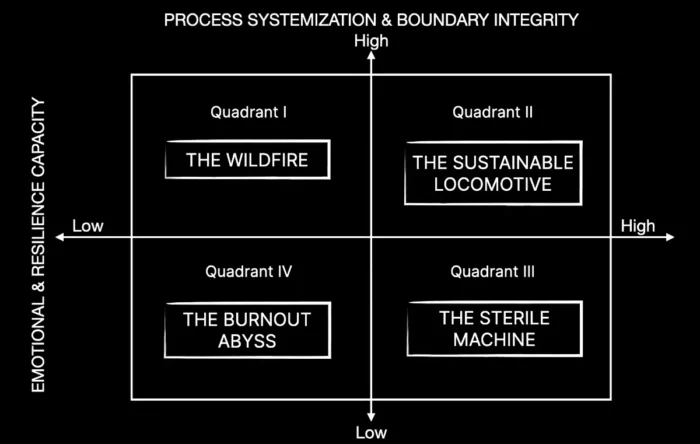
Quadrant I – Wildfire
This quadrant cover extreme passion and psychological capital, but zero logical systems.
High work-family conflict. High surface acting.
This is the most dangerous quadrant because it feels so good. You are on fire. However, you are also burning everything around you.
The strategic action here is not to slow down. It is to extract institutional knowledge and integrate standard operating procedures before the burnout hits.
Quadrant II – Sustainable Locomotive
Quadrant II is the Sustainable Locomotive.
High passion, high systems, low work-family conflict, authentic emotional labor.
This is the elite sweet spot. If you are here, your job is to scale without losing the balance.
Quadrant III – Sterile Machine
Quadrant III is the Sterile Machine.
Perfect systems, completely flat emotional investment. High efficiency, rigid compliance, flat innovation.
This is the founder who built the business but lost the soul. The fix is not more systems. It is reconnecting with a cause that inspires you.
Quadrant IV – Burnout Abyss
Quadrant IV is the Burnout Abyss.
Low passion, low psychological capital, no systems. Severe work-life friction. Profound emotional exhaustion.
If you are here, the strategic action is to stop immediately. Rebuild your autonomy. Rest. Swallow what I call the humility pill and admit that the current path is not sustainable.
The Venture Viability Score (VVS) combines all these factors into one number. Here is the equation:
VVS = (HP × PsyCap) / (LS / ((WFC × SA) + 1))
Each factor is rated on a scale from 1 to 7. Harmonious Passion (HP) and Psychological Capital (PsyCap) are in the top part of the equation (numerator). Logical Systems (LS), Work-Family Conflict (WFC), and Surface Acting (SA) are in the bottom part (denominator), and adding one to prevent dividing by zero.
Run the numbers quarterly. Be honest.
- A score of 25 or above puts you in the Sustainable Sweet Spot.
- A score between 10 and 24 puts you in the Vulnerable Zone.
- A score below 10 is the Burnout Abyss. Structural failure is imminent.
The VVS is not just a number to make you feel good. It is a tool that helps you see if your passion is helping your business or taking over.
Work passion can spread quickly and get out of control, much like a wildfire. This is not just a figure of speech, but something that really happens.
Without deliberate systems to protect your resources, transition from owner-operator to systems builder, and enforce personal boundaries, passion will devour your personal and professional domains.
The entrepreneurs who last are not the ones with the most passion. They are the ones who built the rails.
The P.E.N.C.I.L. Framework is those rails. Hardwire it into your daily habits, audit it quarterly with the VVS, and your fire stops being a threat. It becomes a controlled campfire. Proactively nourishing your performance. Protecting your well-being. Extending your organizational longevity indefinitely.
The question is not whether you have enough passion. You do.
The question is whether you have the discipline to contain it.