

I like to call this the Staircase Question. One sentence that turns your anxiety into action.
It’s just six words: “What’s the first step I’m avoiding?”
I have been an entrepreneur long enough (almost 20 years) to recognize the feeling.
It usually arrives around 2 PM on a Tuesday. You have been working since 8 AM. You answered emails, adjusted the website, checked analytics, reread your strategy document, and attended a meeting that could have been a Slack message.
From the outside, it looks like you have been productive.
And yet.
Something is off.
A quiet unease sits in your chest. You cannot name it, so you reach for the nearest label that fits: “Business is hard.”
That sentence feels true. It feels earned. It feels like something a seasoned operator would say.
But here is the real problem: it is also useless.
“Business is hard” is not a diagnosis. It is a sedative. It gives you permission to stop examining what is actually happening and accept a vague, noble-sounding hardship instead.
Also, it turns a specific, solvable problem into an atmospheric condition you cannot control.
I spent years in that fog. And what pulled me out was not a framework, not any quote I read in books, not a morning routine.
It was a question. A single, five-word question that I now deploy every time I feel the fog rolling back in.
The problem is not the problem. The problem is your attitude about the problem.
Captain Jack Sparrow
Entrepreneurs share complaints almost as often as economists talk about money.
If you visit a co-working space, join a founder group chat, or scroll through business Twitter, you’ll see plenty of people talking about their struggles.
“The algorithm changed.”
“The market is brutal right now.”
“Nobody tells you how lonely it is.”
“My clients don’t understand the value.”
Each of these statements has a strange dual quality. They feel true in the moment. They also prevent you from doing anything about them.
This is what I call narrative mode.
When you enter narrative mode, you become the protagonist of a struggle story. You are the hero fighting against market forces, algorithm shifts, and the general cruelty of entrepreneurship.
The story is compelling. It is also, in the strictest sense, not actionable. You cannot fight “the market.” You cannot negotiate with “the algorithm.”
Simply, you can only sit inside the story and wait for the plot to improve.
Here is what nobody tells you about narrative mode: it is addictive precisely because it pardons you.
If the problem is external and vast, then your inaction is not your fault. You are not stuck because you are avoiding something. You are stuck because the world is difficult.
That distinction matters more than anything else I will say in this piece.
I want to give you a simple model. It is not from neuroscience. It is from watching hundreds of entrepreneurs, including myself, navigate the gap between knowing what to do and actually doing it.
Your brain, when confronted with friction, can operate in one of two modes.
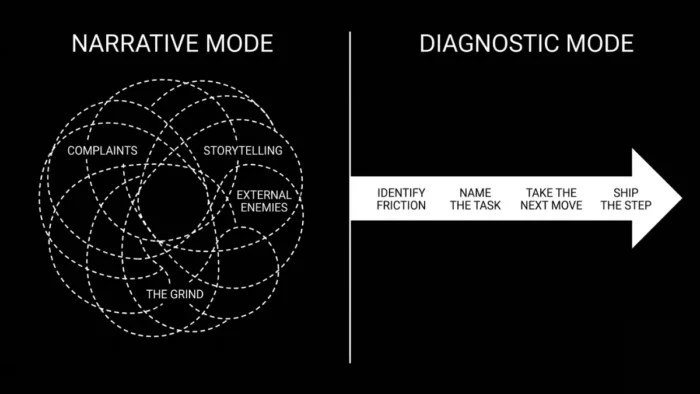
Narrative Mode
In narrative mode, friction becomes a story. You explain why things are hard. You construct a coherent account of what is happening to you.
The account is often factually accurate: yes, the algorithm did change. Yes, the market is more competitive than it was two years ago. Yes, your client really did push back on the proposal.
But accuracy is not the same thing as utility. Narrative mode gives you something to say. It does not give you something to do.
Worse, narrative mode has a compounding effect. Spend enough time telling yourself the story of why things are difficult, and the story becomes your identity.
You become the entrepreneur who is grinding. The founder who is in the trenches. The solopreneur who is battling the algorithm.
These identities feel noble. They also keep you exactly where you are.
Diagnostic Mode
Diagnostic mode offers an alternative approach. Instead of narrating events, you focus on identifying the specific friction point and determining the action that will resolve it.
Diagnostic mode does not care about the atmosphere. It does not care about the macro trends. It cares about one thing: the next actionable step.
Here is the counterintuitive part.
Switching from narrative to diagnostic mode does not require more information. It does not require a coaching call or a new framework or another book.
It requires exactly one question, asked honestly.
That question is the Staircase Question.
“What’s the first step I’m avoiding?”
Five words. No jargon. No methodology. Just a direct inquiry into the one thing you already know you should be doing but have managed to not do.
I want you to notice what this question does not ask.
It does not ask “what is your strategy?” Probably you already have your strategy.
It does not ask “what are your goals?” You already covered them in your strategy.
Also, it does not ask “what is the market doing?” You already conduct market research.
All of those questions keep you in narrative mode. They produce answers that sound important and lead nowhere.
The Staircase Question bypasses narrative entirely.
You cannot answer “what am I avoiding?” with an abstract economic trend. You cannot answer it with a complaint about the algorithm.
The question forces a specific, concrete answer.
And that answer is always a task.
The cave you fear to enter holds the treasure you seek.
Joseph Campbell
Why It Works
This question works because of something I have observed across almost 20 years of entrepreneurship: most of us already know what we need to do next.
We are not confused. We are not lacking a plan. Simply, we are avoiding.
The avoidance is rarely conscious. It disguises itself as other things. Research. Planning. Optimizing the website. Re-reading the strategy document. Attending the conference.
All of these activities pass the “I am working” test while conveniently delaying the one thing that would actually move the needle.
I call this the Busyness Paradox. Busyness is input, not output. The most dangerous form of busyness looks productive enough to fool you into thinking you are not avoiding anything.
The Staircase Question cuts through the paradox because it does not ask whether you are working.
It asks whether you are working on the right thing.
More precisely, it asks whether you are actively avoiding the right thing. And for most entrepreneurs, the answer arrives within three seconds.
How to Use It
You do not need a journal for this. You do not need a morning routine or meditation practice. But you need thirty seconds of honesty.
Step one: stop moving. Close the tabs. Put the phone face down. Eliminate the ambient noise that lets you pretend to be too busy to think.
Step two: ask yourself the question out loud. “What is the first step I am avoiding?” Say it, then let the silence hang in the air for five seconds.
Step three: accept the first answer that comes to mind. It probably won’t feel comfortable. Most likely, it’s the thing you’ve spent the last four hours finding reasons to avoid.
That is the signal. Your brain already knows the answer. It has been running an elaborate distraction campaign to keep you from looking at it directly.
Step four: do that thing. Not later. Not after you finish this newsletter. Right now, or at the soonest possible moment, execute the step you just named.
That is it. That is the entire practice.
Action is the real measure of intelligence.
Napoleon Hill
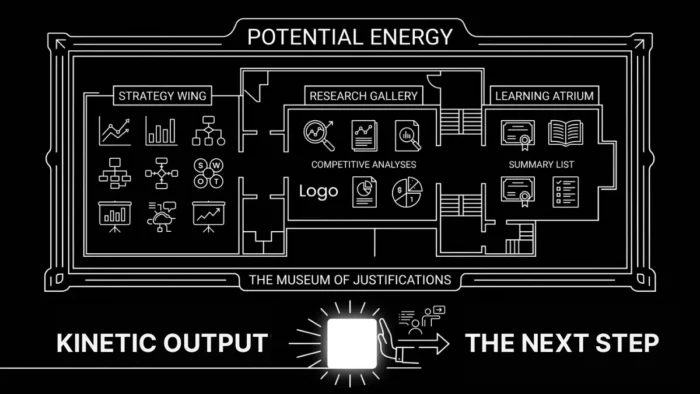
I have a phrase I use with coaching clients when they tell me why they have not taken the obvious next step. I tell them they are curating a museum of good ideas that never left their hard drive.
The museum is impressive. It has exhibits.
There is the Strategy Wing, where beautifully formatted documents explain exactly what should happen.
There is the Research Gallery, where competitive analyses and market studies line the walls.
Also, there is the Learning Atrium, full of course certificates and book summaries and conference badges.
What the museum does not have is output. It is a collection of potential energy, exquisitely organized, perfectly inert.
The Staircase Question is the exit door. It bypasses the museum entirely. It does not ask you to admire the exhibits. Simply, it asks you to name the one thing you would rather not look at, and then do it.
Every entrepreneur I have ever met who broke through a plateau did not do it by adding more to the museum.
They did it by walking past the exhibits and shipping something.
Let me make this tangible.
You are a consultant. You have been telling yourself for three weeks that you need to “work on lead generation.” Your calendar is full of podcasts, LinkedIn engagement, and refining your offer document. The museum is growing.
But you have not sent a single cold outreach message.
Ask yourself the Staircase Question. The answer comes quickly: you are trying to avoid the discomfort of asking directly. You fear rejection. You worry that your careful approach might meet someone who simply says, “not interested.”
Now you have a task. Send five direct messages. Not “work on lead generation.” Five messages. Today.
That is the shift. From atmospheric anxiety to a concrete next move.
From “business is hard” to “I am avoiding sending five messages and I am going to send them now.”
The second version contains less dignity. It also contains forward motion.
The Staircase Question did not come from nowhere. It is the practical application of a larger framework I call the Staircase Strategy.
The main point in the Staircase Strategy is simple: if you try to follow too many goals at once, you will burn out.
Instead of hunting visions that sound good, focus on what you can actually do next. Make sure each step is realistic and helps you move forward.
Don’t try to leap to the top all at once. Just look at where you are and take the next step (stair) in front of you.
The problem is that looking at your feet is uncomfortable.
The top of the staircase is inspiring. The landing page redesign, the new product line, the speaking career, the book deal.
The step directly in front of you? That is usually mundane. Uncomfortable. The one you have been finding creative ways to avoid.
The Staircase Question is the tool that forces your eyes downward. It interrupts the fantasy of the top step and returns you to the reality of the next one. But it is not sexy. It will not make a good conference talk. But it works.
I want to close by naming something directly.
The real enemy of the entrepreneur is not the economy. It is not the competition. It is not even the algorithm, as convenient as that enemy has become.
The real enemy is the question you refuse to ask yourself.
As long as you can keep the problem vague, you can keep yourself safe from the discomfort of solving it.
“Business is hard” is a shield. It protects you from the specific, uncomfortable truth that you know exactly what you need to do next and you have been refusing to do it.
The Staircase Question removes the shield. It does not offer comfort. It offers clarity. And clarity, in the hands of someone willing to act on it, is the most valuable asset an entrepreneur can hold.
So I will ask you directly, the way I ask myself on those 2 PM Tuesdays when the fog rolls in:
What is the first step you are avoiding?
You already know the answer. Now go ship it.