

Most strategy sessions feel like theater.
They might be expensive, with great catering, colorful sticky notes, and two days spent nodding at slides about global market changes. Still, it’s all just theater.
When Monday morning comes, everyone jumps back into their emails. The binder gets put away on a shelf, and nothing is different.
I call this Strategy Theater. It ends up costing more than just the catering bill. You lose months of momentum while your team confuses being busy with making real progress.
Peter Drucker supposedly said that culture eats strategy for breakfast. He was half right.
What actually eats strategy is a bad process. Put the right people in the wrong room with no structure, and they will produce the same output as a bad brainstorming session: a museum of good ideas that never left the conference room.
This playbook is for business leaders, department heads, and facilitators who are responsible for running a session for 5 to 50 people and want it to actually move the needle.
Whether you are designing an annual retreat from scratch or trying to salvage a format that keeps disappointing you, here is how to build a strategy forge instead of another strategy show.
If everyone is thinking alike, then somebody isn’t thinking.
George S. Patton
A strategic session can fall apart quickly if you invite the wrong people.
If your group is too small, you end up with an echo chamber that is out of touch with real action. If it is too big, the session becomes a lecture and people tune out.
Your goal is not to be popular. You are putting together a temporary team focused on intense discussion and collaboration across different areas.
The ideal group size is between 8 and 15 people. If you go over 15, people tend to put in less effort. Some may feel their input does not matter, and a few outgoing people often take over the conversation.
Drop below eight and you lack the cognitive diversity to pressure-test long-term assumptions.
Think of this as building a mosaic.
Leave out engineering, and your product strategy has no technical spine.
Leave out sales, and your market entry timeline is pure fantasy.
Every single person in that room needs a distinct reason for being there and the authority to commit their department to a course of action.
The most important rule is to make sure you balance the views of senior leaders with those of frontline staff.
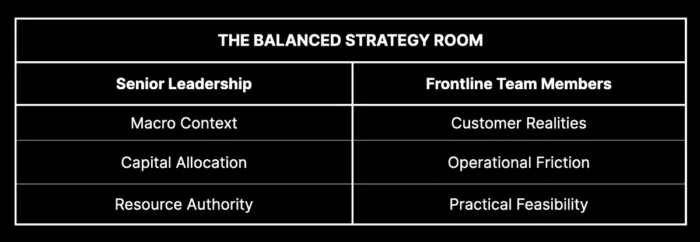
Senior leaders have the macro context and the power to allocate capital.
But your frontline staff are the ones who look your clients in the eye. They know the friction points, the customer complaints, and the operational constraints that leadership glosses over.
Imagine a B2B software company where the executive team decides to pivot upmarket to target enterprise clients. Looks great on a slide. But if a senior customer success manager is in the room, she can immediately flag that the legacy infrastructure cannot support the custom SSO requirements enterprise IT departments demand.
That single intervention saves you 18 months of building toward a fantasy.
Blend these two groups. Your strategy stays ambitious and your implementation plan stays tethered to reality.
Here is a rule that will save you thousands of dollars in wasted collective brainpower: live session time is for debate, decision, and alignment. Information consumption belongs in the async world.
The most common mistake leaders make is burning the first two hours of premium face-to-face time reviewing data reports, financial dashboards, and product update slides. You just paid for 12 people to sit in a room and read. That is not strategy. That is a very expensive study hall.
Start your pre-work about two to four weeks before the team arrives.
In the first week, focus on collecting current performance metrics, churn data, and market analysis. Pay close attention to what your competitors are launching, investing in, and promoting.
The second week is reserved for stakeholder diagnostic interviews. Fifteen minutes per attendee. Ask two questions: What is the biggest unaddressed threat to our business over the next 36 months? And where are we wasting resources right now?
Week 3 is for synthesis, or preparing everything you get for the strategy session meeting.
You must bring together the interviews, market data, and environmental scans into a pre-reading brief. Keep it under 15 pages. If it goes over, it means you are not truly synthesizing the information.
Week 4 is reserved for distribution and accountability. Share the brief along with clear assignments. This is often the stage where leaders lose focus, so stay engaged.
If you send a generic email with a PDF attachment that says “Please review before Tuesday,” it will not happen. Your busiest executives will skim the first two pages in the parking lot five minutes before the session starts.
You know this because you have done it.
Try creating assignments that require active thinking.
For example, ask each person to review the competitive sweep on page 6 and identify our main competitor’s biggest weakness. Then, have them write down how our product team could take advantage of it in the next year.
In such a way, everyone comes in having already considered the basics.
They arrive ready to analyze and contribute rather than just waiting for instructions. That’s how you turn a group of spectators into real participants.
Before you plan out the hourly schedule, choose the structure that fits your strategy, where your team is based, and your budget.
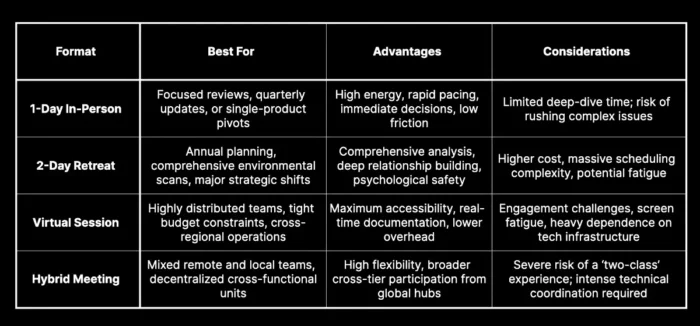
Meeting in person is the best way to build relationships, address tough organizational issues, and tap into creative energy.
Virtual and hybrid formats make it easy to include team members from around the world without overspending on travel.
The decision is simple: choose the meeting format that fits how important the issue is.
If you are overhauling your whole market approach, don’t try to squeeze it into a single day. Schedule a retreat instead.
If you only need to review your current strategy because of making small market changes, a focused virtual session works well.
But remember, never over-engineer the container for what is inside.
If a brainstorm session isn’t guided, it can fall apart in just a couple of hours. It’s important to have a clear structure that still allows for real discussion.
Here’s a proven framework you can use for a focused strategy day. If you need more time, you can also spread it out over a two-day retreat.
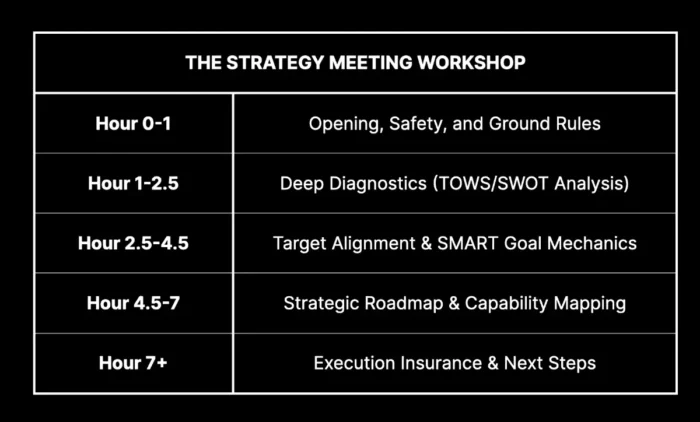
Hour 0 to 1: Psychological Safety and the Rules of Engagement
The first hour sets the tone for the whole strategy session.
As the facilitator, your main job is not to present your own ideas. Instead, focus on creating a space where people feel safe to speak honestly without worrying about negative consequences.
If your team is afraid of looking foolish or disagreeing with the CEO, your strategy session will only produce safe, generic ideas.
Begin by making a clean break from old habits. Clearly explain what you want to achieve. Set clear rules: keep laptops and phones closed except during breaks or when taking notes. Forget about job titles. If a junior analyst has the data, she can question a VP’s idea. Focus on solving the problem, not criticizing people.
Next, try a warm-up exercise. I suggest using the Stinky Fish activity, where each person writes down a big unspoken problem on an index card. Gather the cards without names, then read a few out loud and talk about them directly. This shows right away that it is okay to bring up uncomfortable topics.
Hour 1 to 2.5: Deep Diagnostics (Beyond the Generic SWOT)
Standard SWOT analyses fail because they devolve into boring lists.
Simply, I have seen how teams sit in a circle, list twenty strengths and fifteen weaknesses, pat themselves on the back, and move on without analyzing how those forces interact and what they need to do next.
Here is how you fix it.
Use silent brainstorming. For 15 minutes, the room goes completely quiet. Everyone writes down internal strengths, weaknesses, external opportunities, and threats based on the pre-work intelligence. Sticky notes or a shared digital canvas both work.
Once everything is grouped on the board, apply the SWOT Matrix. Do not just list the quadrants. Force interaction between them with four specific questions:
- SO Strategies: How do we use our core strengths to maximize the external opportunities opening up in the market?
- WO Strategies: How do we minimize our internal weaknesses by taking advantage of external opportunities?
- ST Strategies: How do we leverage our strengths to neutralize external threats?
- WT Strategies: How do we restructure our weaknesses to avoid falling prey to external threats?
That’s exactly what the heart of the Business Strategy Canvas (BSC) is. This analysis of the external and internal environment becomes the guiding force for prioritization of the key strategic initiatives.
Simply, what you do here can help you turn a passive list into an active strategic plan generator. At this point, the session room stops cataloging and starts solving.
Hour 2.5 to 4.5: Target Alignment and SMART Mechanics
Once you know where you stand, you look forward. This block anchors your abstract multi-year vision into clear, measurable goals.
Human beings naturally resist specific targets. Vagueness protects them from clear failure. Your job as facilitator is to push through that resistance every single time.
Suppose your team says: “Our strategic goal is to expand significantly into the enterprise health-tech sector over the next two years.”
That is not a goal. That is a wish. It has no measurement, no accountability, and no boundaries. Push them to apply SMART mechanics:
- Specific: Focus on mid-sized hospital networks with 200 to 500 beds and offer them our main billing product.
- Measurable: Aim to sign 15 new enterprise contracts that will bring in $1.2 million in annual recurring revenue.
- Achievable: Check if we have the needed compliance certifications. If we do not, getting them should be part of our goal.
- Relevant: This aligns with our macro vision of diversifying away from volatile small-business clients.
- Time-bound: By December 31, 2027.
Now you have something you can track, fund, and hold people accountable to: Secure 15 net-new mid-market hospital network contracts generating $1.2M in ARR by December 31, 2027, to diversify our core revenue stream.
There is a world of difference between a vague ambition and an engineered goal. One lets everyone off the hook. The other tells you exactly who failed and exactly when.
Hour 4.5 to 7: Roadmap Architecture and Capability Mapping
With SMART goals locked in, you build the roadmap that defines how you will reach them.
This is where sessions lose momentum because teams get exhausted and slip back into daily operational thinking. Do not let them list minor tactical tasks like “schedule a demo with Client X.” Keep them focused on broad strategic initiatives.
For each major goal, run a Capability Mapping exercise.
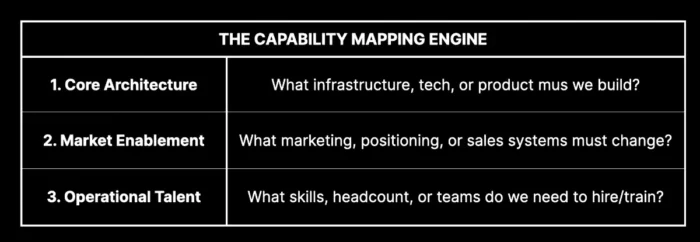
Break the roadmap into three distinct workstreams: Core Architecture (what needs to be built or secured), Market Enablement (what needs to be trained or positioned), and Operational Talent (who needs to be hired or redeployed).
If your roadmap requires launching an enterprise health-tech push, your capability map might reveal that you need SOC 2 compliance (Core Architecture), retrained account executives (Market Enablement), and a dedicated enterprise implementation engineer (Operational Talent).
Identify the dependencies between these initiatives. Flag the resource bottlenecks. Lay out a high-level visual timeline across the next 12 to 36 months.
Hour 7+: Accountability Planning
Use the last 45 minutes to make sure your plan will actually get done.
Before you finish, always clarify the next steps, assign clear roles, and set up a schedule to track progress. If you skip this part, your strategy probably won’t make it past the meeting.
Is it possible to lead your own strategy session? Yes, you can.
But whether you should depends on your budget, how complex your challenges are, and the team’s internal dynamics.
The main issue is what’s known as the split-brain effect. It’s very hard to guide a process objectively while also pushing your own strategic ideas.
When a CEO or department head leads a discussion, they often steer the conversation toward what they want. They tend to support points they like and may overlook or dismiss opposing views without meaning to.
If you are running a routine quarterly alignment with a high-trust, tightly aligned team, an internal facilitator works fine.
If your company is navigating severe market disruption, deep internal division, or an intense multi-year pivot, invest in an external professional. An outside facilitator lets every leader step onto the playing field as an equal. Someone neutral handles the refereeing. Someone unafraid to call out hidden assumptions or name the elephant in the room.
No matter how well you prepare, group dynamics can quickly disrupt a session. People often bring their worries, egos, and personal agendas with them.
Below are the three most common challenges and some scripts to help you address them.
The HiPPO (Highest Paid Person’s Opinion)
You raise a critical question: “How should we defend against our newest competitor?” Before anyone can process the thought, the most outspoken executive in the room jumps in, dictates the answer for ten minutes, and sets the tone. The rest of the room goes quiet.
The fix is the 1-2-4-All protocol from Liberating Structures. Stop running wide-open group discussions. Instead, structure every major debate in four steps:
- Silent Reflection (1 minute): everyone writes down their raw individual thoughts.
- Pair up for a 2-minute discussion. Talk with your partner to compare your ideas, find differences, and develop them further together.
- Join a group of four for 5 minutes. Work together to improve your ideas and agree on what you have in common.
- Share your group’s best ideas with everyone during a 7-minute full group discussion.
By forcing silent reflection first, you give introverts a safe space to formulate their thoughts without being overridden. By the time ideas reach the full group, they have been pressure-tested through multiple rounds. The HiPPO cannot dominate because everyone has already committed their thinking to paper and to their partners.
The Theory Trap
This trap happens when strategy meetings get too theoretical.
The team starts spending hours discussing big ideas, quoting industry experts, and examining future trends, but they never agree on concrete actions.
They avoid getting specific because taking action is hard and means taking responsibility.
Vision without execution is just hallucination.
Thomas Edison
The fix is a non-negotiable Who-What-When rule for every strategic decision.
If someone says, “We need to optimize our cross-departmental product feedback loop,” stop them. Do not let the scribe write that down. Force them to convert it:
- What: Design and set up an asynchronous product feedback repository in Jira.
- Who: Sarah, Head of Product Engineering, will lead this project.
- When: The target date for completion is October 15, 2026.
If a strategic initiative cannot be mapped to a single owner and a specific deadline, it does not go on the roadmap. This forces your team to balance visionary thinking with operational realism.
The Status-Quo Anchor
If you suggest a new idea, someone might respond, “That is not how we do things,” or, “We already tried that in 2022 and it failed.”
Most people like what they know because change can feel risky and upset their daily routines.
Because many strategic initiatives will require organizational change, here is the first sign that resistance can appear.
However, resistance has two faces. It can produce damage, but it can also bring benefits.

Because of that, your strategy sessions are an important part of discovering possible resistance and creating strategies and tactics to overcome it.
Don’t ignore their concerns by making decisions from the top. Doing that often causes quiet resentment.
Instead, use a straightforward and empathetic approach that brings them into the process:
“I know this is a big change from how we have done things before, and I realize the 2022 pilot had real challenges. But our business environment is different now. If we keep doing things the same way while competitors automate, what will happen to our market share in three years? We are not ignoring what happened before. We are learning from it to build something better. Can you help me figure out what safeguards we need this time to make sure we succeed?”
You showed that the pivot is necessary for survival and asked the team to help set up the safety measures. This approach helps turn a resistant team member into someone who helps shape the new direction.
Remember that a session is not truly finished when people leave the meeting room.
It will be successful only when your team leaves knowing exactly what their new roles are, what needs to happen next, and how success will be measured.
There are three steps that help secure the work:
First, start with the 48-Hour Synthesis.
Gather your session notes, the Who-What-When matrix, and your capability map. Then you can organize them into a clear digital dashboard.
Share this with everyone while the details are still fresh. If you wait a week, much of the energy will be gone.
Second, let’s talk about the Cascading Communication Plan.
Leaders should share the strategy openly.
You must collaborate with department managers to turn your vision (big-picture plan) into clear town hall presentations and specific team goals. Every employee needs to see how their daily work supports the long-term objectives.
If people can’t make that connection, the strategy might look impressive, but it won’t help anyone find their way.
Third, make sure you have a regular quarterly routine.
Schedule a one-day strategy session every quarter to check your progress toward your goals. Look at your performance numbers, see what’s changed in your industry, and update your tactics as needed.
Strategy is not something you do once and forget. It needs regular attention. If you are not reviewing your strategy, you are not managing it.
The mechanics of a strategy session change depending on where your organization is in its life cycle. Running one for a high-growth startup is not the same as running one for a mature legacy company.
High-Growth Teams: The Elimination Engine
The essence of strategy is choosing what not to do.
Michael Porter
In high-growth companies, the danger is not stagnation. It is over-expansion. Chasing five opportunities simultaneously and executing all of them poorly.
When facilitating for high-growth teams, focus the session on elimination metrics. Your primary job in the room is to decide what you will not do. Use the roadmap architecture to draw hard boundaries around your core product focus. Aggressively filter out distractions that stretch your engineering or sales teams too thin.
You must focus on a shorter strategic timeline, such as a rolling 12 to 24 months, and make quick adjustments every quarter.
Moving fast is your strength. Don’t give that up for the false comfort of long-term certainty.
Legacy Teams: Breaking the Inertia
For established organizations, the main challenge isn’t about staying focused. It’s about overcoming inertia.
Teams often pay into familiar routines, and their processes become hard to change. The real risk isn’t taking on too much, but rather doing nothing and confusing stability with safety as the market moves forward.
Allocate significant time to External Threat Analysis (Opportunities and Threats) during the diagnostic block. Force the room to study the disruptive, nimble startups cutting into your margins. Use your capability mapping sessions to focus on modernization and retraining.
Your strategy should include bold investments in modern infrastructure, even if these changes temporarily disrupt your existing business lines.
That discomfort is not a problem; it simply shows you that you are making real progress.
The other option is not stability. Instead, it is a slow and quiet decline that no one in the room will notice until it is too late to fix.
Here’s the main point: a strategy session is not just a brainstorming meeting with nicer food. It is more like a forge. You bring in raw ideas, then add focus, structure, and effort. The result is a clear plan your team can actually follow.
Most companies never get past the theater. They keep burning two days a year on sticky notes and slide decks while their real strategic problems go unaddressed.
The difference between those companies and the ones that win is not better ideas. It is better process. And process is something you can build.