

Many entrepreneurs see strategy execution as if it were a simple chess game where only they get to make moves.
You make the plan, set the quarterly goals, and assign the KPIs. Then you step onto the field and expect everything to go as planned.
But things rarely go as planned.
Competitors lower their prices. A partner misses a deadline. Even your own team starts to lose focus on the mission.
The plan you worked on for six months now feels outdated, more like something for a museum than your Monday meeting.
Game theory is usually taught as a pre-game exercise. You sit in a boardroom. You map out the payoff matrix. You decide whether to cooperate or defect.
Then you shake hands and go execute the strategy you just designed. This is useful, but it misses something fundamental. The game does not end when execution begins. It accelerates.
The question worth asking is not “how do I use game theory to plan my strategy?” The question is “how do I use game theory while I am executing it?”
Most execution frameworks treat the battlefield as frozen at the moment of planning. They assume the world will hold still while you deploy your resources, march toward your milestones, and claim your market share.
This assumption is expensive.
Everybody has a plan until they get punched in the mouth.
Mike Tyson
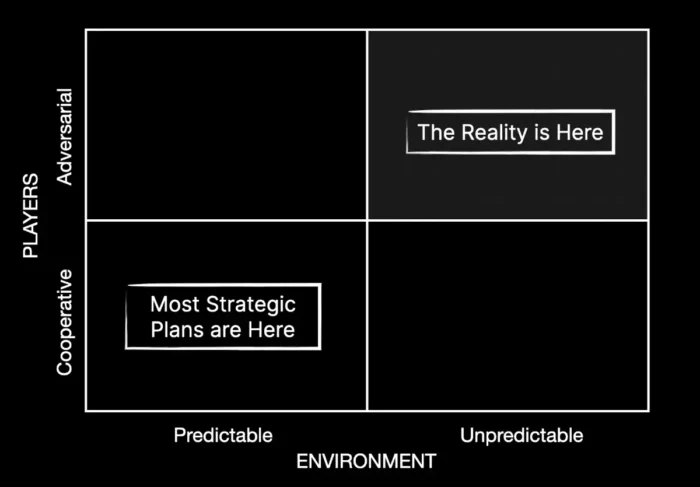
Let me put it in a simple 2×2 matrix.
On one axis, you have the environment: predictable or unpredictable.
On the other axis, you have the players: cooperative or adversarial.
Most strategic plans are designed for situations where things are predictable, and everyone works together. So we have a predictable environment and cooperative players.
In this kind of environment, your Gantt chart is useful, your quarterly roadmap stays on track, and your competitors don’t interfere while you carry out your plans.
Here’s the challenge: most entrepreneurs operate in a fast-changing environment (top-right quadrant) where competitors are constantly adjusting their strategies.
Your competitor is not just an obstacle. They are always learning, watching your actions, and trying to predict your next move. A plan that seemed smart in December might be outdated by March because the situation changes so quickly.
This is what I call the Static Strategy Trap.
You spend months converting potential energy into a specific plan, and then you simply freeze it. You stop converting. The plan becomes a monument instead of a machine.
And the people who beat you are not the ones with better plans. They are the ones who treat execution as a living game, not a scripted performance.
Peter Drucker once said, “Plans are only good intentions unless they immediately degenerate into hard work.“
He was only half right. Plans are good intentions unless they immediately degenerate into adaptive hard work. The adaptation is the part most frameworks leave out.
There is a key shift to understand: execution is not something you do just once. Instead, it is a process that happens over and over, with no set endpoint.
Each quarter, a product launch, pricing change, or hiring decision is a move your competitors notice and react to. Their responses then shape your next steps.
If you treat execution as a one-shot game, you optimize for the current move.
You price aggressively to capture share. You launch fast to beat a competitor to market. Also, you cut costs to hit a margin target.
Each of these moves might look rational in isolation. But in a repeated game, the move that maximizes your payoff in round one might provoke a retaliation that destroys your position by round four.
Consider tit-for-tat in the airline industry. One carrier drops prices on a route. The competitor matches within hours.
Both earn lower margins. Neither gains lasting share.
The move that looked like a dominant strategy in round one turned into a lose-lose equilibrium by round two. The airlines that win are the ones that understand the game has more rounds than their quarterly earnings report suggests.
This logic also holds true in talent markets, product planning, and partnership talks. If you undercut a partner on price, you are not just closing a deal. You are showing that you might not be trustworthy.
And in a repeated game, players who defect repeatedly get isolated. They lose access to coalitions. They pay higher costs for trust. They win the battle and lose the war.
This is the lens that game theory gives you during execution. It forces you to ask a question that most operators skip:
“If I make this move, what does the other player’s next move look like, and what does my move after that look like?“
You stop playing one round at a time. You start playing the game.
A finite game is played for the purpose of winning, an infinite game for the purpose of continuing the play.
James P. Carse
Stage 1: Opening Moves (Resource Deployment and Market Entry)
Your first move sends the clearest signal you ever will. Competitors are watching. Partners are watching. Your own team is watching.
The real question isn’t just “what is the best move?” It’s also “what does this move show others about my strategy?”
Game theory models this as a simultaneous-move game.
You and your competitor are both deciding how to enter a market or deploy a resource, and neither of you can see the other’s move until both are made.
The classic mistake is to always choose the aggressive entry, the dominant strategy that maximizes your payoff regardless of what the competitor does.
Sometimes this is right. But sometimes a phased rollout, a limited geography launch, or a narrow product scope is the smarter opening move because it signals restraint.
It says, “I am entering this market, but I am not declaring war on yours.”
A tech company launching a new SaaS product, for example, can simulate competitor price cuts or feature releases as strategic responses before committing resources.
The simulation does not need to be perfect. It just needs to be better than the alternative, which is walking in blind and hoping the competitor does not react.
Hope is not a strategy. It is a gamble.
Stage 2: Reading the Board (Monitoring Competitor and Market Reactions)
After the game begins, your focus moves from planning your next steps to paying attention to signals.
Each time a competitor changes their prices, launches a new feature, or announces a new hire, they are making a move in the ongoing game.
The skill is not in reacting to each move individually. The skill is in inferring the strategy behind the sequence.
Airlines do this instinctively. When a competitor drops prices on a route, the first question is not “should we match?” The first question is “what is the signal?“
Is this a temporary promotional sale, an inventory clearing, or simply a permanent repositioning? The answer will determine what your response will be. Matching a temporary promotion is a waste of margin. Ignoring a permanent repositioning is a surrender of market share.
In execution terms, this means building a regular cadence of competitor intelligence into your operating rhythm. Not a quarterly strategy offsite. A weekly or even daily scan of the signals the market is sending you.
The goal is not to be the fastest reactor. The goal is to be the most accurate interpreter.
Reacting fast to the wrong signal is worse than reacting slowly to the right one.
Stage 3: Internal Alignment as a Coalition Game
Here is where most game theory discussions stop being useful and start being essential.
Your competitors are not the only players in the game. Your own team is a coalition of players, each with their own payoff function. Your sales team wants commission. Your engineering team wants interesting problems. Your operations team wants stability. Your investors want growth.
These are not aligned by default. They are aligned by design, and the design is your job.
Show me the incentive and I will show you the outcome.
Charlie Munger
Cooperative game theory models how rational players form coalitions when cooperation yields a higher collective payoff than going alone.
The core insight is that a coalition is stable only when every member receives at least as much as they would get by defecting.
In other words, your team members stay aligned with your strategy only when the strategy pays them more than their next-best alternative.
This sounds obvious. However, it is not obvious in practice.
Most leaders assume that a shared mission is enough to hold a coalition together. It is not.
The mission provides the emotional fuel. The incentive structure provides the rational blueprint. Without both, your coalition fractures the moment a better offer arrives, whether that offer is a higher salary, a more interesting project, or a shorter commute.
Sun Tzu said, “Strategy without tactics is the slowest route to victory. Tactics without strategy is the noise before defeat.“
He was talking about armies, but he could have been talking about teams.
Strategy without aligned incentives is a slow route to frustration. Aligned incentives without strategy is noise.
Stage 4: External Shocks and Stochastic Games
No execution plan works out exactly as you expected once it meets real-world challenges.
Simply, regulations change. The supply chain fails. An unexpected economic shock happens. A competitor you did not notice enters your market with more resources and a stronger product.
In game theory, these are stochastic games: games where the state of the environment changes probabilistically, not just in response to player moves.
The smart approach is not to predict the shock. It is to precompute the branches.
A pharmaceutical company facing potential regulatory changes, for example, does not wait for the ruling to arrive and then panic. It models the likely regulatory outcomes, the competitor responses to each outcome, and the optimal adjustment for each branch.
When the ruling arrives, the playbook is already written. The company is not reacting. It is executing a precomputed response.
This is the difference between scenario planning and stochastic game modeling.
Scenario planning says, “Here are three possible futures.” Stochastic game modeling says, “Here is how each player, including us, will respond to each possible future, and here is the equilibrium we are aiming for in each branch.”
The second approach is harder. It is also more useful.
Stage 5: Signaling and Strategic Communication
The final stage is the one most operators ignore entirely.
Every public statement, every product announcement, every hiring move, and every silence is a signal.
Your competitors are reading your signals. Your market is reading your signals. Your team is reading your signals.
The question is whether you are sending them intentionally or accidentally.
Signaling games model how players with private information communicate that information through actions that are costly to fake.
When some company promises a price match guarantee, it is doing more than making a marketing statement. It is also sending a strong message to competitors: “If you start a price war, we will match you, and neither of us will win.”
The signal works simply because it is expensive to bluff. If you announce the guarantee and then do not honor it, your reputation cost is higher than the margin you lost.
In execution, signaling means being deliberate about what you communicate, when you communicate it, and what you leave unsaid.
Silence is a signal too. If your competitor launches a product in your core market and you say nothing, that silence is interpreted as either confidence or weakness.
Which one it is depends on your history, your reputation, and the other signals you have sent. You cannot control the interpretation completely, but you can control the signal.
This is how game theory can change the way you approach execution.
Game theory encourages you to look beyond short-term wins and focus on the bigger picture. Instead of seeing competitors as obstacles, you start to see them as fellow players. It also reminds you not to assume your team is automatically aligned, but to create incentives that make working together the logical choice.
The best executors are not the most disciplined. They are the best modelers of other people’s incentives.
They understand that every move they make changes the board, and every change to the board changes the optimal move.
They do not stick to the plan. They stick to the model, and they update the model every round.
This is not comfortable. It is easier to believe that a well-crafted plan is enough, that your discipline will carry you through, that the market will reward your hard work.
But the market is not a judge. It is a game. And the players who treat it as one, who model the incentives, who read the signals, and who update round by round, are the ones who win.
The question is not whether the game is happening. It is happening. The question is whether you are playing it consciously or getting outmaneuvered by someone who is.
Stop treating execution like a solo performance. Start treating it like a repeated game with high stakes and intelligent opponents.
Your strategy is not a script. It is your opening move. What comes next depends on how well you play the rounds that follow.