

You are sitting at your desk, staring at a plan that no longer works, and you think, is it the right time for a strategy pivot?
The market shifted. The timeline collapsed. The strategy you spent months building just ran into a wall at full speed.
And now you are asking the question every entrepreneur has asked at some point:
Was the whole thing a mistake?
This is where most business owners make the most expensive error they will ever make. Not in the plan itself. Not in the execution. But in what they decide to kill.
When a strategic plan fails, the temptation is to torch everything. The business model. The product direction. The vision that got you started in the first place.
You tell yourself you are pivoting. But what you are really doing is starting from zero, throwing away every ounce of Business Potential Energy you have already stored.
And that is the trap.
A plan is nothing more than a set of assumptions about how to reach a desired destination.
The destination is your vision.
The plan is the route you drew on the map. When the road is closed, you do not erase the destination. You find another road.
Stay committed to your decisions, but stay flexible in your approach.
Tony Robbins
But most entrepreneurs cannot tell the difference between a plan that failed and a vision that was wrong. So they kill both.
The numbers back this up. According to Gartner, 53% of organizations fail to achieve their strategic objectives. That is not a vision problem. That is a rigidity problem.
The tools most businesses use for strategic planning are static documents that cannot bend when reality demands a course correction. When the plan breaks, the whole system breaks with it.
This is why I developed the Business Strategy Canvas (BSC). A one-page framework that separates what must stay constant from what must stay flexible.
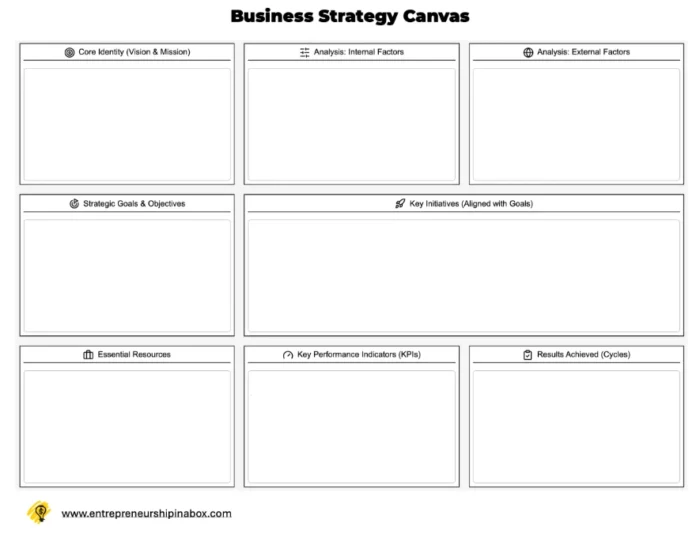
At its center is your Core Identity: mission, vision, and values. These are non-negotiable.
Surrounding them are six other elements: Environmental Analysis, Strategic Goals, Key Initiatives, Essential Resources, KPIs, and Results.
Every single one of these exists to be updated when reality changes. You can also look at the core of the BSC at this video:
As you can see, the vision is the destination. Everything else is the route.
And if you want to build a business that outlasts every plan that you write, you need to learn how to pivot strategy without simply resetting to zero. You need to know exactly which layer of the canvas to change when something breaks.
And you need a process that simply turns recalibration into shipping, not into another six months of planning.
Let me show you how.
If the plan doesn’t work, change the plan, but never the goal.
Anonymous
Here is what most entrepreneurs get wrong about strategy pivoting.
They treat strategy and vision as interchangeable.
When the strategy fails, the vision feels like a lie. The logic goes: “If my plan was sound, and the plan failed, then the vision must have been wrong.”
So they scrap everything. New business. New direction. New identity.
I have been there.
At one point, I was chasing three completely different visions simultaneously. It was a massive identity crisis. I was trying to drive three cars at the same time. I did not move forward. I just stripped the gears.
The cost was not just time and money. It was the accumulated trust, reputation, and capability I had built across all three directions, diluted into nothing.
When I finally stopped, I realized the problem was not the visions themselves. It was that I had no framework for separating what I wanted to achieve from how I was trying to achieve it.
So when one route failed, I assumed the whole destination was invalid.
This is what I now call the Vision-Strategy Fallacy.
The fallacy works like this: you write a plan. The plan is detailed, ambitious, and feels like progress.
But a plan is made of assumptions. Assumptions about the market. Assumptions about your capabilities. Assumptions about timing.
When one of those assumptions breaks, the plan breaks. And because you cannot separate the plan from the vision in your head, the vision breaks too.
Simply, you kill something that was never the problem.
The Business Strategy Canvas exists to prevent exactly this. It has seven components, and only one of them is non-negotiable.
The first is Core Identity. Your mission, your vision, your values. This is the layer that answers: why does this business exist, and where is it going?
If your vision is still worth pursuing — if the problem you want to solve still matters — then this layer stays locked. Period.
The remaining six components are built to be recalibrated.
Environmental Analysis tells you what changed externally and internally. Strategic Goals translate vision into measurable targets. Key Initiatives are the action steps. Essential Resources are what you need. KPIs track progress. Results tell you what actually happened.
When a plan fails, the failure lives somewhere in those six layers. It does not live in the Core Identity.
But because most entrepreneurs do not have these layers separated on a single page, they cannot see where the break actually occurred. So they burn the whole canvas.
Let me give you a real example.
A client of mine launched a SaaS product two years ago. The vision was really strong: make financial planning accessible to solopreneurs who cannot afford expensive advisors.
The initial plan targeted a subscription model with a freemium tier. Six months in, conversion rates were extremely bad. Free users stayed free. Nobody upgraded.
The team did what most teams do. They started questioning the vision.
“Maybe solopreneurs do not want financial planning tools.” “Maybe the market is too small.”
They came within a week of shutting the whole thing down.
Instead, I asked them to pull out the BSC. Core Identity: still valid. The problem was real. Solopreneurs were struggling.
Environmental Analysis: we conducted a quick SWOT analysis and found that the problem was not the vision. It was the pricing plan. Their target customer wanted a one-time setup fee plus low monthly maintenance, not a free basic option aimed at big business sales.
Strategic Goals: they rewrote them based on the environmental analysis. Same vision. Different targets.
Key Initiatives: they rebuilt the onboarding flow around one-time value delivery.
Eighteen months later, the business is profitable. Not because they had a perfect plan. But because they knew which layer of the canvas to change.
This is The Strategy Pivot Principle: the skill is not having the right plan from the start. The skill is knowing what to protect when reality breaks your plan.
And you cannot protect what you cannot name.
This also ties directly into the Staircase Strategy. You cannot chase multiple visions at once without burning out. And you cannot jump from a broken plan to the top of the staircase in a single leap.
The new plan must be built step by step, each one achievable and each one paying for the next. When one step collapses, you do not abandon the staircase. You rebuild that step and keep climbing.
The vision is the top of the staircase. The strategy is how you get there.
If a route fails, you find another route. You do not pretend the staircase was never worth climbing.
Here is the problem with most pivots.
They become procrastination disguised as planning. You hit a wall. You tell yourself you need to “rethink the strategy.” Weeks turn into months.
The canvas you are supposed to be updating becomes a canvas you are endlessly rearranging. And while you are redesigning, you are not shipping.
The Business Strategy Canvas solves this because it forces you to move through the layers in sequence.
You cannot skip ahead to redesigning Key Initiatives if you have not first confirmed that your Core Identity is intact. And you cannot stay stuck in Analysis forever because the final two layers — KPIs and Results — demand output.
Here is how to run a strategy pivot using the BSC, in five steps that build on each other.
Step 1: Lock In Your Core Identity (The Non-Negotiable Layer)
When a plan fails, the first casualty is clarity. Doubt creeps into the foundation. You start asking: am I even in the right business? Should I pivot entirely?
Before you touch anything else, you must write down your mission, vision, and values on a single page. This is the first element of the BSC, and the only one that should survive unchanged through a strategy pivot.
Your mission answers: why does this business exist, right now? Your vision answers: where is it going? Your values answer: what principles govern how we operate?
If the vision still matters — if the problem you set out to solve still exists and still needs solving — then lock this layer. Everything below it can change.
But you need to know what you are protecting before you start changing things.
The biggest mistake here is dishonesty. If you are not honest about whether the vision still holds, you will spend months recalibrating a strategy that was never the problem. Or worse, you will abandon a vision that was still worth fighting for.
The “So What?” test helps. Ask yourself: if I achieve this vision five years from now, will it still matter?
If yes, lock it. If no, that is a different conversation. But most of the time, the answer is yes.
Step 2: Run A Dual Analysis (Internal + External Reality Check)
Most pivots fail because they are built on feelings, not facts. “It did not work” is not a diagnosis. It is a symptom.
The second element of the BSC is analysis. You need both: an external analysis of what changed in the market, and an internal analysis of what your business can and cannot do.
On the outside, do a quick PESTLE scan. Has anything changed in politics, the economy, society, technology, laws, or the environment that challenged your assumptions? A new rule? A new competitor? A change in how customers act?
For the internal part, do a SWOT analysis. What are your real strengths and weaknesses today, not six months ago when you made the original plan? What chances are still available? What dangers are real and which are just worries?
The goal here is accuracy. Do not say “the market is tough.” You must say something like “our conversion rate dropped from 4% to 1.2% because a competitor launched a free alternative.”
As you can see, that specificity tells you exactly which layer of the canvas to change.
Think of this step like a mechanic diagnosing an engine. You do not replace the entire car because one cylinder misfired. You find the misfire and fix it.
The BSC gives you the diagnostic checklist.
Step 3: Rewrite Strategic Goals (Not The Vision)
Now you move to the third element of the BSC: Strategic Goals.
This is where most entrepreneurs make the fatal swap. They rewrite the destination instead of the targets. “Grow revenue by 30% this year” becomes “find a completely new market” becomes “maybe this whole industry is wrong.”
That is not a strategy pivot. That is panic.
Strategic goals should change when the situation changes. They turn the vision into clear, measurable targets based on what is happening now.
If the external analysis told you the market contracted, your revenue goal changes. The vision does not.
For example: your original goal was to acquire 1,000 new customers in 12 months. Your analysis shows the customer acquisition cost doubled because of a new competitor.
Your new goal might be: retain 95% of existing customers and grow through referrals for the next 6 months while building a content engine to lower acquisition costs.
Same vision. Different goal.
The key is that every goal must still trace back to the locked Core Identity. If a goal does not connect to the mission or vision, it is not a pivot. It is a distraction.
Step 4: Rebuild Key Initiatives On The Staircase
The fourth element of the BSC is Key Initiatives. This is where the new plan becomes concrete. And this is where the Staircase Strategy must kick in.
When entrepreneurs design a strategy pivot, they tend to design it as a leap.
The new plan requires resources they do not have, capabilities they have not built, and trust they have not earned. It looks beautiful on paper. However, it is a fantasy.
The fix is to ensure that every Key Initiative must be achievable and must pay for the next one. No step exists in isolation. No step requires a miracle.
If your new Strategic Goal is to retain 95% of existing customers, your first Key Initiative is not “build a world-class customer success team.”
You do not have the resources for that. Your first Key Initiative is “personally call the top 20 customers this month and ask them what they need.”
That is achievable. It requires no new resources. And the insights from those calls pay for the next initiative: redesign the onboarding flow based on actual feedback.
One step at a time. Each step earns the right to take the next one.
That is the Staircase Strategy in action, applied directly to the BSC. No fantasy benefits. Executable reality.
Step 5: Ship Something In 30 Days (KPIs Start Now)
The sixth and seventh elements of the BSC are KPIs and Results.
Here is the uncomfortable truth: most pivots turn into endless planning cycles because there is no deadline for results.
You can keep redesigning the plan forever. The study can always be more detailed. The goals can always be clearer. The actions can always be more refined.
But if you are not shipping what you must ship, you are simply not pivoting. You are just collecting a museum of good ideas that never left your hard drive.
A good plan violently executed now is better than a perfect plan executed next week.
George S. Patton
So, you must set one KPI for the next 30 days. Just one. Not a full report. Not a list of scores. One number that shows if the change is working.
And then ship something that moves that number.
It does not need to be the full vision. It does not need to be perfect.
The Results section of the BSC stays empty until you actually put something into the world. So fill it. One shipment. Real output.
Ask yourself every Friday: did I deliver something this week, or did I just improve the plan?
If you answer the second option for two weeks straight, you are not changing direction. You are avoiding the issue.
The vision is the destination. The strategy is the route. And the route only matters if you are actually moving.