

Most people treat ambition like a virtue. You want more. You dream bigger. You set goals that make your current self look lazy. And you tell yourself this hunger is the thing that separates you from everyone else.
The research tells a totally different story.
Ambition, left unchecked, is not a superpower. It is a system destabilizer. It raises your expectations faster than your capacity can grow. It creates a gap between what you have promised to yourself and what you can actually execute and deliver.
And then suddenly your own ambition punishes you with shame when you fall short. Something that was supposed to fuel you simply starts weighing you down.
I call this the Ambition Paradox: the same drive that pushes you to achieve more is the force that makes you feel like you are never enough.
The data supports this point. Studies that followed high-ability individuals for seventy years show that ambition is linked to higher education, more prestigious jobs, and higher income.
But it also predicts burnout, turnover, and strategy churn when it is not anchored to a system.
The question is not whether you should be ambitious.
The question is whether your ambition is working for you or against you.
This is what the S.L.A.C.K. Ambition Architecture I’ve built to solve. It is a scientific, systems-based operating manual for turning ambition from a liability into a compounding asset. It is not about dreaming smaller. It is about building the structure that makes dreaming bigger sustainable.
Before we get to the framework, we need to understand what ambition actually is. Not the motivational poster version. The empirical version.
Psychologists classify ambition as a middle-level personality trait. It is not a fixed, genetic personality like conscientiousness or emotional stability. Those are Level I traits: stable, deeply ingrained, and largely outside your control.
Ambition is a Level II characteristic adaptation. It translates your abstract personality into contextualized, long-term strivings oriented toward status, rank, and wealth.
This is good news. It means ambition is malleable.
You can shape it. You can channel it.
However, what is also important is that you can also misuse it.
Here is where most ambitious people go wrong: they believe ambition operates in a vacuum. It does not. Ambition relies on social signals and structural alignment.
Research on the reputation effect shows that self-rated ambition does not directly correlate with task performance or promotability. Instead, ambition works through signaling and reputation building.
Ambitious individuals send outward signals (accepting challenges, displaying initiative) that are observed and rated by supervisors and peers. It is this supervisor-rated ambition, the reputation you build, that drives promotability and career outcomes.
The message is tough but clear: your ambition only matters if it leads to real, visible results.
You might feel like you work harder than anyone else, but if there are no results, your ambition stays hidden.
This is just the first sign that the usual story about ambition has flaws. The real issue is even deeper.
Most people believe that setting massive, intimidating goals is the key to extraordinary performance.
The idea makes sense. If I aim for the moon and miss, I might still end up among the stars.
You hear this all the time from organizations and self-help experts: “Set goals that scare you.” “Shoot for ten times growth.”
System dynamics research by Sitkin, See, and colleagues reveals a far more disruptive reality. They call it the Stretch Goal Paradox, and it explains why most ambitious people crash.
When you set a stretch goal (a target characterized by extreme difficulty and extreme novelty), you create a massive attainment discrepancy. The gap between where you are and where you said you would be is enormous.
This gap triggers search behavior: you frantically try new strategies, new tools, new routines. In complex environments, finding a high-performing strategy is exceptionally difficult.
When your search fails, you enter a reinforcing Strategy Churn feedback loop: you jump from one untested, chaotic approach to another, eroding your operational capability and tanking your performance.
At the same time, a second pattern starts. When you keep falling short of your goals, you start to believe you are less likely to succeed. Your commitment to the goal drops. If your confidence falls apart, you give up on the goal and shift into survival mode. Instead of trying to win, you just try not to lose.
Or you quietly lower your expectations so they match what you are actually achieving.
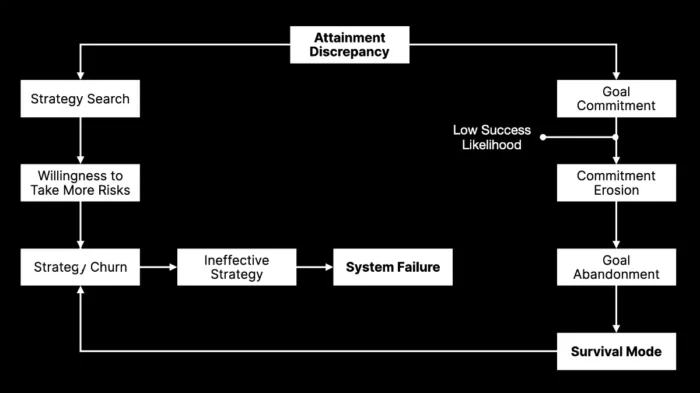
The data is clear and a bit concerning. Stretch goals only help a small group—the top 20% who can handle the extra challenges. For most people, these goals lead to more unpredictable results, lower average performance, and a higher risk of major failure.
Let me translate that. Setting a massive, scary goal does not make you more likely to succeed. It makes you more likely to burn out, quit, and produce less than if you had set a reasonable target.
I’ve learned this through my experience working with hundreds of entrepreneurs, and because of that, I have developed the staircase strategy process, where ambition is adjusted to the stair you’re on. Simply put, the big ambition, translated into a big vision, is broken down into smaller, ambitious goals.
In such a way, you don’t allow the ambition that was supposed to elevate you to become the mechanism that breaks you.
There is a second layer to this problem, and it is even more insidious. Behavioral science has uncovered something called the expectation reference point. When you set a goal, you do not just define a target. You set a psychological anchor.
Expectation is the root of all heartache.
William Shakespeare
Research shows that when people set goals, they expect to reach them 78% of the time on average. If you artificially force someone to revise their goal upward, they will comply on paper, but their median performance expectations remain entirely unchanged. Instead, they simply lower their perceived likelihood of reaching the goal from 83% for attainable goals down to 63% for ambitious goals.
Goals do not drive expectations. They merely reflect them.
This is the fundamental flaw in the “dream bigger” philosophy.
Telling someone to set a higher goal does not make them believe they can achieve it. It just makes them more aware of the gap between their ambition and their actual capability. And that gap is where shame lives.
This is why, in my business strategy canvas, after we set the ambitious vision, we conduct internal and external analyses to identify the capability gap. In this way, we take this gap into account and set specific staircase goals to help us close it. You can also watch this video where I explain the business strategy canvas.
Here is what actually drives performance: underlying expectations, also known as self-efficacy. Research demonstrates that practicing on an easy version of a task raises your expectations of success.
This translates to a 17% increase in actual performance when you transition to harder tasks. Forcing a harder goal onto a system with low expectations yields a statistical null effect on performance.
Seventeen percent. That is the real lever. Not the size of your goal. The size of your belief.
If ambition is a force that can either propel you or destroy you, the question becomes: what determines which direction it goes? The answer is slack.
Slack is the extra time, money, mental energy, and focus you have that is not tied up with current commitments. When you have plenty of slack, your ambition can help you grow. When you have very little, ambition can lead to burnout or failure.
For this purpose, I’ve developed and use with my clients the S.L.A.C.K. Ambition Level-Up Matrix (SALM). I will explain the S.L.A.C.K mnemonic below.
Let’s first look at how this matrix maps this relationship across two axes:
- Performance (your current execution capability) and
- Slack (your available resource buffers).
The result is four quadrants, each with its own dynamics, risks, and protocols.
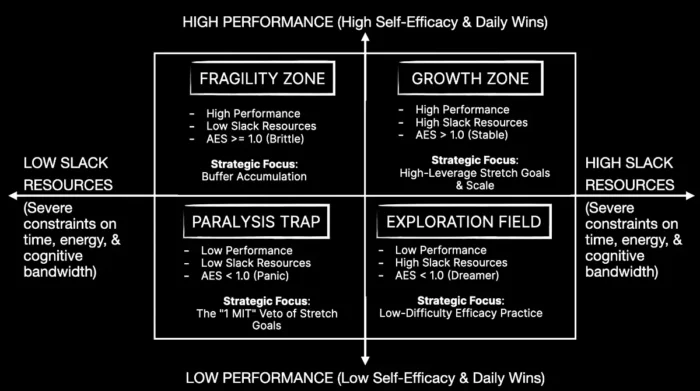
Quadrant 1: The Fragility Zone (High Performance, Low Slack)
This quadrant may seem impressive at first glance. You are getting things done and meeting your goals. Your results are strong. However, there is no room for mistakes. All your mental energy, time, and money are already used up.
The risk in this situation is hard to see until it becomes a serious problem.
If your Ambition Efficiency Score (AES) is at or above 1.0, it seems like everything is running smoothly.
However, the system is fragile. One unexpected event, like getting sick, a sudden change in the market, or a personal crisis, can quickly drain your limited resources.
When that happens, your performance drops and you can end up stuck in the Paralysis Trap.
In this situation, the best approach might seem unusual: say no to any new projects.
Avoid chasing ambitious goals or making things more complicated. Focus on removing obstacles, automating your main routines, and protecting your time so you can build up extra resources.
You need to create some breathing room before you can move forward quickly.
Quadrant 2: The Growth Zone (High Performance, High Slack)
This is the optimal operating quadrant.
Your execution engine is functional. Your self-efficacy is high. You have abundant buffers of time, capital, and mental focus. Your AES is comfortably above 1.0.
Stretch goals work best in this quadrant.
When your system is strong and has plenty of extra resources, you can handle the failures, delays, and risks that come with aiming high. You can try new things without risking everything.
Even if you fail, the whole system stays intact.
Here, the goal is to explore boldly. Look for the toughest challenges and the newest ideas. Go after strong rewards for your efforts. Use tools like code, media, or capital to boost what you can achieve. You deserve to set your sights high.
Quadrant 3: The Paralysis Trap (Low Performance, Low Slack)
This is the most dangerous quadrant, and it is where most burned-out ambitious people live.
You are experiencing low performance, low self-efficacy, and extreme constraints on time and mental energy. Your AES is severely below 1.0.
Here is the cruel irony of this quadrant: it is precisely when you are in the Paralysis Trap that you are most seduced by massive, unrealistic goals. You reach for a stretch goal as a “last-ditch miracle cure” to solve your problems overnight.
When you do not have enough room to handle mistakes or the confidence to keep going, a stretch goal can quickly lead to stress, group anxiety, and constant changes in strategy (Strategy Churn). This often results in avoiding tasks and feeling mentally stuck, which you might mistake for laziness.
You are not lazy. You are in a system that has outrun its resources.
This part is often the toughest: do not allow any stretch goals. Let go of trying to make the perfect plan. Set the bar so low that it feels almost too easy. Use the 1 Most Important Task (MIT) rule and the 5-Minute Rule (work just 5 minutes on MIT) to create a series of small promises you can keep.
Focus only on raising your AES to 1.0. Nothing else is important until you do.
Quadrant 4: The Exploration Field (Low Performance, High Slack)
This is the “Ambitious but Lazy” quadrant. You might have plenty of free time, resources, or energy, but find it hard to follow through. Instead of taking real action, you end up procrastinating by reading self-help books, making detailed plans, or talking about big goals, but never actually getting started.
You set high standards for yourself, but your fear of failing is even stronger. You often mix up perfectionism with true excellence. Your expectations do not match what you actually get done. Your AES is below 1.0 because you never finish and ship your work.
The main idea here is to reset your approach. Skip complicated planning and start with simple, low-pressure practice sessions to build your skills. Make it harder to fall into bad habits by keeping your phone in another room or logging out of social media, and use clear physical reminders to help you take action automatically. The aim is not to overthink, but to take more action.
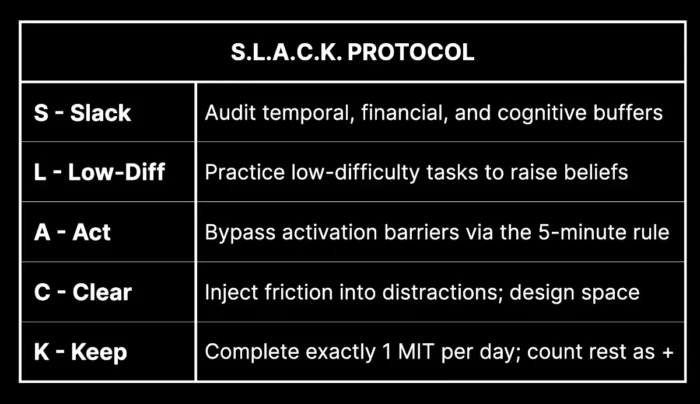
The SALM Matrix tells you where you are. The S.L.A.C.K. Protocol tells you how to move.
It is a five-pillar system designed to shift you from the Paralysis Trap (Quadrant 3) up through the matrix into the Growth Zone (Quadrant 2).
You do not rise to the level of your goals. You fall to the level of your systems.
James Clear
S: Slack Assessment (Audit Your Buffers)
The first rule of the S.L.A.C.K. Protocol is straightforward: don’t move forward until you’ve checked your resources.
Before starting a new goal, project, or commitment, ask yourself if you have enough time, money, and mental energy to handle it.
If your uncommitted resources are near zero, stop immediately. The pursuit of stretch goals in a low-slack state does not increase your output. It fractures your system.
The operational move is to build unabsorbed slack blocks: ninety-minute windows in your calendar that are dedicated to nothing specific.
These times are not meant for meetings or urgent tasks. They serve as buffers. If you cannot find three buffer periods in your week, you are in the Fragility Zone or worse. In that case, you should remove something before adding anything new.
L: Low-Difficulty Practice (Calibrate Your Expectations)
The second pillar deals with the expectation trap. Raising your goals alone will not improve your performance. Instead, you improve by building your self-efficacy, which grows as you succeed again and again at the task you want to master.
The idea is simple: for the first week or two of any new routine, focus on very easy versions of your main task.
For example, if you want to write every day, just open your document and write one sentence. If you want to start exercising, just put on your running shoes and step outside.
Doing perfectly on easier tasks helps you adjust your confidence level. This process is not just about motivation, but about calibration. As I mentioned above, research shows you can see a 17% boost in performance when you move on to more difficult challenges.
A: Activation via the 5-Minute Rule (Bypass the Activation Barrier)
Amateurs sit and wait for inspiration, the rest of us just get up and go to work.
Stephen King
Static friction is always greater than kinetic friction.
The human brain naturally resists the transition from rest to action. This is the activation barrier, and it is the single biggest reason ambitious people fail to execute.
You don’t need to force yourself to push through the barrier with discipline. Instead, try to make the barrier unimportant.
Set a timer and do the task for just five minutes, giving yourself full permission to stop when the timer goes off. That’s the whole rule.
Behavioral activation research and B.J. Fogg’s work on tiny habits confirm that this works for a specific neurological reason: once you cross the activation barrier, physical momentum triggers the dopaminergic reward system.
Ninety percent of the time, you will continue working naturally after the timer rings. But you have to give yourself permission to stop. The paradox is that permission to quit is what makes you not quit.
Action must precede motivation. Not the other way around.
C: Clear Environmental Friction (Design Your Choice Architecture)
Willpower does not last forever. Each time you fight off a distraction, you use up some of your mental energy. People who rely only on discipline to reach their goals often find it does not work in the long run.
The S.L.A.C.K. Protocol replaces willpower with architecture. You manipulate your environment to make good habits default and bad habits difficult.
This operates in two directions.
Friction Injection: make distractions harder to access. Place your phone in a separate room during deep work blocks. Log out of social media apps nightly so you have to re-enter your password.
The five seconds of added friction is often enough to short-circuit the impulse.
Remove friction by making your desired habits easy to start. For example, set out your workout clothes before bed or leave your notebook open on your desk. Organize your tools so it’s simple to go from planning to doing.
For example, I always create my to-do list for tomorrow the night before. 3-5 most important tasks (MITs), so when I wake up, I know exactly what to do.
Through classical conditioning, you can also build cue associations. Light a specific candle, play a designated focus playlist, or use a specific gadget exclusively during deep work.
Over time, the brain associates these cues with focused attention, and the ritual itself becomes a trigger for the state you need.
K: Keep Reality Greater Than or Equal to Expectations (The Daily 1-MIT Rule)
The final pillar is the mathematical foundation of the entire system.
Subjective daily satisfaction is not determined by objective milestones. It is determined by the difference between your actual outcomes and your reference point expectations.
I like to think of this as the Happiness Formula:
Happiness = Reality – Expectations
If you set out to do eight tasks but finish six, it can feel like you’ve fallen short. Your brain might see this as a failure, causing stress and making you want to avoid more tasks.
But in reality, finishing six tasks is a productive day. Still, it’s easy to feel like you didn’t do enough.
If you set out to do just one task and end up finishing that plus five extra, you still get six things done. But your mind sees this as a big win. You went beyond what you expected. You get a boost of dopamine, your self-trust grows, and you start to feel real momentum.
You can have the same results but feel differently about them. What changes is your expectation, not the actual work you do.
Here’s a simple rule: each morning, pick one Most Important Task (MIT) and make it your top priority. When you finish that task, you’ve met your goal for the day. If you get more done, consider it a bonus.
Over time, these extra wins help build your confidence and keep you motivated.
This is not about doing less. It is about managing the reference-dependent utility gap so your brain associates your goal system with success instead of failure.
At the end of each week, check if your ambition is helping you grow or just repeating old patterns.
You can do this by calculating your Ambition Efficiency Score (AES).
AES = Micro-Promises Kept (Reality) divided by Assigned Performance Targets (Expectations)
If your AES is 1.0 or higher, it shows your expectations match your current abilities or are just a bit lower. This helps your mind connect effort with success, builds self-trust, and gradually improves your performance.
An AES below 1.0 means your expectations have outrun your temporal and cognitive resources. Your brain associates your goal system with shame and failure. Task avoidance becomes the default. You must immediately lower the bar.
This is not a measure of productivity. Instead, it shows how healthy your system is. It helps you see if your ambition is helping you or causing problems.
Every Sunday, rate yourself on two dimensions from 1 (struggling) to 10 (flourishing):
Recent Performance: Think about your self-confidence, how consistent you have been, and the small commitments you kept this week.
Slack Resources: Consider how much free time you have, any extra money you can use, and the periods when you can focus.
Mark your scores on the SALM Matrix.
If both numbers are below 6, you are in the Paralysis Trap and should use the S.L.A.C.K. Protocol right away.
If both are above 6, you are in the Growth Zone and can start exploring new opportunities.
If one score is high and the other is low, you are either in the Fragility Zone or the Exploration Field, so follow the steps for that area.
Ambition itself isn’t the issue. The real challenge comes when ambition lacks structure.
If you never give yourself any breathing room, ambition can end up working against you. When you don’t set realistic expectations, it can lead to feelings of shame.
And without a clear plan for how to act on your goals, ambition just turns into stress dressed up as productivity.
The entrepreneurs I work with are always motivated, but what they often lack is clear direction.
Many have grown up believing that simply wanting more is enough.
But that’s not true.
If you want more but don’t have the right structure, you can fall into what I call the Paralysis Trap. You end up staring at a to-do list you can’t start, and the drive that once pushed you forward starts to feel heavy instead.
The S.L.A.C.K. Ambition Architecture gives you a clear structure and helps you see where you are, why you might feel stuck, and what steps you can take next.
Instead of just telling you to “dream bigger,” it focuses on building a system that makes those bigger dreams possible in the long run.
Check your expectations. Notice the small promises you keep. If your AES is under 1.0, avoid setting bigger goals. Make things easier for yourself. Focus on rebuilding your self-trust and giving yourself some breathing room. Only speed up when you’re ready.
Ambition isn’t a virtue; it’s a force. It can help you grow or cause problems, depending on how you shape your life around it.