

I have watched founders give themselves six months to do something that took six days, only to finally run out of time.
The extra five months and twenty-four days were not wasted. They were worse than wasted. They felt productive.
The diagnosis is almost always the same. They gave themselves six months to do what could have been done in six days.
I call this the Deadline Paradox.
The more time you allocate to a project, the less likely you are to complete it at all, and the more likely you are to fill that time with work that passes the “I’m busy” test but fails the “So What?” test entirely.
Cyril Parkinson identified the mechanism in 1955, universally known as Parkinson’s Law, that states:
“Work expands so as to fill the time available for its completion”.
He was right, but he undersold the problem.
Work does not just expand. It mutates. It breeds subsidiary tasks. It convinces you that the peripheral is the priority, and it does all of this while making you feel productive.
The real danger is not laziness. It is the illusion of motion. Yes, the illusion of motion.

Think about the last project you gave yourself a three-month runway on. Now strip away everything that was not the core deliverable.
The brand guidelines you revisited. The onboarding sequence you reworked three times. The competitor research you did was “just to be thorough.” The tool stack migration. The color palette exploration.
If you are honest, the irreducible core of that project, the part that actually shipped value to a real person, probably took less than two weeks.
The rest was what I call Shallow Work: activity that scores high on the busyness scale and near zero on the output scale. You were not lazy. You were working. You just were not working on the uranium.
This is the Busyness Paradox at its most dangerous. High busyness plus low productivity feels like a productive day. Yes, it feels.
Don’t mistake activity with achievement.
John Wooden
I call this the “Treadmill” quadrant on the Productivity-Busyness Matrix. I highly recommend pausing to read the productivity-busyness paradox before continuing with this article to understand the matrix.

But what is more important is that at the end of the week, you still feel exhausted.
You tell yourself you gave it everything. And you give it everything. You put in really hard work. But the ratio, the only metric that matters, is output over input (productivity).

And your denominator is enormous while your numerator is hardly visible.
When I calculate such a level of productivity, I always ask myself: Why these numbers?
Then, I realize that one big part of the answer is that many people do not know how to set the right deadlines. They want to have a larger room for mistakes, errors, missteps, or, in the end, comfort.
It is logical. Nobody wants to work under the pressure of short deadlines, so deadlines become extended and are increasingly unreasonable.
On the other side, reasonable deadlines create this outcome much more reliably.
Why?
Because unreasonable deadlines give you one big room to mistake preparation for execution.
Let’s say you set a deadline that makes you uncomfortable, for something you usually set six months to one week. You can see that something shifts.
The research phase now takes just three hours instead of three weeks. Extra features disappear since they were never meant for the first version. Instead of collecting ideas on your hard drive, you actually start launching your work.
An unreasonable deadline is not a motivational trick. It is a prioritization mechanism. It forces you to identify the element with the highest energy density in the project and convert it first.
Steve Jobs understood this intuitively.
When the first iPhone team hit a wall with the touchscreen technology, Steve Jobs did not extend the timeline. Instead, he told them they had only two weeks to figure it out, or he would put a keyboard on the damn thing.
In this case, the unreasonable constraint did not diminish the product’s value. It revealed what was essential and stripped everything else.
You can see that when you compress your time, you also compress your decision-making. You stop asking “what else could we add, or could we do?” and start asking “what can we remove and still ship on a deadline?”
Those are two different questions. The first one expands the scope. The second one reveals value.
Peter Drucker famously said that there is nothing so useless as doing efficiently that which should not be done at all. You can read more about this in the Efficiency and Effectiveness Matrix.
Simply, an unreasonable deadline is the fastest way to discover what should not be done at all. I’ve also used this principle in my business strategy canvas framework, which, at a high level, prioritizes and outlines the first action plan covering only the highest-priority actions, not based on what we think is highest priority, but on research and data.
Whenever I talk about this framework with my clients, someone always objects and says, “But in such a way, quality suffers. You cannot rush creative work. Some things just take time to be done.”
Yes, this objection sounds wise. However, it is mostly false.
Yes, there are domains where extended incubation produces genuinely better outcomes. Writing a novel. Designing a scientific experiment. Building a nuclear reactor.
But the entrepreneur reading this is probably not doing any of those. They are writing a sales page. Designing a lead magnet. Shipping a feature update. Launching a consulting offer.
In these domains, the gap between “done in two weeks” and “done in two months” is rarely a gap in quality.
It is a gap in confidence.
The extra six weeks were not about making the thing better. They were about avoiding the discomfort of shipping. They were about adding more comfort to yourself.
I have watched founders (including myself) rebuild their landing page seven times in three months and end up with something marginally worse than the version they had on day seven.
The delay was not refinement. It was procrastination disguised as perfectionism.
The quality objection also assumes that quality is a function of time spent. It is not.
Throughout my life, I have found myself saying, “If only I had more time, I would be able to do it better.” But in fact, when I look back, I realize I spent the last several days working. I delayed things, procrastinated, something else happened, and other distractions kept me from this specific project, etc. So, for sure, it was not the time that was the problem.
Quality is a function of clarity of intent, skill, and iteration speed. And one of those variables, iteration speed, is directly killed by comfortable deadlines.
Ship fast. Get real feedback. Iterate. That cycle produces better work than any amount of isolated polishing ever will.
If you are not embarrassed by the first version of your product, you’ve launched too late.
Reid Hoffman
So, the one-million-dollar question is…
The problem with self-imposed deadlines is that you know the person who set them. And that person, you, is terribly forgiving.
An unreasonable deadline only works if it carries consequences. Not “I will feel bad if I miss it.” Something sharper. A public launch date. A client who paid for delivery by Friday. A deposit that burns if you are late. An accountability partner who will not accept your excuses.
Consequences turn a random date into a real deadline. If there are no consequences, you are just putting dates on a calendar and ignoring them. That is more like a hobby than real-time management.
The next rule is that your deadline should feel a bit wild when you set it. If you think, “that seems reasonable,” you are already missing the point. The deadline should make you feel nervous and force you to quickly figure out what you can skip. That quick check is what matters most.
I use a rule I call the 10x Compression Test.
Whatever timeline you initially think a project needs, ask yourself: What would I do if I had one-tenth of that time?
Not nine-tenths. One-tenth. The answer to that question is almost always closer to the real scope of the work than your original estimate.
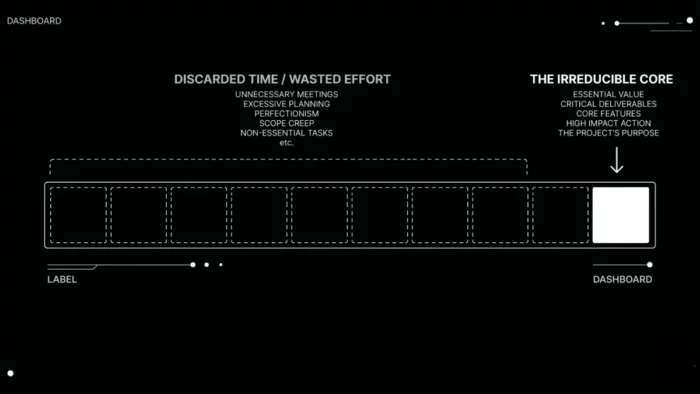
Try the 10x Compression. Test it on something small this week.
A proposal that normally takes you five days. Give yourself until the end of the day.
A newsletter draft that sits in your drafts folder for two weeks. Ship it by morning.
You will discover something uncomfortable: most of what you called “working on it” was really just not wanting to finish it.
We treat time as a resource we need more of. Buy more time. Find more hours. Wake up earlier. Grind harder. The entire productivity industrial complex is built on this premise.
It is exactly backward.
Time is not the thing you lack. Time is the lever that reveals what matters.
When you have too much of it, you cannot see the signal for the noise. Every idea looks equally promising. Every task feels equally urgent. You spread your energy across coal and uranium alike because there is no pressure forcing you to discriminate.
Compress the timeline, and the discrimination becomes automatic. You do not need a better prioritization framework. You need a deadline that makes prioritization unavoidable.
The entrepreneurs who ship the most value are not the ones with the most time. They are the ones who act as if they have the least. They treat every project as if the clock is already running out, because in business, it always is.
Markets shift. Attention moves. Trust decays. Your stored potential energy does not hold its value forever. It is something that changes over time. So, use it now and:
- Set an unreasonable deadline for your projects.
- Ship before you feel ready to get the feedback.
- Let the market tell you what to fix.
You will be amazed at how much work was never actually work at all.

Knowing the framework is the easy part. Applying it to your own work, where the stakes are real and the old habits are comfortable, is where most people stop. Here are the five steps to move from reading to doing.
Step 1: Define the Irreducible Core of Your Project
Before you set a deadline, figure out the simplest possible version of your project that still provides tangible value to someone (your audience, your team members, or your clients). Take out any feature, deliverable, or step that isn’t absolutely necessary.
Why?
Most deadline failures start before the deadline is even set. You are not protecting a timeline. You are protecting a bloated scope that never belonged in version one.
Simply, if you cannot name the core in one sentence, you are not ready to set a deadline. You are ready to waste time.
Let’s say you are launching a consulting offer.
The irreducible core is: a clear description of who you help, what problem you solve, the price, and a way for someone to pay you.
It is not the brand guidelines. It is not the seven-page sales deck. It is not the email nurture sequence.
If you are clear about these four core elements (audience, problem, price, and payment method), you can take a client. Everything else is optional.
Step 2: Run the 10x Compression Test
Take the timeline you instinctively believe the project requires. Now ask: what would I do if I had one-tenth of that time? Write down every cut, every shortcut, every “we can skip that for now” that appears in your answer. Those cuts are your new scope.
Your first timeline estimate usually isn’t a real calculation. It’s more like your comfort zone dressed up in a spreadsheet.
The 10x Compression Test helps you skip your usual justifications and look at the project like an outsider would: as a list of tasks, many of which are just extra. The result from the compression test is almost always closer to the true scope than your original guess.
Let’s say you think a client proposal will take five days. The 10x Compression Test says you only get half a day. So, you drop the custom mockups, use a template, keep it to three pages, and refer to past results instead of making new case studies. Now you can see what was actually taking up those five days.
Or maybe you think a rebrand will take three months. If you compress it to about a week, you might keep the current logo, just update the colors and fonts, rewrite the homepage headline and the about page, and then publish. The full three-month plan included six rounds of feedback and a custom typeface. Ask yourself if either of those would have actually increased revenue.
Step 3: Attach a Consequence That Cannot Be Ignored
Put a deadline that makes missing it feel worse than releasing work that isn’t perfect. In such a way, you create a consequence you can’t ignore.
Simply put, a deadline written in your private task manager or on a piece of paper has no teeth. The consequence must involve another human being, not you. That is what turns an arbitrary date into a real constraint, something that will push you to move forward towards finishing the work.
Without it, you are doing the hobby version of time management.
Let’s say you want to launch a paid workshop. Instead of setting an internal deadline of “sometime next month,” put up a registration page this week with a specific date, open payments, and send the link to ten people you respect. Now the deadline is not yours to move. There are names on a list and money in your account.
Step 4: Lock the First 90 Minutes
Once you have a reasonable deadline, your first block of execution time must be sacred. So, schedule the first 90 minutes within 24 hours of setting the deadline.
No email before it. No “quick calls.” The only activity permitted during that window is work on your irreducible core (what you have defined in step 1).
This is an important step because the gap between setting a deadline and starting the work is where resistance breeds.
Every day you delay the first real deep work session, your project starts to accumulate emotional weight. It becomes a thing you are “about to do” instead of a thing you are doing.
Amateurs sit and wait for inspiration, the rest of us just get up and go to work.
Stephen King
However, a 90-minute block, protected ruthlessly and executed immediately, breaks that inertia before it calcifies.
For example, if you commit to launching a new service page by the end of the month, your first 90-minute block is not for writing the page’s content.
It is for opening your website editor and building the skeleton: the URL, the headline, the section headers, and the buy button.
By the end of the session, the page exists. It is ugly, but it exists. But what is more important is that you just crossed the hardest threshold.
Step 5: Ship Whatever Exists When the Deadline is Over
When your deadline is over, whatever you have done must go out the door without any extensions. Simply, your deadline is not a suggestion. It is a decision you already made, your agreement with yourself, and a promise to yourself that you must keep it.
This is where many people slip up.
They set a deadline that is too ambitious, push themselves to meet it, and then, right at the end, they hesitate. They allow themselves more time.
In doing so, they learn a risky lesson: that deadlines can be changed. After that, no deadline you set will really matter. You need to finish and deliver when time is up, even if you feel a bit embarrassed by the result. That is when it matters most.
Parkinson only gave us the observation. However, the real insight belongs to the entrepreneurs who act on it.
Work expands to fill the time you give it. But it also expands to consume something more expensive than time.
It consumes your energy, your attention, and your willingness to take the next swing.
Every week spent polishing a deliverable that could have shipped on Tuesday is a week you did not spend getting real feedback, making real money, and building real momentum.
And remember: your calendar is not a planning tool. It is a compression tool. So, you must use it that way.
Parkinson was an optimist. The problem is worse than he said. But the solution is simpler than you think.