

Why your strategy document is a collection of promises you never kept — and how to fix it with the Language-Clarity Matrix.
I have sat through the meetings. You have sat through the meetings. The projector is on. The slides are dense.
Someone says “strategic realignment” and heads nod. Someone says “we need to leverage our core competencies to optimize stakeholder value” and nobody asks what it means.
Nobody asks because asking would expose that you do not know either. The room is full of smart people performing understanding for each other.
The greatest enemy of communication is the illusion of it.
George Bernard Shaw
And at the end of the hour, exactly zero new decisions have been made.
This isn’t a communication problem. It’s an execution problem that just looks more polished.
If your team can’t explain your strategy in their own words, you don’t really have a strategy. You just have a set of nice-sounding phrases that never made it out of the conference room.
And every day that your strategy lives in the fog of jargon is a day your business is burning potential energy without converting it into anything real.
I call this the Busyness Paradox, applied to language. Busyness is input — the hours you clock, the meetings you attend, the decks you build.
Productivity is output — the decisions made, the value shipped, the results that land in someone else’s hands.
Jargon is one of the most efficient forms of busyness I have ever seen. It sounds like substance. It feels like progress. But it produces nothing. It is motion, not action.
And motion without action is just the sound of gears stripping.
Let me define the problem precisely.
Jargon is not big words. Big words have definitions.
“Depreciation” is a big word. “Amortization” is a big word.
But you can look them up. They mean one thing. They commit the speaker to a statement that can be verified or disproven.
Jargon is the opposite. Jargon is language that sounds precise but contains no verifiable claim.
It is designed to create the impression of expertise while making it impossible for anyone to say “that turned out to be wrong.”
It is vocabulary as armor.
Take the phrase “we need to drive operational excellence through cross-functional synergies.”
What does that sentence commit you to? By Friday, what will you have done? What number will have changed?
If nobody can answer those questions, the sentence was not communication. It was performance art.
The test is simple. I call it the “So What?” test.
Read the sentence. Ask: “So what does that mean I should do differently tomorrow?“
If the answer is silence, you are holding jargon. If the answer is a specific action, you are holding strategy.
Most strategy documents fail the “So What?” test on page one.
This matters because of something I think about a lot: Business Potential Energy.
Every business is a system with stored potential energy. Not all elements have the same energy density.
The entrepreneur’s job is to identify the high-density elements — the uranium, not the coal — and convert that potential into kinetic output.
Jargon is what happens when you cannot identify the uranium.
You know there is energy somewhere in the system. You can feel it. But you cannot point to it.
So you surround the feeling with professional-sounding language and hope nobody notices the absence of a real claim underneath.
Drucker said it directly: “There is nothing so useless as doing efficiently that which should not be done at all.”
Jargon is the language of doing efficiently what nobody can define.
So what does jargon actually cost you?
Let me be specific.
This is not about sounding smarter. This is about three things that directly affect whether your business ships value or just talks about shipping it.
1. Strategic Jargon Masks the Busyness Paradox
When your team cannot distinguish between “realignment initiative” and actual work, they default to the most visible form of activity.
They make more slides. They schedule more meetings. Also, they write more documents.
The busyness increases while productivity flatlines.
And because the language is so vague, nobody can prove that the busyness is not contributing to the outcome.
Strategic jargon is the perfect alibi for a week of zero output.
2. Jargon Keeps Teams in Analysis Paralysis
The Staircase Strategy teaches that you cannot chase multiple visions at once.
You prioritize by executable sequence: each step must be achievable and must pay for the next one.
But a strategy expressed in jargon is not a staircase. It is a fog.
You cannot identify step one because every phrase contains six possible meanings.
The team debates interpretations instead of executing.
You do not move forward; you just spin.
3. Jargon protects the speaker from being wrong.
If I say “we will increase revenue by 15% by shipping feature X to segment Y by June,” I have made a statement that can be proven wrong.
Such a sentence is jargon, or better said, a hypothesis that requires experimenting to be approved.
In six months, you can look at the number and tell me I failed. That is uncomfortable.
If I say “we will drive top-line growth through customer-centric innovation,” I have made a statement that cannot be proven wrong under any circumstances.
I am safe. And safety is the enemy of execution.
The uncomfortable truth is that a lot of strategy language exists not to move the business forward but to protect the strategist.
It is a shield. And every shield you carry into a strategy session is weight your team has to drag up the staircase.
Confucius got there first: “The man who chases two rabbits catches neither.”
Jargon is the art of chasing twenty rabbits and congratulating yourself on the effort.
Let me put this into a framework you can use. Picture a simple two-by-two. On one axis: Jargon versus Plain Language. On the other: Excuses versus Commitment.
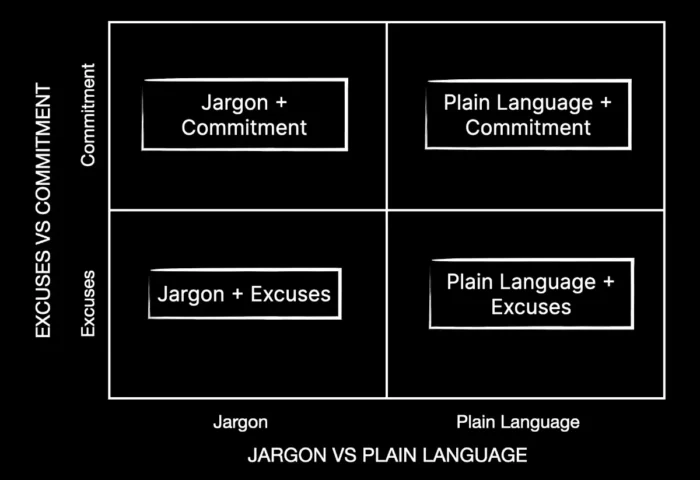
Quadrant 1 (bottom-left) is Jargon + Excuses.
This is where most bad strategy lives. “We need to circle back on the alignment piece once we have more data.”
Translation: “I have no plan and I do not want to admit it.”
This quadrant is comfortable. It is also where businesses go to die slowly.
Quadrant 2 (bottom-right) is Plain Language + Excuses.
This is at least honest. “We do not have the answer yet. Here is what we are missing. Give us two weeks.”
Nobody likes delivering this message.
But it is real. It tells the team the truth. And truth is the only foundation you can build on.
Quadrant 3 (top-left) is Jargon + Commitment.
This is dangerous because it looks good. “We commit to driving world-class operational excellence by Q3.”
The word “commit” is in the sentence. But committed to what?
Nobody knows.
This is the quadrant where leaders feel like they have made a decision while making none at all.
Quadrant 4 (top-right) is Plain Language + Commitment.
“We will ship feature X to 1,000 customers by March 15.”
This sentence is uncomfortable to write.
It can be proven wrong. And that is exactly why it works. It forces you to think. It forces you to decide. And it forces you to commit to a statement your team can actually act on.
Well done is better than well said.
Benjamin Franklin
This is where most anti-jargon arguments stop.
They tell you to “communicate clearly” and then walk away. That is like telling someone to “be more productive” without giving them a system.
Let me give you concrete translations I have pulled from hundreds of strategy documents I have helped prepare.
These are sentences I have seen in real documents — strategy decks, hiring plans, product briefs — next to what they actually meant once you strip the armor off.
“We need to drive strategic alignment across the organization.”
What it means: “We have not decided what the priority is. Different teams are working on different things. Nobody knows who is supposed to be doing what.”
So, the question is how to fix this.
Instead of the above sentence, you can fix it using the following: “Starting Monday, every team’s top priority is reducing churn. All other projects are paused until we hit 5% monthly churn or lower.”
“We will leverage our core competencies to create market differentiation.”
What does this mean for you and your team members? Simply:
“We are good at something. We think it might matter to customers. However, we have not verified this.”
Here’s a stronger way to phrase this in your strategy document:
“We are chosen by customers since we reply to support tickets within two hours, whereas our competitors take an average of twenty-four hours; therefore, this quarter we will keep focusing on speed and mention it in every sales discussion.”
Next example:
“The objective is to optimize synergies across business units.”
This simply means: “Two teams are doing overlapping work. It is inefficient. We should probably stop duplicating.”
But instead of a confusing, jargon-filled sentence, it is much better to include the following in your strategy document:
“Team A will handle all content production. Team B will handle all distribution. And Team A stops posting. Team B stops writing. Go.“
“We are pursuing a customer-centric innovation strategy.”
This sentence simply means that “We want to sound like we care about customers.”
But nobody knows how, or what we want to achieve and measure our progress. So, it is not helpful strategy document language.
Much better strategy document language is:
“We will interview 20 customers this month. Every product decision from April onward will cite a specific customer problem it solves. If we cannot name the customer and the problem, the feature does not get built.”
Specific, action-oriented, telling us what to do, how to measure progress, and what to do next.
Let’s look at one more example.
“We need to attract top-tier talent with a compelling employer brand.”
This simply means:
“We are struggling to hire. We have not asked the candidates who said no why they said no. Also, we are guessing at the problem.”
However, we can improve this by using much clearer strategy document language:
“We will interview the last 10 candidates who rejected our offers. We will publish the three most common reasons by April 30. Our job descriptions will address those reasons directly, starting May 1.”
Can you notice the pattern?
Every fixed sentence contains a number, a name, or a deadline.
Every original sentence contains none of those things.
Numbers, names, and deadlines are the enemy of jargon because they create accountability.
“By March 25” means on March 26 someone can ask if you did it.
“10 candidates” means someone can count. Jargon disappears the moment you add a number.
This is what I mean by Value Shipping.
Every message you send — every email, every deck, every all-hands presentation — is a shipment.
The question is not “did I communicate effectively?”
The question is “did what I said land in someone else’s hands in a form they can use?”
If your team cannot convert your words into action, the shipment did not land.
You fired a blank.
Here is the idea I want to leave you with.
Most people think of clear language as a communication skill.
Something you learn in a workshop. Something the communications team handles.
However, that framing is wrong.
Clarity is a leadership act.
When you say “we will ship X by Friday” instead of “we will pursue operational excellence,” you are doing something uncomfortable.
You are putting your name next to a claim that can be proven wrong. You are giving up the safety of vague language.
Simply, you are telling your team: I am willing to be judged by results, not by how smart I sound.
That is leadership.
Not the title on your email signature. Not the number of people who report to you.
Leadership means being the person in the room who is willing to say what others are avoiding.
Usually, what people avoid is a simple but uncomfortable sentence that begins with “we will” and ends with a deadline.
More about deadlines and the deadline paradox, with a clear worksheet you can find in my video:
Steve Jobs had a rule at Apple: if you could not explain something in thirty seconds, you did not understand it well enough.
He was not making a point about communication style. He was making a point about thinking quality.
Fuzzy language is always a symptom of fuzzy thinking. You do not fix the language and then fix the thinking.
You must fix the thinking, and the language tightens on its own.
So here is your homework.
Open your most recent strategy document.
Read the first paragraph. Apply the “So What?” test to every sentence.
If a sentence does not tell your team what to do differently tomorrow, delete it. If the paragraph collapses to two sentences, good.
That means you have a strategy. The other 48 pages were just motion.
The highest form of strategic thinking is not the ability to hold a complex model in your head. It is the ability to compress that model into a sentence that a twelve-year-old could repeat back to you.
If you cannot do that, you are not a strategist. You are a curator of good-sounding words that never left the hard drive.
Say what you actually mean. Ship value. That is the whole game.