

Last week I started auditing the implementation of a client’s strategic plan. Not a company, but an organization, closer to a public body. The document covers 2021 to 2026.
It is more than 150 pages long.
It is beautifully formatted. Different colors for different chapters. Clean visuals. The first almost a hundred pages are analyses: SWOT, TOWS, data pulled from the statistics bureau. That part is fine, actually. It’s thorough. But it is not strategy. It is an external document that got stitched into a strategy.
The last fifty pages are the strategy itself, and they are carefully organized. Strategic goals. Each goal has priorities. Each priority has measures, actions, or operational plans. And each measure has indicators.
I sat with it for hours, and even I found it hard to tell where the strategy ended and the action plan began. What could be measured and what couldn’t.
And here is the part I couldn’t shake: if I, a consultant paid to understand this, was struggling, what happens to the person who actually has to execute it?
Because that is the real test of any plan. Not whether it looks complete on paper. Whether a person can open it on a Monday morning and know, within seconds, what they are supposed to do.
Imagine that person. Every day they open a 150-page document and try to find their task. They have to guess which measure belongs to them, because the document doesn’t attach responsibility to any of it.
They have to guess whether there’s a budget, because the document doesn’t say. Also, they have to guess the deadline, because there isn’t one.
Three hours later, they are exhausted from deciding what to work on today. Around noon, they pick the only option that makes sense: let’s go for coffee and decide later.
Day after day. Week after week. Month after month. Year after year. What got done? Nothing.
And this is the part people rarely admit, about that client, about me in 2007, and probably about you. The document wasn’t a failure of effort. It was a failure of sequencing.
I know this trap from the inside, because I built it myself before I ever diagnosed it in someone else.
In 2007 I started my first company. I did everything by the book, and I mean everything they taught me at university.
A complete business plan. Forecasts. Visuals. Every model and framework I had been told would protect me. I produced the kind of document a professor would hang on the wall.
However, it did not help me. It became a burden. It came close to destroying me, my company, and my family.
What I wanted was simply something that would guide me each day, every day. What I got was simply a wall of difficult analysis that had no idea what I should do first. I didn’t need a hundred pages. I needed one page that told me the next step.
That is the confession. I ran headfirst into the exact problem I now untangle for my clients. I am not standing above this. And I was the poster child for it.
What I’m about to describe has a name, and once you hear it, you will see it everywhere.
I call it sequencing intelligence.
Sequencing intelligence is the ability to look at an entire system, find the small number of points where the most leverage is sitting, and have the discipline to act on those points first, while deliberately ignoring everything else.
It is the difference between the person who tries to do everything at once and accomplishes nothing, and the person who does one thing at a time and eventually gets everything done.
Here is the uncomfortable truth hiding underneath your overwhelm: the energy was never the problem. You are not lazy. You are not undisciplined. And you are exhausted from doing everything at once.
The failure isn’t that you stopped trying. The failure is that you tried so hard, at so many things, that none of it had a chance to move.
This is the loaded part.
Let me walk through the three lies that keep you stuck.
Lie #1: Analysis is strategy
A hundred pages of SWOT and TOWS and market data is context. It is the raw material strategy is made from.
But it is not strategy, any more than a pile of bricks is a house.
Strategy is a decision about what to do, in what order, with what resources, by whom, and by when.
Most strategy documents never make that decision. They gather the bricks and call the job done. That is why they balloon to 150 pages: when you aren’t sure what the decision is, you add more context so it feels like you’re making progress.
Lie #2: A plan without an owner, a budget, and a deadline is still a plan
Look back at that 150 page document. Three things were missing from nearly every measure: no name attached to responsibility, no budget and no deadline.
Each omission in itself is a quiet assurance that nothing will happen. All of them together are not a plan at all. They are a wish dressed up as a plan.
You can fill a document to the point where it’s too long to read with measures and indicators and if you’ve got absolutely nobody who owns any of it, has any money to put into it or a date on it you’ve just created paperwork rather than a route forward.
Lie #3: Busyness is productivity
Here’s where sequencing intelligence gets its teeth. In my research I called it the “busyness paradox” and it is the lie that destroys more startups than any other.
It works like this: when execution becomes cheap, people execute all over the place. Every department is off and running with its own improvement initiative. Everyone is optimizing their own little bit and watching their own local KPI go up. On paper it all looks very busy, very efficient, very productive.
But the system, the whole company, does not move.
In operations theory, this is the core lesson of the Theory of Constraints. A chain is only as strong as its weakest link, but a system is only as fast as its bottleneck.
Improving anything that is not the bottleneck does not speed up the system. It just burns energy. You can get every department humming at maximum output and still ship the same amount out the door, because everything piles up in front of the one constraint you refused to look at.
An hour lost at a bottleneck is an hour lost for the total system. An hour saved at a non-bottleneck is a mirage.
Eliyahu M. Goldratt
Seneca saw this two thousand years ago. He called it busy idleness, and the image he used was ants crawling endlessly up and down a bush, going nowhere, with no destination. “Everywhere means nowhere,” he wrote.
That is the busyness paradox in a single sentence.
If you have been reading this and recognizing yourself in the founder who can’t finish anything, here is the thing you need to hear clearly:
Your overwhelm was never a discipline problem.
The entire productivity industry wants you to believe the fix is more effort, more willpower, more grinding. But if effort were the answer, you would already be successful, because nobody tries harder than the person who is failing at everything at once.
The reason you’ve quit goals before is not that you lack discipline. It’s that you were trying to hold five goals in your head at the same time, and the human mind can only push hard on one thing.
Epictetus put it with a sharpness that has survived two millennia. “You must leave some things entirely alone, and postpone others for the present.“
He compared the man who jumps from ambition to ambition to an ape who copies everything it sees: one minute an athlete, the next a gladiator, then a rhetorician, then a philosopher, never doing anything after the fact, always with a cold desire.
That is not a lack of ambition. It is an excess of it, untempered by choice.
Focusing is about saying no.
Steve Jobs
Socrates got at the same thing with fewer words: it is better to accomplish a little well than a great deal unsatisfactorily.
So take the vindication. You were right to feel that something structural was wrong. It wasn’t your character. It was your sequence.
The problem was never that you weren’t disciplined enough to do everything. The problem was that you were trying to do everything, and that is a problem no amount of discipline can solve.
You may be thinking this all sounds like ancient wisdom dressed up with a new word. You would be half right. The other half is math.
This is where sequencing intelligence stops being a philosophy and becomes a formula. In one of my latest scientific papers, I developed something called a potential energy density index. The idea, borrowed from physics, is that some changes carry far more stored energy per unit of effort than others.
No, I’m not going to bother you with the math and formulas; I would try to explain it in plain English.
Think of it as the difference between uranium and coal. Both are fuel. But a tiny amount of uranium releases more energy than a whole train of coal.
In a business some changes are uranium (a small amount of effort, massive systemic impact) because they’re precisely on the constraint. Most changes are coal (easy to do, feel like you’re making progress) and they’re on a non-bottleneck and produce almost nothing.
The concept is deliberately straightforward. You take the increase in systemic output that a given change would produce and divide it by the organizational energy that change would cost.
Energy here is not just money. It’s capital, it’s time, it’s disruption, it’s meetings, it’s mental load. A change directed at the actual constraint gets a high score as the output jump is huge and the resistance is minimal. A change directed at any other constraint gets a score of nearly zero as no matter how hard you push you’re just going to be hitting the same wall as the constraint you’ve completely overlooked.
The busyness paradox can now be stated as a formula problem: uncoordinated teams run dozens of coal changes and call it progress. Sequencing intelligence says find the uranium first.
You don’t need to compute this. You need to accept the one idea it proves: what you work on matters infinitely more than how much or how fast you work.
The order is the strategy.
Which brings me to the only part of this entire article that gives you an instruction. Here is how you actually use sequencing intelligence, today.
I call it the staircase strategy, and it is the approach that pulled me out of my own 2007 disaster.
Say you have five strategic goals. Do not chase all five. Look at them and ask one question: which goal, if achieved, makes the others possible?
That’s your first step. Not the most important one, not the one that will impress the most. It’s the one that opens the door to the rest.
Now go into that first goal. If it has five priorities then ask the same question again. Which priority if done first will make the next one easier? Then do the same exercise with the measures. Which one single action is the foundation upon which the others are built?
What you get is a staircase. One step at a time.
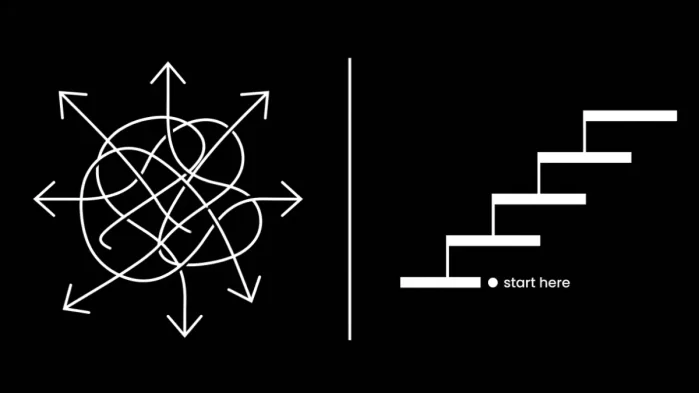
In any given period, you are focused on exactly one thing: the first measure. Finish it, and it becomes the foundation for the second. Finish the measures and the first priority is done. Also, finish the priorities, and the first goal is done. Then, and only then, do you move to the second goal.
Everything else can wait. Do it deliberately, on purpose, and without feeling guilty.
Effective executives do first things first and they do one thing at a time.
Peter Drucker
When Sequencing Fails
Here’s the honest truth: I’m not here to give you a catchy slogan.
Sometimes sequencing doesn’t work out. You might put the steps in the wrong order, or start and realize the real problem was somewhere else. That’s normal, and it’s not a reason to give up.
What matters is that you notice quickly and change the parameters after you start. The whole point of doing one thing at a time is that when it’s wrong, you can see it clearly and correct course, instead of being lost in the fog of ten simultaneous projects.
This is also why people give up on their vision. It’s not that the vision was wrong. They give up because the approach was to demand everything at once and when everything at once broke them, they blamed the dream rather than the process.
Your vision was never the problem. The approach was.
The Business Strategy Canvas
I finally built it. I wanted one page, each day, that told me what to do. So I created one.
I call it the business strategy canvas, a single-page blueprint that holds your strategic goals, the one priority that unlocks the next, the one measure that is the foundation, and the one thing you work on right now.
It’s strategy and execution on the same page, deliberately too small to be able to hide a vague commitment.
It’s the exact opposite of the 150 page document. The 150 page document will bury the next action. The canvas will not allow a measure to stand without an owner, without a budget and without a deadline.
It is the difference between a plan you admire and a plan you can actually execute.
That is the whole method in one sentence your grandfather would approve of.
Marcus Aurelius took the lesson of doing few things and sharpened it into a daily question. He suggested asking himself, on every single occasion: “Is this one of the unnecessary things?”
If you take only one thing from this letter, take that question with you tomorrow morning.
Open your plan, whatever it is — the 150-page document or the five-goal chaos in your head — and ask it, line by line, and cross out everything that fails the test. What remains will be short. It will be one page, not 150. It will have an owner, a budget, and a deadline. And it will point at one next action, not twenty.
And that one page is where your vision finally starts to move.
You never had a discipline problem. You had a sequencing problem. Now you have the tool to fix it.