

The single question that reveals whether you built a business or just built yourself a job.
Think about your calendar for a second. If someone told you today that, starting next month, you had to be unreachable for thirty straight days — no calls, no emails, no WhatsApp checks, no “quick five-minute decision from the boss” — what would the honest, animal-level answer be?
Not the polished answer you’d give an investor. The one that lives in your stomach.
For most founders, that answer arrives instantly, and it isn’t pretty. Disaster. Chaos. Nobody can replace me. My customers will leave. My team will freeze. I’d be cleaning up the wreckage for months.
You know the feeling — it’s the reason you haven’t taken a full weekend off in three years, and why even when you do “get away,” half your brain stays tethered to the phone under the towel.
Here’s the thing nobody tells you: that stomach-answer is the single most valuable piece of business intelligence you will ever collect. And most of us spend years running from it.
I ask this question — can you leave your business for one month? — to every established founder I work with. It makes people visibly uncomfortable, which is exactly why it works. Because it isn’t a vacation-planning question. It’s a diagnostic.
Answer it honestly, and you learn more about how you’ve actually been building your company than any audit, spreadsheet, or board meeting will ever tell you.
If your business depends on you, you don’t own a business—you have a job. And it’s the worst job in the world because you’re working for a lunatic!
Michael Gerber
That is the reason why this question has the effect of an accusation. Throughout our lives, we assert that the business cannot function without us, claiming that our expertise is the essential support wall of the entire operation; and when someone then approaches and gently asks what would happen if you left, all of that identity is suddenly brought into sharp focus.
The irony is that the solution is always present in the room; as soon as the question is put to you, you know whether or not you can leave. Your genuine reaction after three seconds is the true answer, while all the remarks you make afterward are merely marketing.
So let’s stop acting like it’s a hypothetical. It’s a test — and like every good test, it has a pass condition and a fail condition, and most founders fail it without ever knowing the test was running.
The moment you feel that tightening in your chest (no way, it would be a disaster, nobody can replace me), you’re not protecting your business. You’re confessing something about how you built it.
Over the years, I’ve written down the answers I get to this question, because after a while a pattern emerges.
Five answers keep coming back, wearing slightly different costumes depending on the founder and the industry. Here they are, verbatim from my notes:
- “No way — it would be a disaster.”
- “I’d love to, but nobody can replace me.”
- “I took two weeks off last year and spent months normalizing everything after.”
- “My customers need me. My employees need me. My partners need me.”
- “I could leave, but only if I had more competent people.”
On the surface, five different problems. A founder might nod and say, well, those are just different situations.
They aren’t.
Strip each one down and you find the same confession in five outfits: I built a dependency, not an asset.
The business does not run unless I push it. It has no systems, no transferable competence, no independent heartbeat of its own. It is not a company. And it is me, in more locations, doing more hours.
That’s the uncomfortable truth hiding inside every answer, and it’s the reason the question is worth asking in the first place. Until you can name what’s actually wrong — not the symptom, but the design flaw underneath — you’ll keep treating a structural problem with motivational band-aids.
Let’s take the first answer seriously, because it’s the honest one.
When a founder says it would be a disaster, they almost always believe it’s about their people. They’re convinced their employees lack the competence to run things, which is why the fifth answer — I need better people — is really the same answer wearing a staffing solution.
But that’s not true, and deep down you know it’s not true. You hired those people partly to expand the business’s competence. Nobody recruits a team of people who are supposed to make the company worse.
So the bottleneck was never the people. The bottleneck is two things, and both of them belong to you.
The first is a belief. Somewhere along the line you internalized the idea that “competence” means “what I personally can do.” So every time you look at your team, your brain runs the comparison — they’re not as good as me — and the comparison becomes a self-fulfilling prophecy.
You never hand over the work in a way that could let them grow, because you’ve already decided they can’t.
The second is the absence of procedure. When your people know exactly what to do, and you’ve got competent people around you, walking away stops being a risk and becomes a non-event.
The reason it would be a disaster is not that they’re incapable. It’s that you never gave them the rails.
This is where it gets brutally simple. Developing competence and writing down procedures is not a favor you do for your employees. It is the job. It is the entire job of an owner who wants to own an asset instead of a shift schedule.
The second confession sounds noble: nobody can replace me. It is, in fact, the most flattering lie a founder can tell themselves.
We like to believe we’re indispensable because it confirms the story we need — that we’re the smartest person in the room, that the business rests on our singular genius. And there’s just enough truth in it to keep the lie alive.
You are important. Your judgment matters. But “important” and “irreplaceable” are not the same thing, and confusing them is expensive.
Here’s the reality: running a company over time requires a set of competences that no single human being can hold, much less you specifically.
Even if you somehow acquired one new capability today, the business would immediately need another one tomorrow. And some of the capabilities you already have will quietly become obsolete while you’re still proud of them.
That’s not a flaw in the plan. It’s just how a growing business works — it outgrows any one person by design.
So the founder who insists “nobody can replace me” is chasing an impossibility and calling it dedication. The smarter move is to stop asking whether you’re replaceable and start asking a better question: how do I build something that is bigger than me?
You have to change what you think you are. Not the hero who personally powers every process. The architect whose actual job is to make the machinery run whether or not they’re in the room.
That’s an identity shift, and it’s the hardest part of this whole thing, because it asks you to let go of the one version of yourself that feels safest.
Now the third answer, because this is the one that almost nobody wants to talk about: I took two weeks off, and it took me months to normalize afterward.
You hear a version of this all the time at conferences, always delivered with a rueful laugh, as if it’s just the cost of being a busy founder.
It’s not. It’s a red flag the size of a building.
Think about what that sentence actually describes. You were away for two weeks. Nothing obvious collapsed — no fire, no catastrophe — but the business piled up in your absence. Work accumulated quietly, decisions waited in a queue, and the whole thing held its breath until you came back. Then you spent months digging out.
That is not what an organization looks like. That’s what a job looks like when the worker finally gets a chair from the corner and a lunch break.
When I hear this answer, I don’t need to ask any follow-up questions. I know exactly what’s going on: the company has no systems.
Work has no defined flow. No one is clearly responsible for any part of it, and there is no agreed definition of what done looks like when you aren’t standing over it. Everyone works hard — nobody will ever say otherwise — but the hard work is tethered to you personally, and the moment you’re gone, the tether goes slack.
The additional time won’t do it; what’s needed is a proper structure. That is the reason I keep stressing the Staircase Strategy and why the Business Strategy Canvas and a genuine library of standard operating procedures are important—not because I have any enthusiasm for paperwork—but because they make the difference between a business that can look after itself and one that ends up in a mess waiting for its owner to come back.
Once responsibilities have been written down and the duties named so that everyone can see what “normal” should be, the build-up ceases. It isn’t because people are working harder, but because the system takes on the work rather than you doing it.
“Everyone Needs Me” Is a Story You Wrote
The fourth confession is the sneakiest one, because it hides inside the word need.
My customers need me. My employees need me. Or, my partners need me.
Yes. And I need my coffee, but that’s not a business model.
The unpleasant aspect of it, and I must include myself since I’ve engaged in it as well, is that there is a genuine question to be asked regarding that sentence—namely, how much of it is based on true necessity and how much of it is flattery that you’ve been quietly enjoying?
Being needed feels a lot like being valuable, and it’s distressingly easy to confuse the two.
We tell ourselves we’re burdened by everyone’s dependence on us, but a quiet part of the founder brain likes that dependence. It proves we matter. It’s the opposite of irrelevant. And so, without ever deciding to, we build businesses that are wired to keep needing us — because a business that can run without us is also a business that could, in some terrifying corner of the psyche, forget we exist.
But being central is not the same as being valuable, and the confusion costs you more than you can afford. Real value doesn’t require your hands on the wheel every hour. In fact, the most valuable thing you could possibly build is something that delivers value without you — because that’s the only thing that ever scales, the only thing that ever sells, and the only thing that ever lets you rest.
Customers should need your company. They should not need you to answer at 11 p.m.
If they do, you haven’t built a brand. You’ve built a subscription to your own attention, and you’re the product.
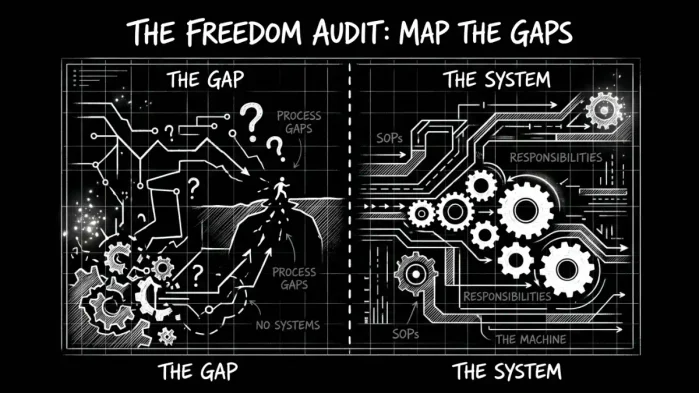
That’s enough about diagnosis. The section you really wanted is here: instructions on how to carry out the test and how to deal with what it shows.
Let me make something clear at the beginning. The first time you take this test, it’s going to seem extremely harsh, and that’s the idea behind it. It’s not meant to be a holiday. It’s a probe, one that is intentionally set up to reveal every instance in which your business is secretly relying on you.
You are not going to “pass” it on the first run — and if you do, either your business is genuinely systemized, or you cheated by staying half-connected and pretending you didn’t.
You don’t fail this test, by the way. That’s the wrong way to frame it. What you get back is a map: a precise, ranked list of every gap between “the business I think I built” and “the business I actually built.”
That list is worth more than the thirty days themselves. And the tool for turning that list into a plan is what I call the Freedom Audit.
Think of the Freedom Audit as the operating manual for the whole test. It runs in three phases — before, during, and after — and each phase has a single job.
Phase One: Prepare the Machine.
The key is not to prioritize what’s on your schedule, but to schedule your priorities.
Stephen Covey
This is the unglamorous work nobody wants to do, which is exactly why it’s where everyone fails.
Before you book anything, you build. Write down the processes that currently live only in your head — how leads become customers, how work gets assigned, how decisions get made when you’re not in the room.
Make specific individuals, not “the team”, responsible. Create a small collection of standard operating procedures (SOPs) so that every task that occurs regularly has both a written owner and a written standard. Put these procedures on a one-page Business Strategy Canvas.
On the first test, you can tell whether the operations actually support the strategy or whether you’ve simply been reacting for years, and you can arrange the entire approach using the Staircase Strategy: one step earned at a time, each step making the next one possible.
You don’t attempt to organize the whole company before leaving. All you do is carry out enough organization so that the main system can make one complete cycle on its own.
Phase Two: Actually Leave.
This is the part most founders sabotage. They “leave” for a month but keep the Slack on, keep answering “just this one thing,” keep being the shadow boss from the beach. Don’t.
The entire thing is a case of real absence. If the founder is only partly present, then the outcome will also be only partial, and you’ll end up thinking that you have more freedom than you actually do.
Go to another place, switch off the notifications, and let the system work on its own.
What happens next is data, not disaster. You are not watching to catch your people failing. You are watching to find out where the dependency lives.
Phase Three: Audit the Gaps.
When you return, don’t feel the need to go straight to the backlog.
Start by posing the honest questions: what accumulated and why? Which of the decisions actually required you and which ones merely seemed to? And which person took the initiative while who else simply waited for being rescued?
Every one of those answers is a line item in your Freedom Audit. Some are people problems. Most are process problems. They all trace back to a system you haven’t built yet, and now you have a numbered list that tells you exactly what to build next.
Run this once a year, and something strange happens. The first year is a shock. The second year is uncomfortable. The third year, the test gets boring — and boring is the whole goal, because a business that runs while you’re away is the precise definition of an asset.
One more thing. You don’t need a month to start. The scale of the test is adjustable, which is what makes the Freedom Audit something you can begin this week.
Try one full weekend. Then one full week. Then two weeks, then the full thirty days. Every increment teaches you something the last one couldn’t, and every increment moves your business a little further away from you — which, counterintuitively, is the only direction that’s actually forward.
I’ve returned to one specific statement many times: no matter what you do, running a company will eventually outgrow you. The issue then is whether it does so while you’re still involved, or instead pulls you along as its most costly and most exhausting bottleneck. bottleneck.
Build the machine. Then go find out if it can run without you.
The answer might sting the first time. It’s still the most useful thing you’ll learn all year.