

A 2×2 matrix that tells you which anti-distraction system to build — before you read another list of tips.
It is 9:40 AM. Your phone is face-down in another room. Your app blockers are on. Your “deep work” playlist is playing. By every checklist on the internet, you are doing this right.
And nothing is shipping.
You have been “working” for two hours, and the only thing you can point to is a paragraph you deleted twice and a renewed conviction that you need a better Notion setup.
The phone wasn’t the problem. The phone was never the problem. The problem was sitting in the chair with you the whole time, and every app blocker in the world cannot reach it.
That’s the thing nobody tells you about distraction. It isn’t one enemy. It’s at least four, and they attack through different doors. Which is why the advice is so reliably useless — it hands everyone the same four tricks and hopes one of them lands.
So before I hand you another system, I want to do something I almost never write. I want you to stop, figure out which door your distraction is coming through, and only then decide what to build.
Most “beat distraction” advice treats four different conditions as if they were a single cold. Take a vitamin, drink water, rest. And when the vitamin does nothing, you conclude that you are the problem — you just lack discipline.
You don’t.
The headline-grabbing fixes all target one flavor of the disease: environmental intrusion. Notifications, an open phone, a teammate who needs “one quick second.”
For the person whose day is genuinely ambushed by inputs, these fixes work beautifully. Put the phone away and the fog lifts in an afternoon.
But distraction has three siblings, and they don’t respond to a phone in a drawer.
One looks like a calendar so full of “equally urgent” priorities that you can’t tell which one to touch first, so you touch the easy one.
One looks like a founder who can’t log off — who is excellent at responding and terrible at deciding, because other people’s urgencies keep becoming his own direction.
And one looks like the thirty-tab founder: medically incapable of shallow work, going deep on everything except the one thing that ships.
Same symptom. Four diseases. Four cures.
You do not choose an antidote until you know your type. That is the entire game.
Here’s the diagnostic. Two questions, two axes, four quadrants. Don’t overthink it — your gut answer is usually the honest one.
Axis one: where does the leak come from? Is something reaching in (external intrusion), or are you reaching out (internal fragmentation)?
Axis two: what is the cost? Are you losing depth — the ability to focus on the one thing in front of you — or direction — the ability to choose the right thing at all?
That brings you to four archetypes; imagine them as rooms in a haunted house and locate the one which knows your name.
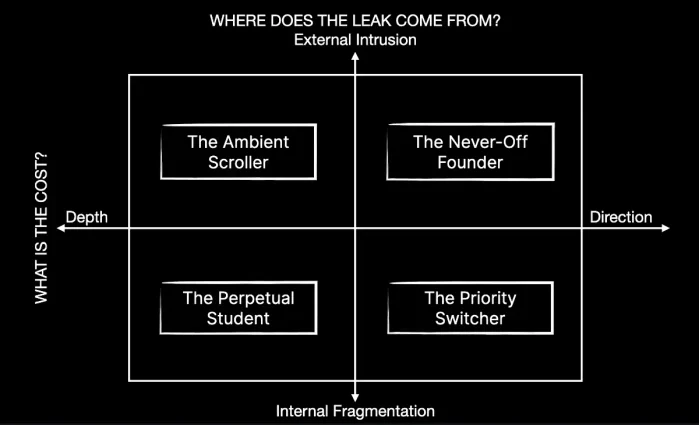
The Ambient Scroller
External intrusion combined with depth bleed.
The issue you have is access. You’ve not worked out what is important today; it was the environment that made that decision for you, and it made the wrong choice—something like a notification here, a viral thread there, and a “quick check” that ended up taking forty minutes.
You don’t lack focus. You’ve simply never given yourself a clean room to focus in.
The cost is depth. You’re intelligent and capable, but your best thinking keeps getting interrupted before it can catch. You live in the top ten percent of everything and the top one percent of nothing.
The reason you are able to carry the load is because of friction and not willpower—the phone goes out of the room and instead of having a revolving door the input has a front door.
The Priority Switcher
Internal fragmentation multiplied by direction bleed.
That phone isn’t your concern; it’s your staircase’s.
You have seven “equally urgent” priorities and a genuine belief that switching between them is agility.
It isn’t.
It’s visionary multitasking — the belief that you can drive three cars at once because they’re all great cars. You don’t move forward. You strip the gears.
The cost is direction. You are remarkably good at starting and increasingly allergic to finishing, because finishing one thing means admitting the other six will wait — and waiting feels like failure to a mind this ambitious.
Your load-bearing move is the hardest one in this whole article: one single daily priority, and everything else becomes explicitly optional.
The Never-Off Founder
External intrusion with direction bleed.
You are always on. 2 AM firefighting, “one quick second” turning into an hour, every client’s emergency becoming your Tuesday.
On paper you’re responsive. In practice, other people’s urgencies keep hijacking your direction — you’re not choosing your work anymore, you’re just fielding it.
The price you pay is direction, and it’s the most insidious because it disguises itself as dedication; you feel indispensable, having created a career that depends on your being there all the time, and you call that career “entrepreneurship”.
Your load-bearing move is, in fact, a boundary, not a blocker; it is a shutdown routine which ends the loop so that the fires of today will not determine the agenda of tomorrow.
The Perpetual Student
Internal fragmentation combined with depth bleed, but not the kind you think.
You can go deep. That’s the cruelty. You’ll spend six hours lost in a pricing model or a psychology paper and love every minute.
The problem is the depth is aimed at a museum, not a shipment. You curate a world-class library of things you understand and have shipped none of them.
The result is two-fold: on one hand, depth is lost because of the large number of open loops, and on the other, a sense of direction is lost since it is believed that greater understanding means progress.
The key to your ability to carry a load-bearing move is sequencing—choose one item, accept the difficulty of leaving the other eleven, and send one of them out into the world where it can make a real difference.
The rules themselves were never fake. They were just prescribed blindly. Here’s what each one actually treats, so you stop taking medicine for a disease you don’t have.
1. One Single Daily Priority
For the Priority Switcher and the Perpetual Student.
Each morning, before touching anything, you ask yourself one question—that is, what is the one action which, if I carry it out today, makes all the rest of the things irrelevant?
That’s the load-bearing move. Not the most urgent thing. Not the thing someone is shouting about. The one thing with the highest energy density — the uranium, not the coal.
Everything else on your list becomes optional. Not “later.” Optional. That single word is the whole mechanism, because it strips your ten urgent items of their power to pull you in ten directions. You can only strip the gears if you’re holding multiple gears. Hand yourself one and the metaphor dissolves.
Four hours spent on a single activity is better than twelve hours spent on all sorts of things. That’s what the Output Density Principle is, and it’s the only calculation that counts in a schedule this busy.
2. The Phone Leaves the Room
For the Ambient Scroller.
It has nothing to do with self-control, it’s a question of surface area; even though a laser and a floodlight consume the same number of watts, the laser is better because the light it emits goes only forward.
Your attention is the same — intensity equals power divided by area, and an open phone is the widest area in your workspace.
Concentration is the secret of strength in politics, in war, in trade, in short in all management of human affairs.
Ralph Waldo Emerson
So you don’t fight the temptation. You remove it from the room. Out of reach is out of mind, which sounds like a bumper sticker and happens to be load-bearing: the average person checks their phone over fifty times a day, often because it’s simply there.
Distance is not discipline; it is just the lack of a decision to act every nine minutes.
Friction is the only willpower trick that really works; just make the undesirable option inconvenient and you’ll have already won before the battle begins.
3. Fixed Input Windows
For: the Ambient Scroller and the Never-Off Founder.
Scrolling isn’t rest. It’s input, and unmanaged input is the fastest way to bleed your best output hours onto the floor.
So give input a front door. Two or three fixed windows a day — say, after your single priority ships, and one in the afternoon — where you check everything: email, feeds, messages, all of it, in one deliberate pass. The rest of the day, the mailbox stays closed.
The result is incredible. You cease having to carry around the general anxiety of needing to check all the time, since checking is now scheduled and therefore final. You no longer regard each notification as a kind of call. And you regain the only thing that no app blocker is able to restore: a mind which is not constantly half-listening for the next ping.
If you control the input windows, you simply control the cost of your whole day.
4. The Shutdown Ritual
For the Never-Off Founder.
The real reason for your scattering is usually not the place that you suppose it to be; it isn’t the phone, it’s the open loop.
The unfinished work that the mind is unwilling to let go of becomes a mental burden which you carry over into dinner, over into bed, and even through the awake hour at 2 AM. You are unable to rest since your brain continues to deal with yesterday’s emergencies. For this reason you do not apply discipline but instead arrange a closing ceremony.
At the same time every day, you write down what got done, what’s unfinished, and — this is the part that matters — the single priority waiting for you tomorrow. You close every loop that can be closed and give the unclosed ones a home on paper instead of in your head. Then you say, out loud if it helps: shutdown.
The idea of rest as a reward obtained after completing a to-do list (a list that never gets finished) changes so that rest becomes a planned element of the system itself. A mind that actually rests is one that has a clear direction when it starts work again rather than being left with leftover thoughts.
Here is the video explaining the whole productivity system, including the 2×2 distraction grid to find where you are and the steps to take to get out of it. Download the workbook here and start implementing what I’ve discussed in this article and the video.
Here’s the quiet truth under everything you just read.
You’ve been fighting distraction with the one tool guaranteed to lose. Willpower is a last resort, not a first line of defense. It’s the thing you reach for after the system has failed — the emergency brake, not the engine.
Build a day that depends on willpower and you’ve built a day that depends on your weakest moment.
Which means the entire discipline conversation was aimed at the wrong target.
The goal isn’t a stronger you. The goal is an environment that does the focusing for you, so your willpower can do the only job it was ever good at: the choosing.
You do not rise to the level of your goals. You fall to the level of your systems.
James Clear
Decide what kind of distracted you are. Build the one motion that treats your actual disease. Then let the design carry you.
That’s not a hack. That’s a system. And systems don’t need you to be a hero — they just need you to show up once, build them, and let them win.